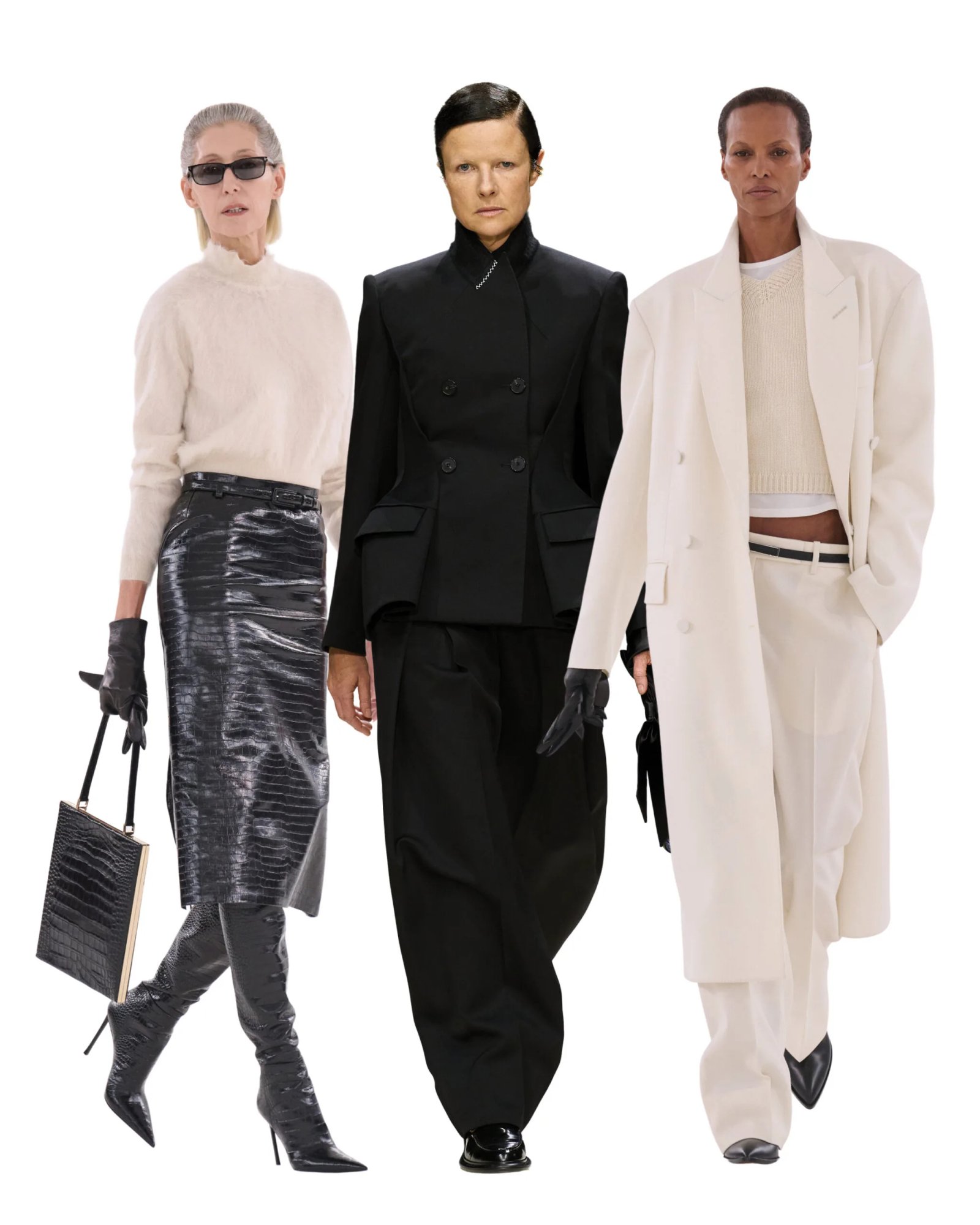
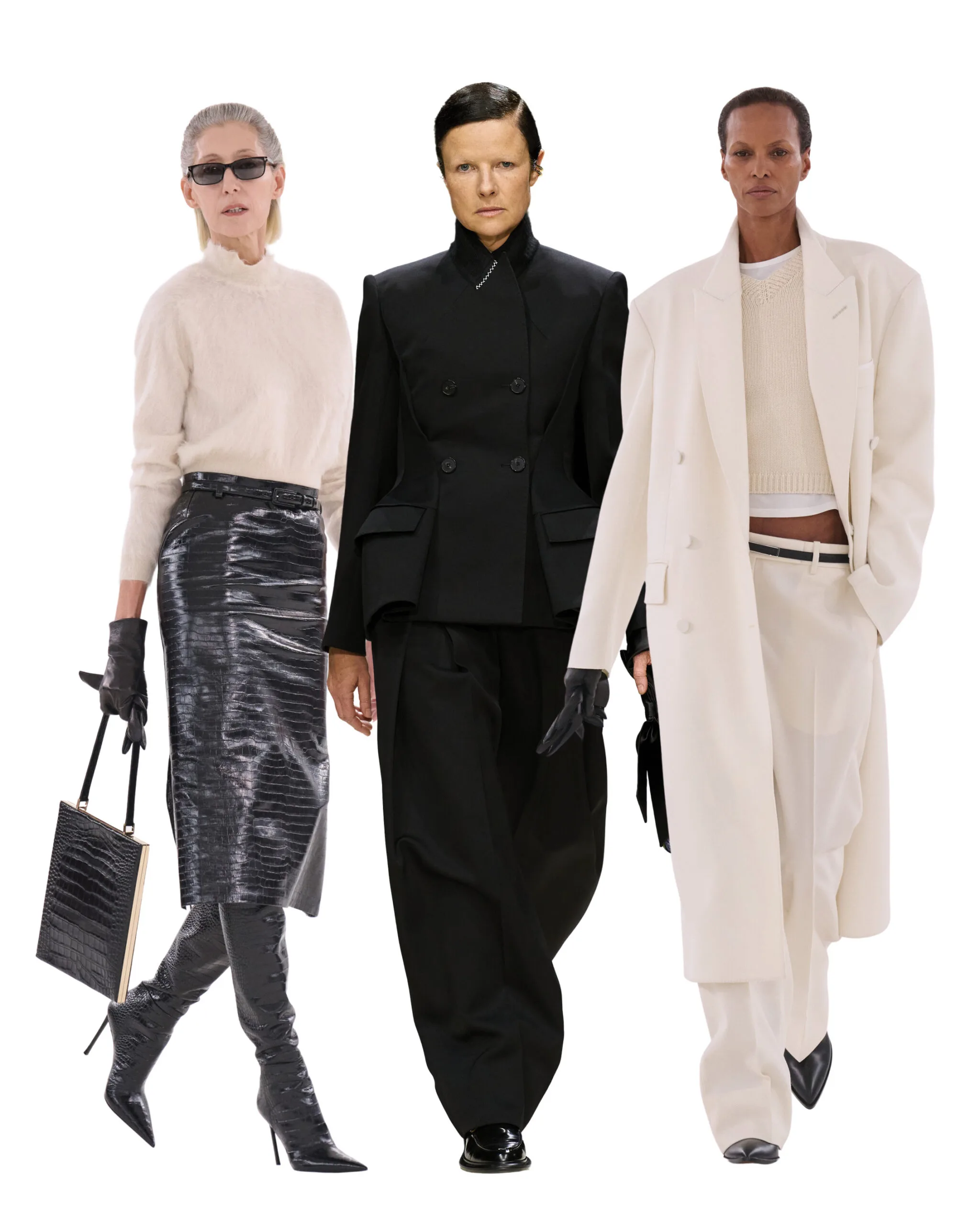
Almost three minutes into Tom Ford’s autumn/winter 2026 show, a woman stalks onto the runway. The presentation is taking place in a stark white box of a room, and it’s silent, save for a high-pitched, eye twitch-inducing hum, like feedback from a poorly connected speaker. As the woman plants one stiletto-heeled foot onto the carpet after the other, your eyes can’t help but trail from her croc-embossed boots to her croc-embossed pencil skirt. Her bag – also croc-embossed – hangs from a leather-gloved hand as she slinks down the runway. Her silver bob is slicked back, and upon her nose rests a slimline pair of black sunglasses. She’s magnetic: self-assured, sexy, you probably wouldn’t want to cross her. She’s also 58, but as if that matters.
The cast of models for Tom Ford’s show skewed older – 61-year-old supermodel Kristen McMenamy walked, as did 55-year-old Jana Kapounová, 50-year-old Yasmin Warsame and a handful of mature male models – and for good reason. These were certainly not clothes for twenty-somethings. Centred on the idea of seduction, the collection sat somewhere on the spectrum between office siren and impeccably dressed madam. Pencil skirts clung to hips, heels were knife-sharp, and blazers were cut within an inch of their lives and worn atop sheer shirting. Slips of skin peeked out from low-slung trousers, revealing slivers of hips on both men and women, and in an unexpected turn, transparent raincoats and skirts exposed lace underpinnings and sheer tights. The collection was pure sex, but there was hardly a hemline above the knee or a NSFW neckline in sight. Rather, this was a show about desire; about being a grown-up who knows who they are and what they want. And they plan to dress for it. Tom Ford’s sultry, seductive woman in midlife was not an isolated instance this season. Across the board it was as if creative directors at the helms of all the houses decided they’d had enough of trying to chase the dollars, eyeballs and clicks of a generation chronically online. Instead, from Givenchy to Chanel, designers set their sights on demographics closer to their own age and made an entire collection for them.
The past couple of years has seen this new muse simmer to the surface across pop culture, literature and now fashion too. But instead of this woman being a tired empty-nester who has lost interest in her husband and is generally bored with the mundaneness of her existence, she’s having a damn good time. Or – at the very least – she’s coming to terms with the fact she might have only lived half of her life, and if she wants things to be different in act two she ought to do something about it. One of 2024’s most talked about (and pontificated-on) films was Babygirl, the erotic thriller that saw Nicole Kidman play a high-powered businesswoman pursuing a torrid affair with her fairly charmless but strangely alluring intern, played by Harris Dickinson. It ignited all sorts of discussions about power dynamics and desire, and brought into the public consciousness the idea that – shock! – women in middle age want to feel sexy and wanted and, believe it or not, horny too. In the nearly two years since the film’s release, those conversations have only become louder. “I think many women [in midlife] become less interested in what they should want and more interested in what they actually want,” says Dr Wendy Roncolato, a clinical psychologist and founder of Cloudberry Clinic in Sydney.
“I also think many become less interested in proving themselves. They often have a clearer sense of what matters to them, what they’re good at, and where they want to invest their time and energy.” In her work, Roncolato counsels countless women through the transition into middle age, whether that’s rediscovering who they are without children at home or rebuilding their lives after loss or divorce. “There isn’t one midlife experience,” she adds, “but what often changes is that there’s less interest in living according to somebody else’s script.” Josephine Eve, a Sydney-based personal stylist and wardrobe consultant, who works with women typically undergoing some sort of transition in their personal or professional lives, notices this shift among her clients too. “A lot of the women I work with have spent years looking after everyone else,” she says. “Somewhere along the way they’ve stopped investing in themselves.” It’s a tale as old as time: women shelving their own needs and desires in favour of everyone around them, only to wake up one day to a life that might be full but is barely their own. “The biggest thing I hear is, ‘I just don’t feel like myself anymore,’” Eve says. “I don’t think clothes change who you are as a person, but they can absolutely change how you feel about yourself.” Givenchy creative director Sarah Burton gave that sentiment airtime in her autumn/winter 2026 collection. The show notes described it as “a multifaceted mirror held up to the complexity of women’s lives”, which Burton translated via 56 looks that oscillated between androgynous and hyper-feminine, depending on how the Givenchy woman was feeling that day. Her tailoring expertise appeared in menswear-inspired suiting, all broad shoulders and pinstripes, but also in darted coats and starched-collared shirts worn in reverse.
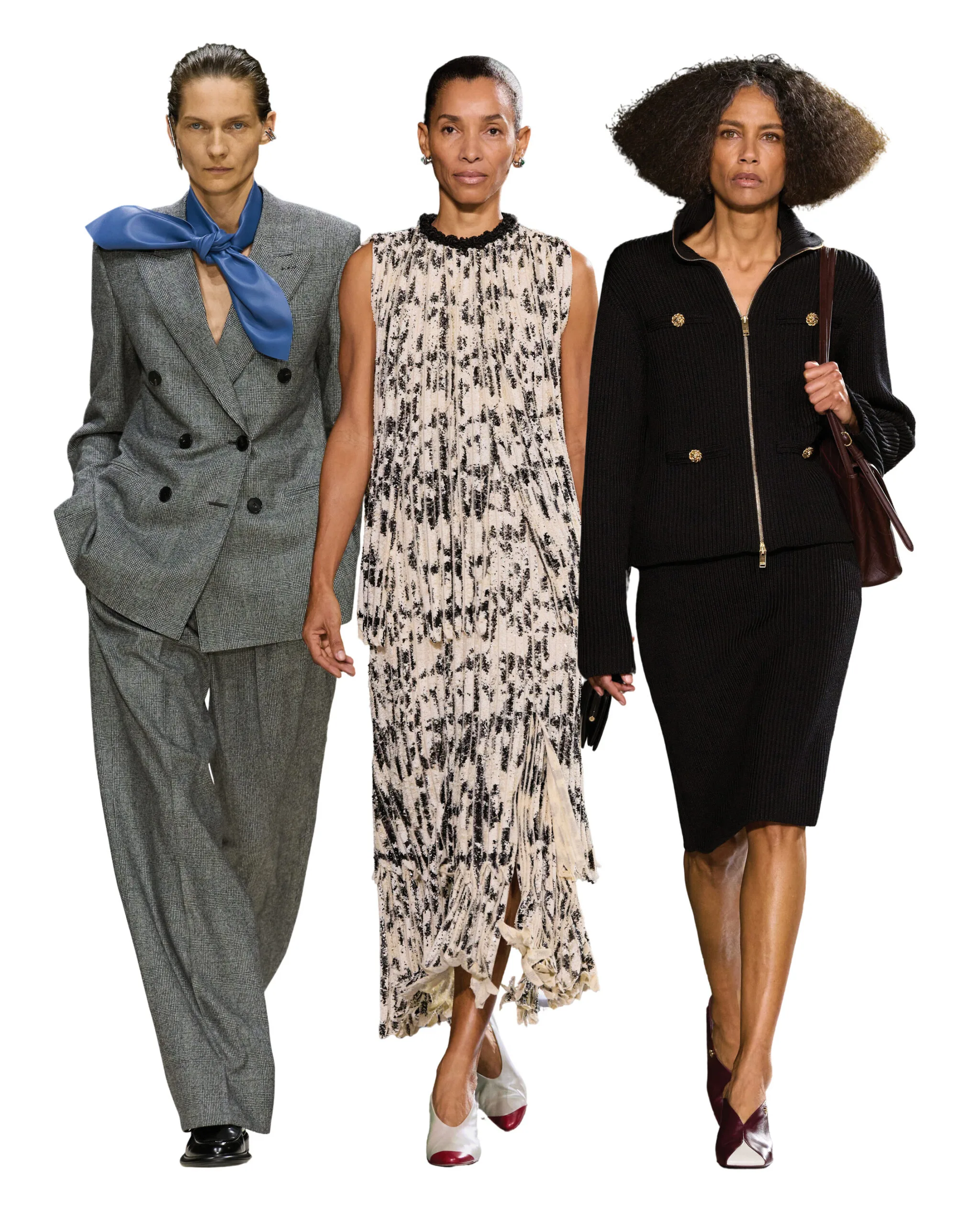
The sharp edges were tempered by weighty duchess satin, which Burton draped into fluid capes, dresses and tunic tops. And before it got too serious, she saturated the runway in leopard print, vermilion, cobalt blue and acid-bright yellow. These were the kind of clothes you couldn’t wear half-heartedly. They demanded guts, confidence. If you saw them on a fifty-something woman striding through the CBD, they would make you think, “I’d like to be her.” “To me, women just want to have their confidence back. They don’t want to dress like their daughters,” notes Marlene Mangioni, owner of the multi-brand boutique 23Albert in Sydney. Her clients, who she says range in age from 40 to 70, come to her for direction at a time in their lives when they might be feeling lost, sartorially or otherwise. “Maybe their bodies have changed or they have no idea how to dress for their age,” she says, “but the minute you put the right clothes on, their whole attitude changes. It gives you the ability to face whatever you are dealing with.” Whether you watch the fashion shows or not, seeing yourself – or at least your age – reflected back at you on a runway does more than just give you some inspiration for what you could wear to the office or your son’s wedding. At the most basic level, it indicates that women in middle age are customers these houses see and want. When 50-year-old model Stephanie Cavalli opened Chanel’s autumn/winter 2026 show in a rib-knit skirt suit, it made very clear who creative director Matthieu Blazy was designing for: a youthful spirit. And their age? Totally irrelevant.