U.S. President Donald Trump told a rally in Port Huron, Michigan, on Sunday that he expects his trade war with Canada to be settled soon, asserting Ottawa is now prepared to concede on virtually everything, even as Prime Minister Mark Carney has only hinted that Washington may be inching toward Canada’s position. The remarks come less than two weeks before the Nov. 3 U.S. midterms, in which the Canada tariffs are a live issue—but critics say the claim is pre-election posturing, noting Ottawa walked away from the table in August over last-minute American demands and that Trump is still layering new tariffs onto dozens of products even as he eases some 50 percent levies.
Carney, asked at a news conference Monday whether the file had moved in the past week, suggested Washington may be edging toward Ottawa’s demands but did not spell out any terms. Trump’s prediction follows his announcement Friday that some of the 50 percent levies will come off at the end of the month, while tariffs are added to dozens of other products.
The president used the Michigan rally, held to support Republican candidates in the Nov. 3 vote, to repeat his claim that Canada left him no choice. “Canada has been ripping off the United States for years, OK? For years. And I had to do it. We’ll have that settled pretty soon. They’re willing to give us anything at this moment,” Trump said. Ottawa has confirmed no such offer; the Carney government broke off talks in August, citing what it described as unreasonable last-minute American demands.
Talks stalled since August collapse
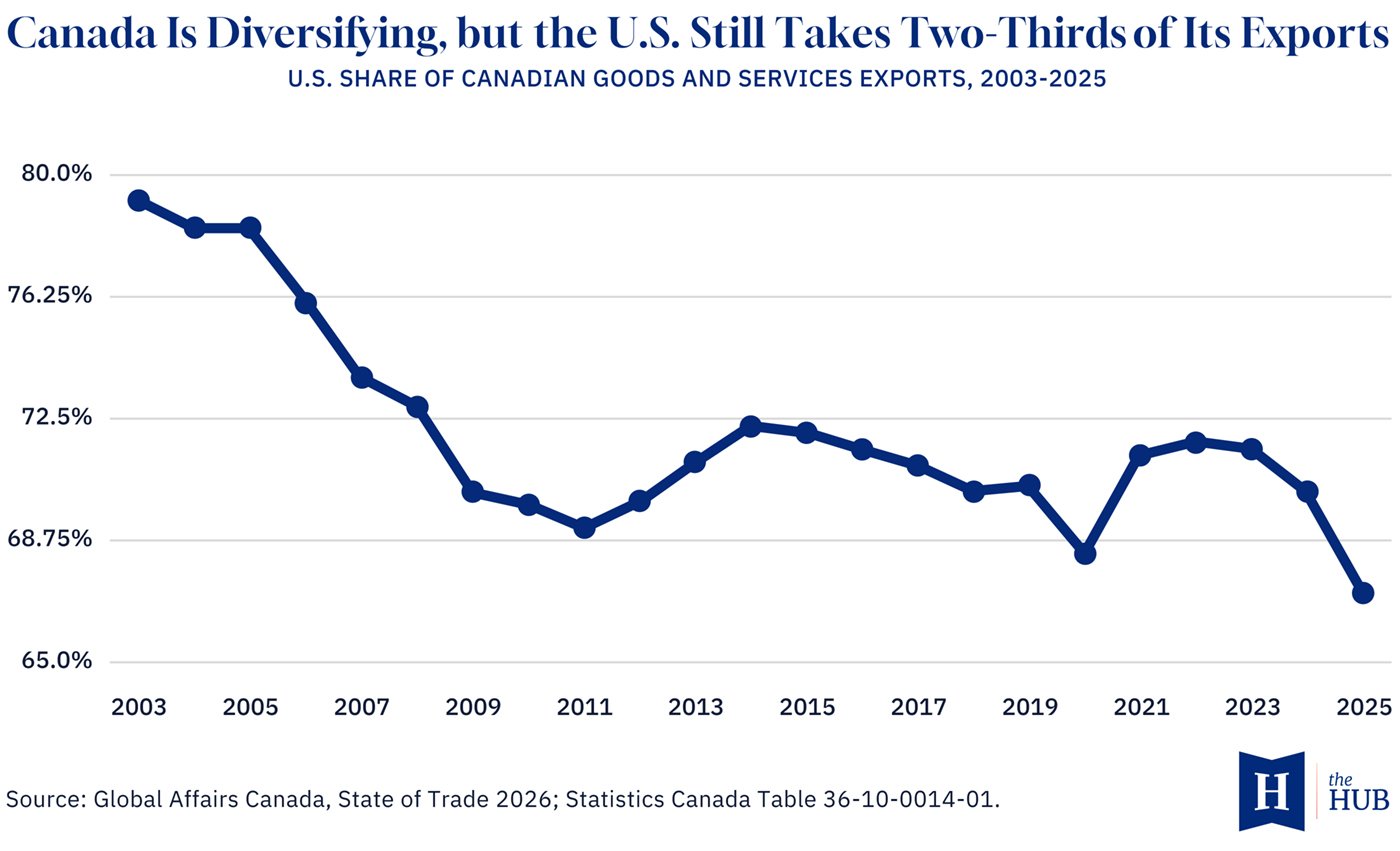
The August breakdown came after negotiators had appeared to reach a framework in Washington on Aug. 18. The Hub‘s reporting on the file found the stakes reach beyond the current tariff schedule: Trump declined to renew CUSMA ahead of a July 1 milestone, pushing the pact into rolling annual reviews, and the U.S. still takes close to 70 percent of Canadian exports, down from 76 percent a year earlier, even as Carney has pledged to double non-American exports within a decade.

Trump has not ruled out quitting the pact entirely, which requires six months’ notice, and formal review talks with Canada are widely expected to drag well into 2027. That timeline leaves open what Ottawa would need to settle the tariff dispute in the meantime.
Experts split on whether to settle now
Ed Fast, writing for The Hub, argued the president’s pattern is to wield tariffs as leverage to extract concessions from Canada while offering none in return, and that any settlement reached irritant by irritant, or inside the pending CUSMA review, would favour Washington. “Renegotiating now within the very narrow confines of CUSMA leaves Canada with little negotiating capital and will almost certainly result in a one-sided outcome in favour of the Americans,” Fast explained. An acceptable deal, in his view, would be a wider bargain that puts regulatory reform, critical minerals, energy, defence spending, continental security and softwood lumber on the table together.
But Rudyard Griffiths, the co-founder and publisher at The Hub, and Sean Speer, The Hub‘s editor-at-large and co-founder, reject that call to hold out, arguing Canada should have taken the deal on the Aug. 18 terms rather than wait for a shift in American politics they contend is not coming. As they describe it, that framework would have cut the headline auto tariff to 15 percent from 25 percent and steel and aluminum levies to 25 percent from 50 percent under quotas, in exchange for Canada dropping its retaliatory tariffs and pressing provinces to restore American alcohol. “Those insisting that Canada should hold out are mistaking a durable shift in American politics for a temporary Trumpian aberration,” they write, adding that sacrificing the wider economy to shield an auto sector worth 0.7 percent of GDP is short-sighted.
Trump’s forecast of a quick settlement could reflect the electoral calendar more than any change at the table, given that Ottawa has confirmed no new offer and Washington is still adding tariffs. The clearest evidence is the gap between the president’s claim that Canada will concede everything and Carney’s hint that it is the United States moving. Whether a settlement resembles the August framework or a broader bargain should become clearer once the midterms are past.
The near-term calendar is set: the midterms are Nov. 3 and the partial rollback of the 50 percent tariffs takes effect at the end of the month. Beyond his hint of American movement, Carney has not laid out Ottawa’s conditions for returning to the table.
The Hub’s mission is to create and curate news, analysis, and insights about a dynamic and better future for Canada in a…