Key Points
-
Driving-assistance specialist Mobileye Global has entered the humanoid robotics space with an acquisition that leverages its specific know-how.
-
You mostly know it as a mobile compute-processing name, but Qualcomm’s power-efficient edge computing tech has far wider applications.
-
Tesla’s Optimus may not end up being the best humanoid robot, but the company will be the first to make them in massive quantities.
- These 10 stocks could mint the next wave of millionaires ›
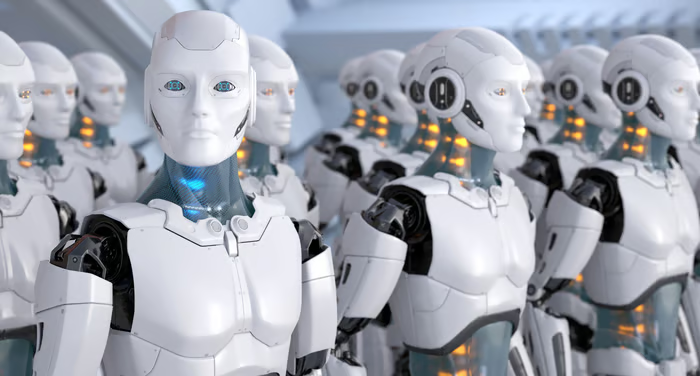
Ready or not, humanoid robots are coming. There could be as many as 1 billion of them on the planet by 2050, in fact, according to Morgan Stanley, when this market could be worth as much as $7.5 trillion. And that’s just humanoid robots with two arms, two legs, and something like a head, capable of doing physical work originally designed for an actual human in a human environment. There will be lots more autonomously operating equipment making decisions within warehouses, factories, distribution centers, and even on job sites by that point, making the market far larger.
The advent of humanoid robots will easily be the technology industry’s biggest and most world-changing development during this stretch, though, as well as the biggest opportunity for investors.
Missed Nvidia in 2009? This Rare Signal Is Flashing Again. In 2009, a “Double Down” signal flashed for a little-known chipmaker called Nvidia. For the first time in years, that same “Total Conviction” signal is flashing for a company 1/100th the size of Nvidia. Continue »
To this end, here are three top stocks to consider owning if you’re looking for a way of plugging into the humanoid robotics revolution.
Mobileye Global
You probably know Mobileye Global (NASDAQ: MBLY) as a maker of advanced driver assistance systems (or ADAS) that are becoming standard safety features on more and more automobiles. Its Mobileye Drive platform, meanwhile, is being tested as tech that will steer fully autonomous vehicles. These clearly aren’t robotics-related solutions, however.
Except that the company is now in the robotics business, through its $900 million acquisition of humanoid robot developer Mentee, announced early this year.
At first blush, it seems like a pairing of two entirely unrelated organizations. That’s not quite the case, though. One of Mentee’s AI-enabled MenteeBots’ biggest claims to fame is its 3D-mapping capability, which enables navigation in complex environments. And as January’s press release explains “the evolution of Mobileye’s autonomy stack over the last few years beyond goal-driven navigation toward holistic, context-aware and intent-aware reasoning, provides a natural foundation for general-purpose robots designed to operate productively alongside humans.” Specifically, this combination will facilitate the development of “systems designed to understand context, infer intent, interact naturally with humans and act safely and effectively in the physical world.”
It still remains to be seen exactly how the two organizations will meld their technologies into one single autonomous platform. It shouldn’t be much longer, though. Mentee was already in the process of providing proof-of-concept equipment to potential customers when Mobileye made its offer, with mass production and commercialization expected to begin in 2028. That’s still likely to happen on schedule, with any Mobileye-provided upgrades likely to begin materializing shortly thereafter, if not during this initial deployment.
Qualcomm
Much like Mobileye, Qualcomm (NASDAQ: QCOM) isn’t seen as much of a robotics name. You likely know it as a maker of mobile phone chipsets, including smartphone processors. You can still find a few phones bearing its name, though these are just devices made by companies that license the use of its brand name.
Dig deeper, though, and you’ll find that Qualcomm’s compute/processing solutions have been dramatically elevated over the course of the past several years. Its so-called Snapdragon processors are found onboard AI-capable laptops and smartphones, and now, the same power-efficient computing tech is being embraced by AI data center owners/operators. Qualcomm’s competitive computing edge, however, is (literally) the “edge” computing that occurs between a device and a remote data center, enabling both autonomous and controlled functions simultaneously. This is ideal in scenarios where multiple robots must work together in order to perform complex tasks.
Image source: Getty Images.
And yes, the company is adapting its existing know-how specifically for humanoid robots. In January of this year, Qualcomm unveiled its Dragonwing IQ10 chipset, purpose-built for general-purpose robotics, which is already being utilized by up-and-coming humanoid robot developer Figure.
There’s still work to be done. A lot of it, in fact. Qualcomm’s got the size, reputation, and existing robotics relationships with names like Advantech, Kuka Robotics, Robotec.ai, and VinMotion, though, to position it as a leading name once humanoid robots enter the mainstream.
Tesla
Last but certainly not least, although it’s predominantly an electric vehicle manufacturer right now, is Tesla (NASDAQ: TSLA). Co-founder and CEO Elon Musk believes the company’s Optimus humanoid robot could become the company’s best-selling product, and maybe even “the biggest product on Earth.”
If you can look past the colorful theatrics, you can sort of understand Musk’s optimism.
Although he’s got a penchant for overpromising and underdelivering on timeframes, there’s no denying he’s eventually changed the world in many of the ways he said he would; the electric vehicle industry largely exists today because Musk propelled it into the mainstream. He’s apt to do something similar on the humanoid robotics front.
The company’s competitive strength? It’s not necessarily the development of the world’s very best autonomous android — even Musk himself acknowledges that China is home to a handful of robotics developers coming up with some jaw-dropping tech. Rather, Tesla’s clear edge is its production capacity. Leveraging its current size as well as some of its factory space originally intended to make electric vehicles, Musk expects to be manufacturing 20,000 humanoid robots per week by the end of next year. That’s annualized output of one million units.
They may not be the very best in terms of functionality, but for customers who need identical robot workers in the thousands, Tesla can deliver them. This grander production scale should also mean the company’s per-unit production costs will be measurably lower than those of its competitors.
Just remember that for all three of these stocks, it’s a very long-term opportunity. Morgan Stanley’s $7.5 trillion target is also for 2050. That’s 24 years into the future. Taking your shot on any of these names for this reason now will require incredible patience.
Missed AI’s “Act 1”? Act 2 Could Be 14x Bigger
Most investors think they missed the AI boat because they didn’t buy Nvidia in 2005.
But according to our analysts, we’re only at the end of “Act 1″—the R&D phase. “Act 2” is the global rollout, a massive technology build-out that Google’s CEO says could be more profound than fire or electricity.
While everyone watches the chip designers, one “backbone” company provides the critical technology that Nvidia and AMD literally cannot function without. We’ve detailed this under-the-radar player in our new AI Playbook.
James Brumley has no position in any of the stocks mentioned. The Motley Fool has positions in and recommends Qualcomm and Tesla. The Motley Fool recommends Mobileye Global and recommends the following options: short November 2026 $7 puts on Mobileye Global. The Motley Fool has a disclosure policy.