
Every ten years, the telecommunications equipment lobby invents a new miracle to convince mobile operators to spend hundreds of billions of dollars on radio hardware they cannot afford. For 5G, the miracle was remote robotic surgery and self-driving cars—applications that either stayed in conference demos or bypassed the public cellular billing system entirely. As the 6G standardization machine rolls through 3GPP Release 20 and toward Release 21, the industry has settled on its new salvation story: Integrated Sensing and Communication (ISAC).
The pitch from vendor keynotes is sexy. Mobile operators already own millions of cellular towers covering the planet. By upgrading those towers to 6G, every base station will supposedly double as a high-resolution radar. Operators will stop just selling cheap data plans; they will sell a live “digital twin” of the physical world, charging cities to monitor street intersections, aviation authorities to track low-altitude drones, and defense ministries to guard the skies.
Let’s call this narrative what it is: commercial bullcrap.
To be clear, the underlying radio engineering is real. Using radio echoes to help a cell tower steer its beams around obstacles, or to spot a drone in open sky near an athletic stadium, is a legitimate, incremental technical feature. But the claim that nationwide 6G radar will be a mainstream revenue engine that pays for 6G network deployment violates basic radar physics, ignores how cellular hardware works, peddles terrifyingly weak use cases, and repeats the exact business-model delusion that broke the 5G enterprise promise.
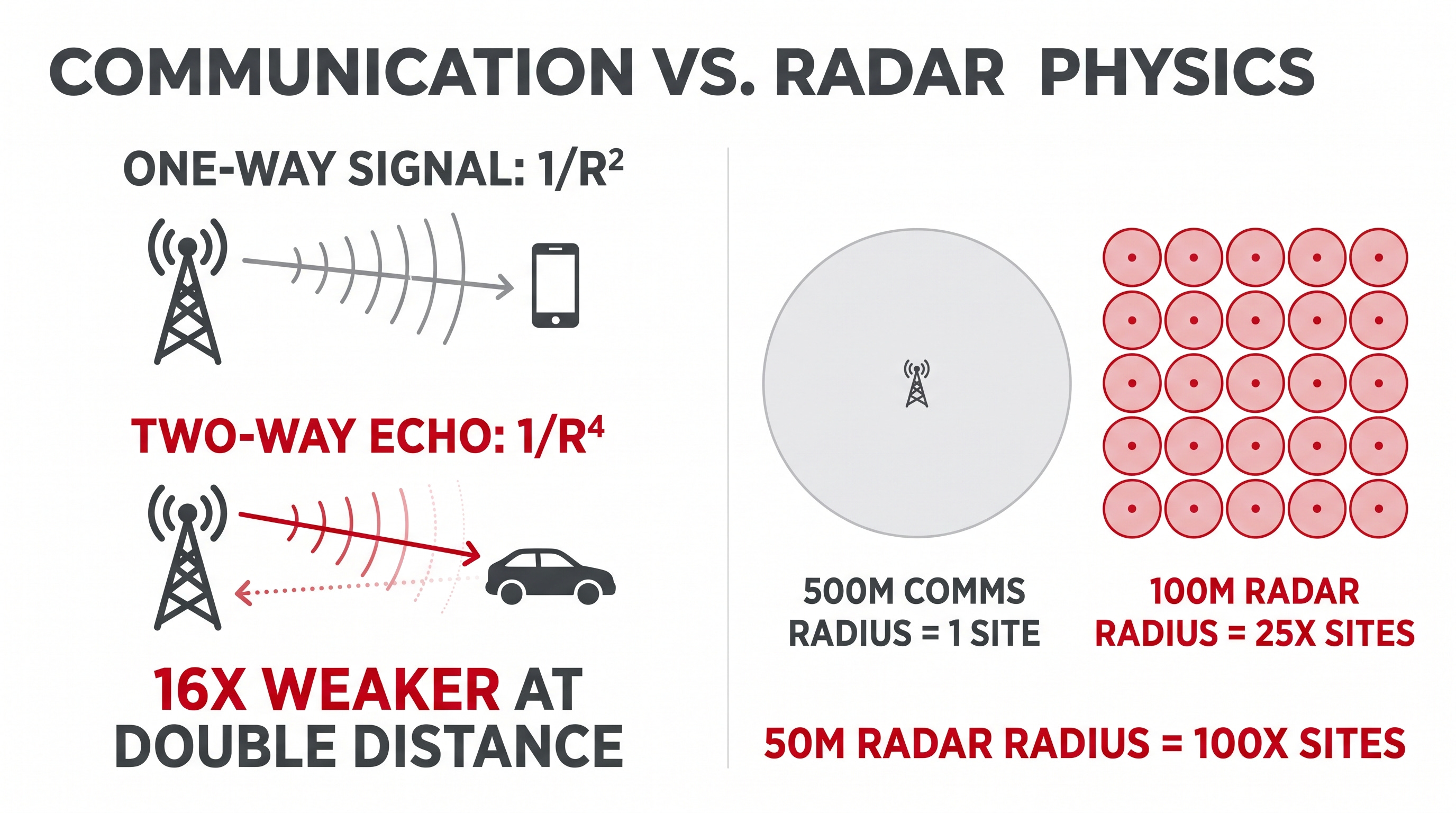
To understand why a cell tower is not a radar station waiting to be unlocked by software, let me explain the difference between a one-way message and a two-way echo.