
Quick overview
- Johnson & Johnson’s stock fell 5.73% despite beating Q3 earnings estimates and raising full-year guidance.
- The decline was primarily driven by a 96% drop in GAAP EPS and disappointing MedTech sales growth of only 2.5%.
- The pharmaceutical segment showed strength with a 7.7% sales increase, driven by new products for multiple myeloma and psoriasis.
- Investors are closely monitoring developments in talc litigation and the potential spin-off of the orthopedics unit.
Johnson & Johnson (NYSE:JNJ) is trading near 249-250 in pre-market action today, recovering slightly from declining 5.73% on Tuesday to close at $248.61. The decline came despite the healthcare giant beating earnings estimates and raising its full-year guidance. Investors were more interested in the reported GAAP decline than in the better-than-expected results, with shares trading well off their 52-week high of $281.07.
Q3 Beat and Higher Guidance Overshadowed by GAAP Charge
On Tuesday, J&J reported stronger-than-expected third quarter results: adjusted earnings per share of $2.59 compared with the about $2.54 LSEG consensus. Sales grew by 5.9% year-over-year. However, GAAP EPS plunged 96% to just $0.09. The company blamed the drop on three factors – the special charge on its proposed talc litigation resolution, the Firefly Bio acquisition and the joint venture with Sail Biomedicines.
Adjusted EPS fell 7.5%, even as year-to-date free cash flow increased more than 6% to $15.1 billion. J&J also increased its full-year ’26 sales outlook, now anticipating 7.4% growth to $101.2 billion, and adjusted earnings per share at $11.10. But the upgrade of guidance did not compensate for the concern over the reported profit drop, and the stock’s valuation.
MedTech Weakness Triggers the Sell-Off
MedTech was a big disappointment as sales growth was only 2.5% against expectation for better growth. According to CFO Joe Wolk, the unit faced several pressures, including continuing Abiomed heart-pump weakness after the UK study, plus international headwinds from the Middle East conflict, European austerity measures and pricing in China.
Wolk added that J&J now leans toward spinning off its orthopedics unit rather than selling it outright. It comes after recent reports of talks with Apollo Global Management. A portfolio manager quoted by Reuters said depressed MedTech valuations probably made a sale harder to complete.
Pharma Remains a Bright Spot
J&J’s pharmaceutical business helped offset the weakness, with sales rising 7.7% to about $16.8 billion. Newer products for multiple myeloma and psoriasis and newer drugs for schizophrenia drove growth.
Tremfya sales jumped 68%, and management said the franchise could eventually exceed $10 billion in annual sales. A recently released psoriasis drug called Icotyde has been initiated by more than 20,000 patients since it came to market this year. Wolk said revenue would probably be about double without the free goods being used during the launch.
What to Watch Next
Valuation continues to be an issue. At Tuesday’s close, J&J traded at roughly 22 times the midpoint of its 2026 adjusted EPS guidance and about 29 times its roughly $21 billion full-year free-cash-flow guidance. Others, however, believe that the sell-off is excessive due to the increased guidance and pharmaceutical strength.
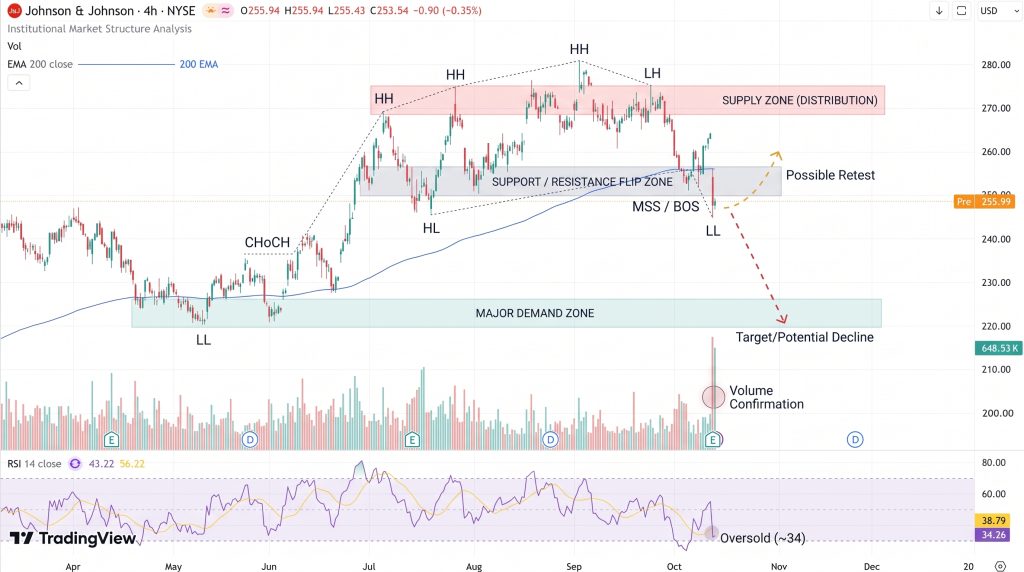
From a technical standpoint, support is in close proximity to the Tuesday’s day low at $245 and if MedTech concerns intensify, the $235 area appears to have a firm floor. Resistance is around 260-265 and the $281.07 is the longer-term target if sentiment improves.
Investors will be waiting to see how the talc litigation unfolds and any additional orthopedics spin-off news before the next quarterly report.
FAQs
- Why did Johnson & Johnson stock fall after earnings?
J&J shares dropped 5.73% as investors focused on a 96% decline in GAAP EPS and weaker-than-expected MedTech growth, overshadowing the earnings beat and higher full-year guidance.
- What is the outlook for JNJ stock?
The outlook depends on pharmaceutical growth, MedTech performance, and litigation developments. Support sits near $245, while resistance is around $260 to $265. These levels may change as market conditions evolve.
Bottom Line:
Johnson & Johnson raised its full-year guidance after beating Q3 earnings estimates, but MedTech weakness and the sharp GAAP profit decline triggered a sell-off. Investors will watch pharmaceutical growth, litigation updates, and plans for the orthopedics business for signs of a recovery.

Arslan Ali Butt
Lead Markets Analyst – Multi-Asset (FX, Commodities, Crypto)
Arslan Ali Butt serves as the Lead Commodities and Indices Analyst, bringing a wealth of expertise to the field. With an MBA in Behavioral Finance and active progress towards a Ph.D., Arslan possesses a deep understanding of market dynamics.
His professional journey includes a significant role as a senior analyst at a leading brokerage firm, complementing his extensive experience as a market analyst and day trader. Adept in educating others, Arslan has a commendable track record as an instructor and public speaker.
His incisive analyses, particularly within the realms of cryptocurrency and forex markets, are showcased across esteemed financial publications such as ForexCrunch, InsideBitcoins, and EconomyWatch, solidifying his reputation in the financial community.