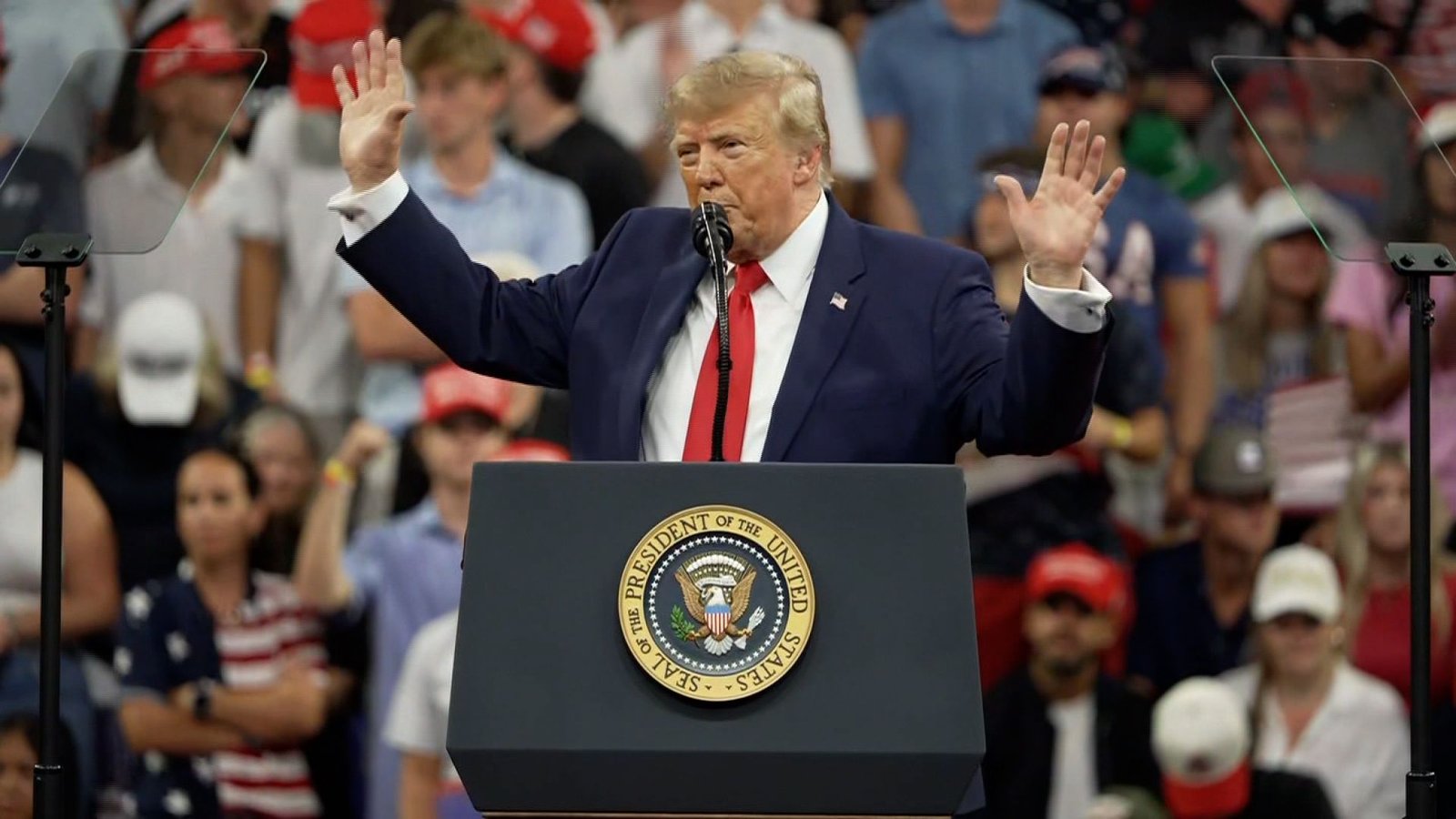
Russian President Vladimir Putin, Chinese President Xi Jinping, and US President Donald Trump attend a trilateral meeting on the sidelines of the Asia-Pacific Economic Cooperation Leaders’ Summit in Shenzhen, China, on November 19, 2026.
| Photo Credit: Vyacheslav Prokofyev/VIA REUTERS
The trilateral meeting between Russia, China, and the United States, held in Shenzhen, China, concluded on November 19 on the sidelines of the Asia-Pacific Economic Cooperation summit. The outcome was a four-point joint statement, the “Declaration toward Peace”.
The three nations are major nuclear powers and permanent members of the UN Security Council. Russia and the US are engaged in active wars in Ukraine and Iran, respectively, and China has pressed expansive territorial claims in its own region, including the South China Sea and over Taiwan. The declaration focussed on issues such as energy supply and UN reform but left out the emerging ambiguity around frontier technologies like artificial intelligence. The question is why the US and China, rivals in AI, left out any reference to AI regulation.
The joint statement commits the three countries to four areas of cooperation. First, as veto-power holders, they acknowledged the under-representation of other regions and called for UN reforms—a position that also aligns with India’s push for a permanent Security Council seat. Second is the commitment to stable energy flows, following the Strait of Hormuz blockade, which had hurt China’s energy security. Third is the recognition of state consent and opposition to jurisdictional overreach by bodies like the International Criminal Court—a position aligned with Russian interests, since the ICC has issued an arrest warrant against President Vladimir Putin for war crimes in Ukraine. Fourth is a reference to nuclear non-proliferation, with the US keen to bring China into the conversation rather than engage Russia alone.
Artificial intelligence applications now span civilian sectors like education and strategic sectors like defence and security. The US holds roughly 72 per cent of global AI computing capacity accumulated since 2022, according to Epoch AI estimates. In September, President Donald Trump directed federal agencies to rename “Artificial Intelligence” as “Super Intelligence”, a move critics read as signalling unrestrained development rather than caution. Nvidia, the world’s largest AI chipmaker, is also under scrutiny: its chief executive, Jensen Huang, is the subject of an ongoing US investigation into an alleged relationship with a Chinese national suspected of ties to Chinese intelligence; Nvidia says it has found no evidence that company secrets were compromised.
However, the twist is that while the US dominates AI infrastructure, China holds the leverage as the leading source of global AI research talent. This is where the two rivals’ interests converge: one needs human resources, the other needs infrastructure. The US has drawn an increasing number of Chinese-origin researchers—an 11 per cent rise in 2025, adding more than 2,100 researchers, by one industry estimate. Such mobility illustrates that AI leadership is not determined by computing infrastructure alone; it also depends on the ability to attract, retain and mobilise human capital.
Both nations have also established dominance in AI in their own ways. The US leads in developing foundational AI platforms that few other countries can challenge, and looks to sell these as a business—ChatGPT, launched in 2022, is the clearest example. China, meanwhile, has moved faster on AI deployment across its economy, including AI-integrated humanoid robots, an area where US industrial deployment lags.
Both countries are also wary of regulating the strategic, meaning military, use of AI. The Stockholm International Peace Research Institute’s 2025 research warns that AI-enabled military applications could compress decision-making timelines and increase the risk of nuclear escalation, even without direct integration into nuclear weapons systems. The declaration’s emphasis on nuclear risk reduction, without corresponding attention to AI-enabled military risks, exposes a gap in the emerging international security architecture.
AI development, then, appears unstoppable, with both nations racing to reach their own command centres of the technology in future—the fundamental reason both avoid regulation. Both intend to develop AI freely, and whoever reaches “artificial general intelligence” first could command the AI stack. The larger question is where other nations, such as India, stand in this race.
This is worth evaluating because AI requires data, power, coolants, and semiconductors. China’s data advantage stems from its population and economy. India, however, generates a large volume of data that American companies can draw on—a pattern critics describe as a form of “digital colonialism”. Google’s data-centre campus in Visakhapatnam, Andhra Pradesh, is one example: reported investment figures have ranged from $6 billion to $15 billion across different announcements, and it is described as among Google’s largest investments in India. US companies stand to gain from this even as the host nation’s own resources, including power and water, remain strained by drought and pollution.
Way forward
As the risks of unregulated AI mount globally, the task is to regulate it cautiously without impeding its development altogether—AI for the good of humanity, as the principle might be put. The European Union’s AI regulation, with its transparency and governance obligations, offers one precedent. India’s own “MANAV” vision, unveiled by Prime Minister Narendra Modi at the India AI Impact Summit in February, sets out a similarly human-centred approach built on inclusivity, ethics, accountability, and data sovereignty rather than exclusivity. Global cooperation on AI regulation, it can be argued, is the need of the hour—one where none of the major players holds a monopoly on its development.
Girish M. is an independent policy researcher based in Mysuru.
Also Read | The sudden rise of AI alarmism
Also Read | When the machine gets it wrong, who pays?