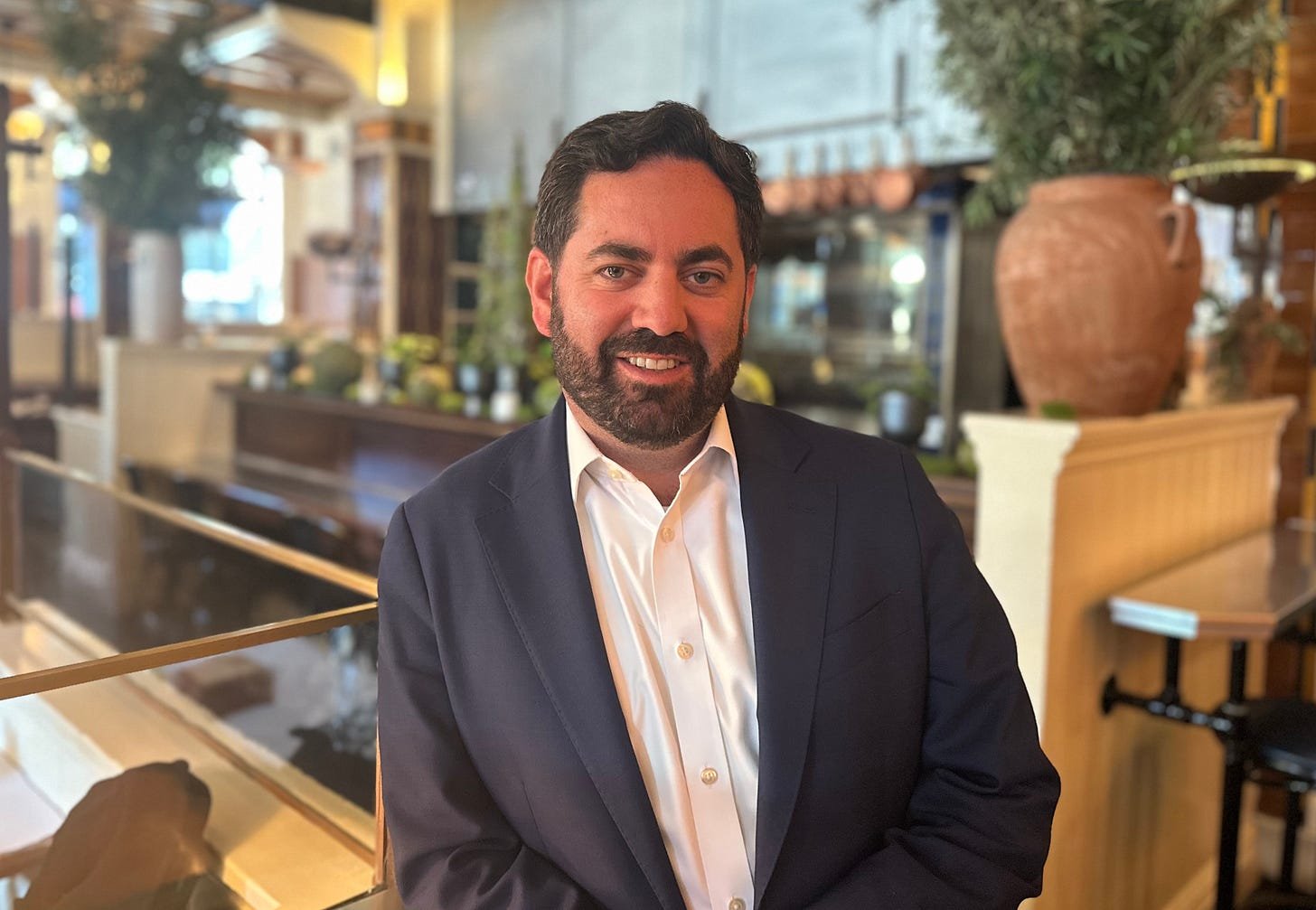
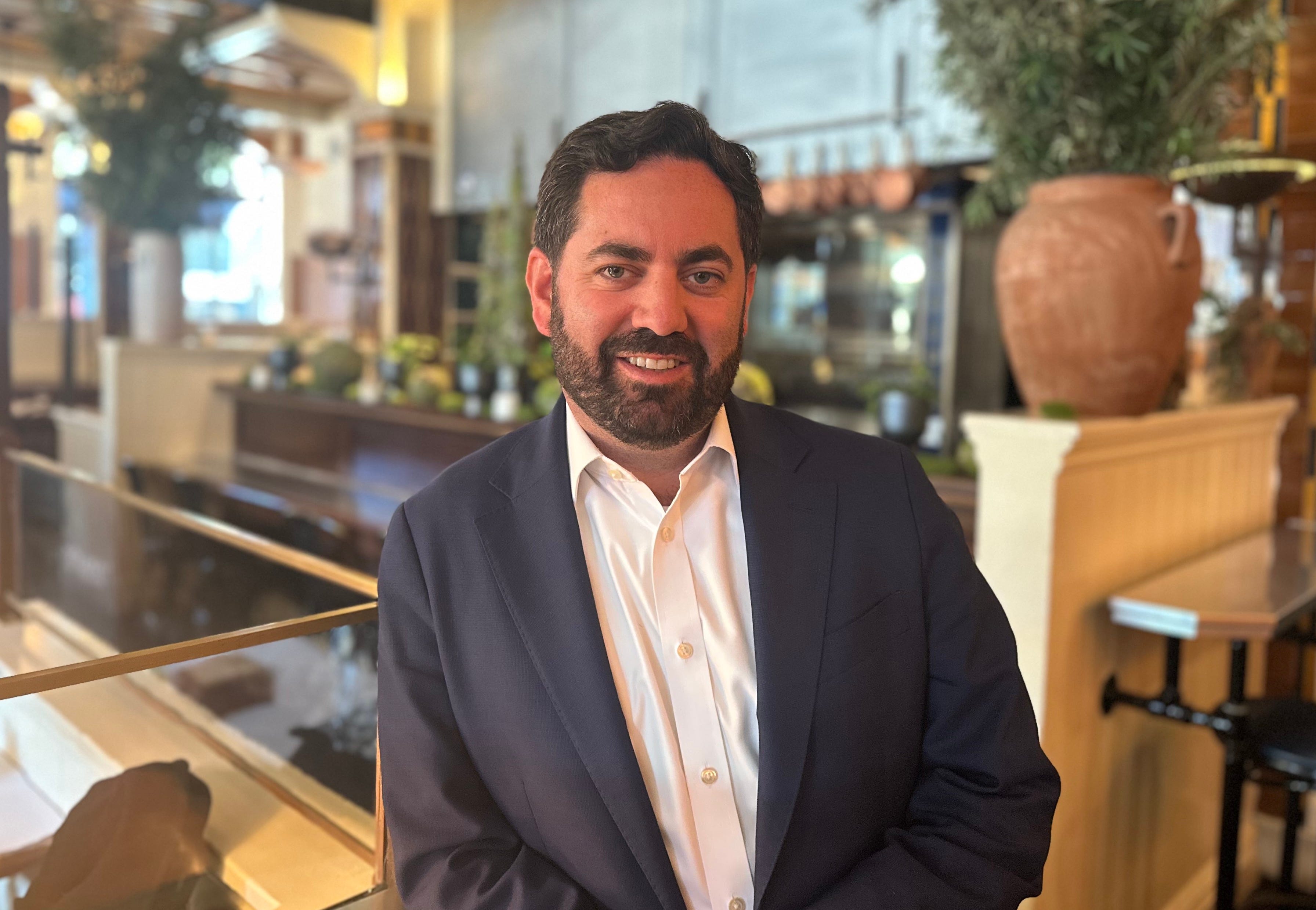
The New York Editorial Board spoke with Congressman Mike Lawler, a Republican who represents New York’s 17th Congressional District (Rockland and Putnam counties and parts of Westchester and Dutchess counties), on the morning of October 8, 2026. Lawler, first elected to the U.S. House of Representatives in 2022, is seeking a third term in November. He’s being challenged by Democratic nominee Cait Conley, who declined the Board’s invitation to be interviewed, in one of the most-watched House races of the 2026 election cycle. (photo by Liena Žagare)
Participating journalists: Timmy Facciola, Nicole Gelinas, Josh Greenman, Alyssa Katz, Ben Smith, Liena Žagare.
Full Transcript
Ben Smith
First of all, thanks for coming in. We’re living in an age when there’s no requirement that you talk to reporters. So it’s a very positive thing that most New York elected officials and candidates do. We note that your opponent declined, which is too bad. And I think that every winning candidate in the primary this year has come in. So just as a statement of the importance of talking to the media.
And I guess I just thought I’d start it off by asking why you think, in talking to your constituents, they hate Donald Trump so much.
Mike Lawler
That’s a good way to start breakfast.
Look, we live in a deep blue state that, I think, obviously politically has moved leftward, especially New York City. Since Mike Bloomberg last won elected office in 2009, the dynamics of New York City have shifted dramatically.
I’ll be honest, I think voters across New York hate most of their elected officials. In my district, Kathy Hochul has a 60% disapproval. Chuck Schumer’s at 70%. Chuck Schumer’s despised after 52 years in elected office. So I think, broadly speaking, New Yorkers tend to not suffer fools gladly, if you will. They don’t like most elected officials.
And in my district, Trump has always remained roughly around 49% disapproval. We’ve done probably, since I’ve run for Congress, a dozen polls. He doesn’t move. The cake is baked. You either like him or you don’t. You either agree with him or you don’t. There’s very little movement there. That’s not the case with Hochul, who has just precipitously gone down. Schumer’s numbers are so bad in the district, there’s about 0% chance he runs for reelection.
Josh Greenman
What about Mamdani? Is the cake baked on Mamdani in your district?
Mike Lawler
I’ll say his statement yesterday [on October 7] certainly didn’t earn him any friends in my district. He’s roughly around the same as Hochul, around 60% disapproval in my district. So I think his policies and the things that he’s advocating for, that does not play well in the Hudson Valley, where people pay among the highest taxes anywhere in the country. People are not enthusiastic about footing the bill for his socialist wish list.
Nicole Gelinas
What is your constituents’ biggest concern right now, and how has it changed over the past year?
Mike Lawler
So I think when you look at where I represent, it’s an area that pays among the highest taxes anywhere in the country. It’s got one of the highest costs of living. The average home value in Westchester County, for instance, went from $700,000 to $1.2 million in five years. Who can afford that? Utility costs are up 58% in New York State over the last six years under Kathy Hochul. I think most people are very focused on the overall cost of living, whether it’s their tax bill, whether it’s their mortgage or rent costs, whether it is health care costs, whether it is energy costs.
Nicole Gelinas
And what about gas prices?
Mike Lawler
Yeah, gas prices are part of it. But gas prices are volatile and will fluctuate. They will come down. The challenge longer term is that housing costs continue to go up. Health care costs continue to go up.
Nicole Gelinas
And what can you do about those things in Congress versus at the state level?
Mike Lawler
So, for instance, on the tax side of it, I led the fight to increase the SALT [state and local tax deduction] cap from $10,000 to $40,000, which was the single largest tax cut in the entire bill, and put, on average, over $4,000 back in the pockets of my constituents. Over 90% of my constituents were able to fully deduct their state and local taxes, whether they took the standard deduction or itemized.
When you look at housing, I led on the largest bipartisan housing package to pass Congress in 36 years. Six of my bills were in it. And if you go look at the base text of the bill that I put out last Congress and the beginning of this Congress, which had almost 40 provisions in it, most of that is in the final bill. So I led on a bill that’s actually going to increase supply, cut red tape, increase access to capital and reduce overall costs for home-buyers and home-builders.
In addition, we’re close to finalizing permitting reform, which is critical. This is a good bipartisan agreement that should pass when we get back after the November election. This has been talked about ad nauseam for years, and it’s finally going to get done. And I think that’s a good thing for New York, especially given the disastrous energy policies that have been put in place in this state that have limited supply, that have jacked up utility rates.
Health care. To me, there needs to be an overhaul of our health care system. Each side has to get over their dogma on health care. The Affordable Care Act had some good things in it, like covering pre-existing conditions, allowing 26-year-olds to stay on their parents’ health care. But it’s also not fulfilled the promise that Democrats said it would. They said it would cut costs. It does not cut costs.
Nicole Gelinas
So what’s the Republican dogma?
Mike Lawler
So if you look at health care, here’s an area where I actually agree with somebody like AOC. Insurance companies should not be owning providers. They should not be owning PBMs [pharmacy benefit managers]. You have to break up this monopoly. The consolidation that occurred over the last 16 years under the Affordable Care Act has not produced the economies of scale. Most of the private practices are gone. They’re either owned by the big hospital systems, larger providers, insurance companies or hedge funds. That is not producing access or reduced cost. And so you have to break that up.
We do need competition across state lines. New York’s health exchange is a joke. There’s no competition on it, and the prices are insane. If you look at association health plans, we passed this through the House. Every Democrat voted against it, to allow small businesses to be able to pool their resources and actually purchase health insurance for their employees. CBO scored it and said it would reduce health care premiums by 11% immediately. So there’s things like that that can be done.
Workforce. We are not producing enough nurses and doctors. We need an overhaul of our education system. The two-year associate degrees are critical to get more people into the nursing profession. We should be expanding access to that. I have a bill, for instance, on where we educate so many people that come from overseas on a student visa, and then we send them out.
Josh Greenman
I think Alyssa may have something on health care, but before we get completely away from costs, one other thing on costs, which is you blamed Hochul for energy prices, but you didn’t mention tariffs, I don’t think. What role have they had in not bringing down costs, at least, if not dragging them up?
Mike Lawler
OK, I’ll answer that in a second. Let me just finish my point on health care. Look, at the end of the day, we need to have an overhaul of this system. It’s workforce. It’s the insurance companies. We’ve taken on the prescription drug costs. We’ve actually reduced them by 3%.
You talk tariffs. What did tariffs do with respect to European price controls? It actually forced change. You can’t look at all of this and just say yay or nay. You have to actually look at it in totality. When you have Europe putting price controls on American prescription drugs that are manufactured here, and then we are footing the bill to subsidize it, and nobody says boo. I talked to so many of the pharmaceutical companies last Congress, and they said, “Listen, if you take on Europe’s price controls, it will actually bring down costs.” That’s what they said. And the President was right about that. And so you actually saw a 3% drop, which is the largest drop in 60 years.
Now, tariffs as a long-term tool, I don’t agree with. I’ve said that from the very beginning. Tariffs as a short-term negotiating tactic to force trade renegotiation, to apply pressure on these countries that have been fleecing us for years, to force businesses to reinvest in the U.S. instead of moving their operations overseas. Go look at upstate New York. It is ground zero for the decimation of bad trade policy. We’ve seen the consequence of it, where all these jobs, all of the investments have left. Go along the entire I-90 corridor, and these communities have been long decimated by bad trade policy.
So my view as far as the President’s tariff regime was very simple: Use it as a short-term tactic. I do not agree with the volatility, where he just kept changing the rates and the numbers. I think that was wrong and foolish. I think applying pressure on these countries, though, was necessary. When they put not just price controls but barriers to entry on American goods and products, and we’re just allowing all these companies to go build overseas, decimating these communities, I think that was wrong. And by the way, Democrats agreed with that stance for years. Chuck Schumer supported tariffs for years, and then all of a sudden they no longer do.
Alyssa Katz
So on health care, as a result of the One Big Beautiful Bill, a substantial number of New Yorkers lost their access to the Essential Plan, which is insurance for people who earn a little too much to get Medicaid. And a lot of them were cast into this health care marketplace, as you called it, a joke. What do you have to say to them now, and did you support that specific aspect of the bill that obviously included a lot of things?
Mike Lawler
OK, so let’s put in context the changes in the actual bill, because frankly I think a lot of people don’t know what was in the bill or what the bill actually did. Medicaid doubled under Joe Biden. And New York has the most expensive Medicaid program in the entire country. Bar none. It’s just not even close. 80% more than the average of the other 49 states they spend on Medicaid. Highest per capita in the country.
New York was going to do a Medicaid redesign prior to COVID. They were going to have another Medicaid redesign because even Cuomo and Democrats admit, “OK, this is out of control.” Obviously, COVID happened, got scrapped. Medicaid explodes. That is not a sustainable model. And they were allowing everybody and anybody to get on to the system. They were not doing verification. They were allowing illegals to collect Medicaid benefits, period. And that’s just not something that I or anybody that’s being rational could support.
So what did we actually do? We put eligibility verification. We sped it up to twice a year instead of once a year. Why? Because people were staying on the program well over a year when they were not legitimately supposed to be on the program. Secondarily, citizenship verification. Third, work requirements for able-bodied adults without dependent children. You have had about 3.4 million people across the country who are able-bodied adults refusing to work. That’s absurd. And I think most Americans, if you talk to them about that, they fundamentally agree with that. I would also point out Democrats under Joe Biden voted to expand work requirements on SNAP eligibility. Chuck Schumer negotiated that with Kevin McCarthy and Joe Biden.
Ben Smith
Is that the framework, that pulling people, threatening people’s health care, causes them to work, or that they work better when they don’t have health care?
Mike Lawler
People absolutely will work if you are putting the onus on them to go get a job. If you’re just telling them, “Hey, it’s free, no problem, stay home,” what sound policy is that? Look, at the end of the day, are there complications? Sure. But if the position of all of you and the Democrats is, “No, we don’t need to have work requirements, no, you can just qualify, you can just get the benefits…”
Ben Smith
I was asking if it worked.
Mike Lawler
Well, it’s being implemented. It’s being implemented right now.
Alyssa Katz
And the Essential Plan?
Mike Lawler
I’ll get to the Essential Plan, because we negotiated this. In addition to those three changes, I and a number of my colleagues that were pushing on this, we stopped a number of changes from happening. We stopped FMAP changes. They wanted to change the FMAP floor from 90 to 50 on the expansion population. They wanted to lower the traditional population from 50 to 45. We stopped that. They wanted to do DSH cuts, block grants, per capita caps. We stopped all that. So we were able to protect New York from massive changes that would have severely impacted its budget.
The Essential Plan was one of the issues where New York, Minnesota, and Oregon were the only three states using this tax provision to fund their plan. We tried in these negotiations — and look, it’s a big bill and you’re negotiating over a lot of different issues — we tried to get in a one- to three-year extension on that provision so that New York could transition over. We couldn’t get it through the House version. We went to the Senate. I talked to Greater New York [Hospital Association]. I talked to HANYS [Healthcare Association of New York State]. I talked to everybody and anybody to say Schumer and Gillibrand need to go negotiate with them. Like, we get they’re not voting for the final bill, but go negotiate, because you got plenty to trade. And they didn’t lift one finger to do that. They didn’t care, OK? They cared about the politics. They didn’t care about the actual outcome of it.
We tried to get the waiver. We couldn’t get it through. I went to Dr. Oz on the waiver for the basic plan after it was done. We got that through. But here’s the thing about the Essential Plan: The Essential Plan is a result of a longstanding court order that New York is bound by to provide health care for certain immigrant statuses. New York up through 2015 paid 100% of the program. So prior to 2015, this was part of New York State’s budget. They used this tax provision that only three states were using. So it got eliminated.
And this year’s budget, Kathy Hochul could have paid to fund it. She said, it’s too expensive, we can’t pay for it. So that was a policy choice of New York to not fund the program that they created, that they funded prior to 2015. She chose not to do that. But meanwhile, she found $8 billion magically to go close Zohran Mamdani’s budget gap? These are choices. When New York increases its state spending by $19 billion in one year with no controls, no oversight. People complain about Washington, D.C., and the lack of oversight and pushback against the President. What exactly do Democrats in Albany do on the Hochul administration?
Josh Greenman
So do you like the Essential Plan? You would have saved it if you had been in her position? You would have given state money to keep it going?
Mike Lawler
For lawful immigrants? Yeah, I would have been fine with it. But again, we tried to extend it in the negotiations. I was pushing for an extension of it. But at the end of the day, we got the basic plan waiver through with Dr. Oz, and New York made a decision not to fund it.
In addition, I got the MCO tax extended for New York for an additional nine months, which netted them $1.2 billion. That was me and Dr. Oz. That was it. That was the negotiation between the two of us, and I got it extended for nine months. The FEMA funds: Andrew Garbarino, myself, and a number of others were able to get the administration to release those funds on the hospitals. It was over $2 billion for New York’s hospital systems. The Biden administration sat on that for four years. Those were all the funds related to COVID that should have been going to the hospitals over that four-year period. I don’t [know] why they sat on it, but they did. And so we were able to get that released.
So look, health care to me is a big issue, but New York also has to take some responsibility here. You can’t have a system that is 80% greater in expenditure than the national average.
Josh Greenman
Do you think there’s a lot of Medicaid abuse in your district? Set aside for a second undocumented immigrants.
Liena Žagare
Tell us as well what share of the district depends on these programs, and what are you hearing about?
Mike Lawler
Look, the programs for the people that rely on them, that are lawfully on them, they’re protected. That’s the whole point.
Liena Žagare
But how many, what share of the district relies on them?
Mike Lawler
Look, the numbers that get thrown out all the time are all over the map, whether it’s 30%, 40%, it’s in that ballpark. But at the end of the day, the people who rely on this program, we protected them. The disabled, seniors, single mothers, children, that’s who Medicaid was designed for. And those are the people that are protected, and there’s not a problem.
When you have a system… Look, Kathy Hochul acknowledges with her CDPAP reforms, a program that went from $10 million to $11 billion in, what, three years?
Josh Greenman
For everyone to know, this is the Consumer Directed Personal Assistance Program.
Mike Lawler
Yeah, this is for the home-care aides. You have a program that went from $10 million to $11 billion. That is an acknowledgment by the state when they’re saying, oh, we have to fix this. That’s an acknowledgment by the state that there’s a problem with the system.
Ben Smith
Do you want to ask that fraud question?
Josh Greenman
Yeah. There’s a lot of talking about Medicaid fraud in various parts of the country. J.D. Vance hammers it repeatedly. I’m curious, are there places or parts of your district where you think this is particularly… where there are problems waiting to be confronted?
Mike Lawler
You seem to have a position about parts of my district.
Josh Greenman
No, I’m just asking an open question.
Mike Lawler
Look, if there’s fraud anywhere it’s committed, it should be prosecuted. And this has been a failure of the state. Letitia James has effectively ceded that department within the AG’s office. She’s not doing anything on it. So if there are people that are committing fraud, I don’t care who they are or what community they’re from or where they’re doing it. If you commit fraud and defraud the taxpayers, you should be arrested and prosecuted, period. Full stop. So to me, it doesn’t matter. I don’t care who it is. And I would hope that everybody would want to root out the fraud in the system, because, by the way, that takes away from the very people who need the funds.
Ben Smith
Maybe a couple more on healthcare?
Alyssa Katz
But the drivers of that explosive growth in the program are presumably not primarily fraud. It’s businesses that, and Hochul has been going after some of them, but that have built business models around long-term care, around consumer-directed health care. This was supposed to be for a population of severely disabled, and now it’s very, very widely used. And I guess perhaps you are arguing that it should be so widely used, but if not, then what…
Mike Lawler
That I’m arguing it should be?
Alyssa Katz
Well, in other words, you’re saying people are getting the care that they need, and yet you’re also saying that the—
Mike Lawler
Sorry, I don’t recall saying that, but…
Alyssa Katz
You’re protecting people who are on Medicaid or dependent on Medicaid or other programs to get those benefits, and yet we’re seeing explosive growth in the program. I guess another way of asking it is, what do you think the drivers are of that explosive growth, and does it have anything to do with business models?
Mike Lawler
The Medicaid program was originally designed for seniors, single mothers, children and the disabled. That’s who the program was designed to help. The Affordable Care Act effectively expanded Medicaid because of the expansion population, and New York is one of a handful of states that went whole hog on that. And so they decided to expand Medicaid significantly. And the federal government picks up 90% of that expansion population. You qualify for Medicaid in New York just by being here for 30 days. That’s it. That’s your qualification. You show up, you’re here for 30 days, you qualify for Medicaid.
New York needs a Medicaid redesign. It’s just a reality. They did it when [Andrew] Cuomo first came in [as Governor]. They were going to do a second one right before COVID. They scrapped it for obvious reasons, given a health pandemic. OK, we get that. But now we’re five years out from the health-care pandemic. What are you doing?
When Kathy Hochul acknowledges… I mean, Blake Washington, who’s a great guy, he’s her budget director, he wrote a whole op-ed about how the CDPAP program is rife with fraud. So if they’re acknowledging it’s rife with fraud, then what are they doing about it? The solution that they created is a joke. They effectively… OK, so we’re getting rid of all the fiscal intermediaries. We’re doing effectively a no-bid contract with a donor of hers. And then we’re giving a sweetheart deal to 1199. How did that fix the program?
Nicole Gelinas
Speaking of fraud and cost-cutting, do you think that DOGE was a success, considering that it at most saved 10% of what [Elon] Musk promised, and even that is somewhat debated?
[Crosstalk]
Mike Lawler
I think where it was important and helpful was actually a lot more with respect to the technology and updating and upgrading systems within the federal government and forcing some real changes, and, frankly, the lack of communication between departments and agencies and data sharing, which I think is critical to actually establish long-term cost savings and root out duplication or waste or fraud within the systems. I think as far as immediate savings, it produced some. I don’t think it produced anywhere near what was, I guess, projected. But I think part of what we’re trying to do is you have to slow the rate of growth long-term. I’ve long been a believer you’re not going to just slash and burn your way out of these types of challenges. You have to systemically go through department by department, agency by agency, line by line, and actually start to make changes.
But moreover, when you’ve increased spending the way the Biden administration did, which was $5 trillion in two years, or you increase the way New York has, where they’ve increased state spending by over $100 billion in a decade. New York spends double what Florida spends. And we could sit and argue about, like, well, Florida should spend more on this. But at the end of the day, when you have 3 million people less and you’re spending double, shouldn’t there be some level of introspection and say, you know what, are we getting our bang for our buck here? Or the fact that New York City now spends more than the state of Florida. The city, 8 million people, spends more than a state of 23 million people. That is disturbing.
Nicole Gelinas
So what would you cut in the federal government, considering you’ve promised not to cut Medicare or Social Security?
Josh Greenman
Defense? A lot of money in defense.
Ben Smith
Just to maybe reframe the question a little: Social Security, Medicare, as Nicole said, biggest portion of spending. The next biggest is defense. Do you think you should cut defense? Are we spending too much on defense?
Mike Lawler
I think defense needs a complete audit and a complete review of every single expenditure within it. There are things that we have allowed to lag in terms of investments within our defense budget. But there’s also clearly a lot of waste in the defense budget as well.
Ben Smith
Are there any major platforms that you would kill? Any of the fighter jets or aircraft carriers?
Mike Lawler
Well, I think one of the things that’s interesting is all of the autonomous aircraft that is coming online, I think, will be able to be produced at a much faster and cheaper rate and cost to the government than the F-35, for instance. The F-35 is a great piece of equipment, but it is extremely expensive.
Ben Smith
Should we stop making those? Should we pull the plug on that?
Mike Lawler
No, I think part of it is figuring out, as technology changes, as the capabilities to mass produce change, as warfare changes, which we’ve seen… If you look at Iraq and Afghanistan versus what has gone on in Russia and Ukraine, for instance, obviously drones have become a much bigger part of warfare. I think it is a question of not necessarily, like, OK, we’re eliminating the F-35. The question, though, is, are we going to put more investment in autonomous aircraft versus manned aircraft? I think that is likely the case and the way that the Pentagon is moving. So I think there does need to be a review as to which aircraft, which missiles, which type of artillery we need and don’t need.
And I think also what you’re going to see… You look at the competition with China. China has been investing heavily in their naval fleet. We haven’t been. And so part of this is figuring out, in this competition with China, which is really what we are dealing with from a foreign policy standpoint and from a military standpoint, how we need to respond to that. I’ve met with the chairman of the Joint Chiefs…
Josh Greenman
Well, I wanted to throw something to you, which is related to warfare, which is related to China, which is Iran. How’s it going? Is it similar to how you thought it would be going? And if not, why not?
Nicole Gelinas
Are we at war with Iran?
Mike Lawler
Yeah, of course.
Look, when you look at foreign policy, it doesn’t operate in a vacuum or a silo. All of it is interconnected. And when the President talked about, for instance, getting China out of the control of the Panama Canal, and many people snickered and sneered, he was right. Why would we want China in control of one of the most important waterways when it comes to trade? He was right about removing Maduro. Why? Because you had this alliance between Venezuela and China. Venezuela had effectively cut off the oil supply to the U.S. and an industry that we built in Venezuela. You had China’s malign influence in the Western Hemisphere.
When you look at what China has effectively done, they have been the biggest purchaser of Iranian petroleum. Over 90% of Iran’s oil sales went to China. During my time in Congress, I have made that a cornerstone of the work that I’ve done on the Foreign Affairs Committee and as chair of the Middle East [subcommittee], going after that illicit oil trade, passing numerous sanctions bills, including the SHIP Act, which I passed with then-Senator Rubio, the Iran-China Energy Sanctions Act.
Josh Greenman
There are many, many ways to confront those kinds of things, but this was a very specific thing that happened.
Mike Lawler
Sure, but it’s all interconnected. And so what did the President effectively do? He’s cut off China’s oil supply from both Iran and Venezuela in the last 10 months. And there’s immense pressure on China right now. In addition, with Iran, the military operation itself, which effectively lasted about six weeks, the major throw of this military operation was effective at going after their ballistic missiles capability, their drone capacity, their naval fleet, their air defenses, which Israel had largely decimated in advance of, and eliminating their leadership.
Ben Smith
So if we’d asked you then, we told you then, this is where we are now, the regime’s still in power, they’re still… You would have said, I’ll take the deal? Like, knowing then what you know now.
Mike Lawler
Listen, it is an entirely more complex situation than people want to make it. If the objective is to ensure that Iran does not possess a nuclear weapon, and the objective is to ensure that they stop financing terrorism around the globe — I think we can all acknowledge they’re the greatest state sponsor of terrorism — if the objective is to eliminate the threat they pose to our Arab partners in the region, who I deal with routinely, and obviously eliminate the threat posed to Israel and the threat posed to our troops in the region, then you have to make difficult decisions. And nobody would think…
Ben Smith
So the hindsight is 20/20, but I’m asking you about in hindsight.
Mike Lawler
No, but I’ve said, no, I don’t believe it was a mistake. And I’ve been very clear about this. Look, I serve as chair of the Middle East and North Africa Subcommittee. I’ve spent a lot of time on these issues. It is a difficult decision anytime you choose to send U.S. troops or use…
Nicole Gelinas
Should Congress vote?
Mike Lawler
Congress has voted. We have voted. We have voted.
Let me just make this point, because I think this is entirely part of the problem. There’s no consistency by anybody on this stuff. When Barack Obama went into Libya for seven months, Nancy Pelosi and Chuck Schumer said he did not need war powers authorization. They said he was well within his Article II powers to do it. And there was no objection by many people, certainly New York Democrats among many of them, who just said, yep, no, Barack Obama has the authority to do it. Hillary Clinton didn’t have a problem with it. OK, so let’s be consistent. If you believe Donald Trump needed war powers authorization, then so did Barack Obama. So did Joe Biden on the dozens of operations that he engaged on.
The War Powers Act has long been debated. The President informed Congress within 48 hours of the initial strike. That is the initial requirement there. Congress then can choose to act within 60 to 90 days. We’ve had numerous votes. Congress has acted. Now, I have voted no. Others have made the decision to vote yes.
What I find disturbing about it is you have people that are legitimately voting yes to order an immediate withdrawal of all U.S. forces from the region. How exactly do you do that when they are attacking commercial ships, when they are targeting U.S. military bases, when they’re targeting our allies? It’s political. It’s not honest. It’s not sincere. It is not a serious effort. It is entirely driven by politics, because some of my colleagues sincerely wish we fail so they can just say, we told you so. That, to me, is disturbing. I don’t care who the President is. To me, that mindset is so bad for our country. And frankly, a lot of my colleagues have helped Iran throughout this nine-month endeavor because of the way they’ve conducted this.
Timmy Facciola
Back in, I think, March, you told me this was going to be over in 60 days. So were you wrong? Did you underestimate the response that America was going to face?
Mike Lawler
I said the military operation would effectively be over in about six weeks, which, if you look at what they actually did, the six-week window was about where they were. They have responded to aggression by Iran. They have responded to address the issue in the Strait of Hormuz. Oil flow is now at about 94% of what it was prior to the conflict starting. Because what did they do? They dredged along the coast of Oman. They’re moving commercial ships along the coast of Oman. They have blockaded Iran’s ability to move their own oil. Iran’s economy is a disaster. You have over 300% inflation. Their currency is worth…
Timmy Facciola
I think a lot of your constituents would say that our economy is a disaster. That’s how they feel when they go to the grocery store or the gas station.
Mike Lawler
So you had cumulative inflation of 21% under Joe Biden. The baseline price of everything went up. Everything. Inflation right now is about 3.4%. It’s still too high. We want to bring it down. We want prices to come down. We want gas prices to come down. But let me ask you this. Most of the Democrats support eliminating fossil fuels. Right? That’s a baseline policy position.
Timmy Facciola
I don’t know if that’s a baseline policy. Fully support eliminating fossil fuels?
Mike Lawler
That’s what they want. That’s what they advocate for time and again.
Josh Greenman
Are you saying over some time horizon or right now?
Mike Lawler
This is their stated policy position. I don’t support…
Timmy Facciola
Which Democrats?
Ben Smith
Can I just—
Mike Lawler
No, no, no, but I want to make this point, because I think this is important. I don’t support eliminating fossil fuels. You need oil and gas. It’s just a reality. You need oil and gas. So Democrats right now are focused on gas prices, which is understandable. But what will gas prices be if they follow through on their policy position of eliminating oil and gas production in America?
Timmy Facciola
That’s just, like, an invented hypothetical.
Mike Lawler
It’s not an invented hypothetical.
Timmy Facciola
The reality is that we’re at war right now, and gas prices have skyrocketed. Even the sort of, like, the state’s efforts to try to do the 2030 [climate targets], back off and lower levels like that, even some Democrats are conceding that’s not a realistic expectation. But it seems like Republicans haven’t acknowledged the reality that this war is taking longer than expected.
Mike Lawler
Well, first of all, anytime you’re dealing with war, this idea that it’s, like, lickety-split, that’s just not a realistic assessment.
Timmy Facciola
I’m describing it that way because that’s how you described it to me.
Mike Lawler
No, what I said to you is the military operation, which is true, OK? It was effectively six weeks. Would you acknowledge that?
Timmy Facciola
If you look at the way the President talks, it doesn’t seem like he thinks…
Mike Lawler
But I’m not the President.
Timmy Facciola
He’s the Commander-in-Chief. The Commander-in-Chief doesn’t seem to be under the impression that the war is over.
Mike Lawler
Nobody has said it’s over. What we have said, OK, and what they’re responding to, is the threats posed by Iran on the Strait of Hormuz? Which, I think everybody would like to see that open. So you have to respond to that.
Timmy Facciola
Did you foresee this?
Mike Lawler
Of course. Did people think they weren’t going to try to respond with the one thing they effectively could do?
Ben Smith
…A final one on this?
Nicole Gelinas
Well, I was just going to say, why do you think bond prices on the sovereign debt globally are so high, reaching records we haven’t seen in a quarter century? This is pushing mortgage rates up to more than 7%. Is this global investors’ verdict on Trump fiscal management or something else?
Mike Lawler
No, we’re $40 trillion in debt. We’re paying over a trillion in interest on the debt. We have some long-term structural problems that we have to address as a country. That’s not just Donald Trump. Everybody…
Ben Smith
But the rate’s just gone up over the summer.
Mike Lawler
Look, you have real structural problems that I think as a country we have to tackle. And the next Congress and the Congress after that are going to have to be very serious about dealing with our long-term debt.
It’s why I’ve been on a working group, bipartisan, part of Problem Solvers and No Labels, working with people like Josh Gottheimer, Jared Golden, who’s leaving, but trying to address some of the structural problems that we have on our debt. If you don’t address that, of course the bond market is going to be more problematic. We have to get serious about it. And getting serious about it is not just, like, dealing with revenues. Revenues continue to hit consistent highs, and yet we’re still running $2 trillion deficits. So how do you actually address that? You have to start looking at some of the structural challenges here.
Ben Smith
Sorry, I just wanted to get to two genuinely controversial and difficult questions. You had one about congestion pricing.
Nicole Gelinas
Oh, yes.
Ben Smith
Forget the F-35s. What about the MTA?
Nicole Gelinas
You joined two Congress members in the region to try to preempt New York’s congestion toll, which you call a congestion tax. But why should the federal government be able to stop New York State, under its own democratic process, from implementing a toll on its own roads?
Mike Lawler
Would New York like to forgo federal dollars? I mean, look…
Josh Greenman
But you’re, like, a big advocate of local zoning control as well, for housing.
Mike Lawler
Right, but here’s the problem. I’m in the MTA region. My district is entirely in the MTA region. We don’t have fair representation on the MTA board. Rockland County has a quarter fucking vote. That’s a joke. And when we’re paying $50 million more into the MTA than benefits receiving. We’re the only one with a net negative imbalance in the MTA. We’re not being served by the MTA.
And so I asked repeatedly… So, you’re raising these funds, which is nothing but a cash grab. Let’s all be honest. This is not about congestion. It’s certainly not about the environment. It’s a cash grab. That’s all it is. And Kathy Hochul was dishonest with voters when she froze it, OK? And then magically approves it right after the election.
Josh Greenman
So [Nicole’s] question is about federalism.
Mike Lawler
Yes, but I also believe in fair representation, and we’re not being represented on the MTA board. And so this never should have been approved. They did not do a full environmental review. The Biden administration fast-tracked it without a full environmental review, which many people in New York have always said, oh, we’ve got to have the full environmental review — but now we don’t need it.
Nicole Gelinas
How does that square with permitting reform, and why do we want to do some things faster and some things slower, and how do we know which is which?
Mike Lawler
Look, you have duplication of environmental reviews, both at federal and state level. Federal law obviously preempts state law. I don’t believe this type of congestion toll should be permitted nationwide. I just don’t. It is a complete scam. It is a money grab. It has nothing to do with reducing congestion.
Ben Smith
It does seem like you’re in favor of permitting reform except when it affects specific concerns to your Rockland County constituents, whether it’s zoning or whether it’s, like, New York State passing this toll. And maybe that’s just because you have priorities, but it does seem like there’s kind of a combination there.
Nicole Gelinas
Data centers.
Mike Lawler
Well, my view on data centers is what?
Nicole Gelinas
Well, should those permits also be fast-tracked?
Mike Lawler
It’s local control of zoning, right? Which is fine.
Ben Smith
But that’s the same stuff that is stopping pipelines and…
Mike Lawler
But here’s the thing. This is not just local control when it comes to a tolling system that impacts everybody in the region. It’s not just a New York thing, OK? You’re taking federal dollars for this. You are creating a system where people like my constituents have to drive because they don’t have adequate mass transit options. So they’re getting hit with a tax. You talk about affordability. How is it affordable to increase a toll on people by $5,000 to commute daily into the city?
Josh Greenman
Do you bring similar scrutiny to other tolling systems? Because there are a lot of tolling systems that the state has set up.
Mike Lawler
You have tolls across the highway system in New York. Some states don’t do it. Some states do do it. If the toll is consistently applied, fine. But that’s not what’s happened here. And we have said repeatedly…
Josh Greenman
What’s inconsistent specifically about the application?
Mike Lawler
Well, when you look at the facts… Again, the whole objective is to force people to mass transit. That’s what they say. They want people to ride the subway system.
Josh Greenman
Is it consistently applied to cars?
Mike Lawler
They want people to ride the subway system. That is the objective, correct? That’s what they said.
Josh Greenman
What’s the objective of any toll? It’s to help pay for the roads and throw off some other money, possibly.
Mike Lawler
A normal toll, sure. They said very clearly this was designed to do two things: Reduce congestion and address environmental concerns. This is what they said. I don’t believe that, but this is what they said. But when you don’t have mass transit options to avoid paying the toll, and you’re being penalized for driving into work with an additional toll, then, yeah, that is inequitable. And I don’t think that’s right.
And we asked repeatedly for the state to come up with a plan to actually address that inequity for people who don’t have mass transit options. And they didn’t. They chose not to. But meanwhile, we’ll provide free busing to people who ride the bus system. And we don’t go after people who jump the turnstile. The MTA is losing over a billion dollars a year on people who jump the turnstile and refuse to pay to ride the bus. How is that fair? Why should my taxpayers be footing the bill for that?
Nicole Gelinas
So should the federal government be able to also outlaw parking fees in American downtowns? Meaning if you have to drive in, you have to park. Should that also be illegal?
Mike Lawler
No, look, at the end of the day, this was a system that required federal approval, did it not? OK, so I’m saying the federal government should not have approved it.
Josh Greenman
But there still has to be some consistent grounds where you apply that authority.
Mike Lawler
At the end of the day, this was the first of its kind in the country, right? So you’re trying to compare apples to oranges here. This is the first of its kind. I’m opposed to it. I don’t know why that’s such a controversial position for you, but I’m opposed to it.
Josh Greenman
We wanted to talk about Israel.
Ben Smith
And Mamdani.
Alyssa Katz
But on the question of federal authority, on a very different topic, you led legislation to require the federal Department of Education to use the International Holocaust Remembrance [Alliance] definition of antisemitism in its civil rights enforcement actions against institutions of higher education. And we have seen the Trump administration go very aggressively against Harvard and other schools, and with very direct threats to their funding. And I think it’s raised serious concerns, including for me, about academic freedom. And even as somebody who’s concerned about antisemitism, I don’t support this as an approach or a tool, personally. And I’m Jewish, right? So is it antisemitic of me to have that position? And what do you think about how the administration has enforced civil rights law now that it’s been happening?
Mike Lawler
Look, if this was any other group that was being discriminated against on college campuses, the outrage by almost everybody in the newsrooms would be on a level like 1,000. If it was anybody else that was being subjected to that type of discrimination on a college campus, the spotlight that would be shone would be massive. The challenge here is that for too long, academia allowed antisemitism to fester on these campuses under the guise of the Israeli-Palestinian conflict.
Josh Greenman
But how can you… What is antisemitism and what is speech, political speech, which you must protect? I think you probably agree, I think you probably strongly support the First Amendment.
Mike Lawler
Sure.
Josh Greenman
So you would give wide latitude for people to be able to make political speech, including saying they’re against the state of Israel. They believe that Israel, Zionism is racist. Is that antisemitic, inherently, to say Zionism is racist?
Mike Lawler
So if racism was occurring on a college campus, what would be your response to it? Is that free speech?
Josh Greenman
You are presupposing the answer to my question.
Mike Lawler
No, no, no. Is that free speech?
Josh Greenman
Well, can I go on a college campus — Should I be able to go on a college campus and say I believe that some religions are inferior, I believe that some races are inferior? Say that?
Mike Lawler
And what would the school do to you? What would the school do to you?
Josh Greenman
Do you believe someone should be able to say that?
Mike Lawler
What would the school do to you?
Josh Greenman
No, my question. I’m asking a question. Do you believe someone should be able to say that?
Mike Lawler
Well, the schools, these institutions have their codes of conduct, right? We saw that hearing, Elise Stefanik asked them about their codes of conduct. If somebody said something that X race or X ethnicity was inferior, how do you think the school would respond?
Josh Greenman
How should they respond?
Mike Lawler
The child would be suspended. You and I both know that. And here’s the challenge. There’s no consistency, OK? If there was a protest taking place against the LGBTQ community, you and I both know the school would act. They would stop it. They allowed this to go on on these college campuses, allowed students to be violently assaulted. At Columbia, you had staff members being held hostage in the library. What world are we living in here? These are private institutions. This whole notion that it’s like, oh, you’re allowed to act like an asshole and engage in a free-for-all, it’s just not reality.
And so when you look at the IHRA definition, why did we choose to do that as part of the Antisemitism Awareness Act? Because antisemitism clearly is not defined in federal law in the way that other classifications are and that the courts have deemed through different Supreme Court rulings. And we wanted to push to make sure that these institutions recognize that they have a responsibility under Title VI. They’re taking federal dollars. They have a responsibility to uphold civil rights and Title VI of the 1964 Civil Rights Act. They were not doing it. They were failing in their responsibility.
And so the bill would define, this is what antisemitism is for the purpose of Title VI enforcement. Thirty-seven states have adopted the IHRA definition. Dozens of countries around the globe have adopted the IHRA definition. The Obama administration adopted the IHRA definition for the purpose of the State Department. The bill simply said, for the purpose of Title VI enforcement, this is what is defined as antisemitism. It does not prohibit free speech. It does not criminalize free speech. I had people saying that I was looking to ban the Bible. I’m a practicing Catholic. I’m not looking to ban the Bible.
Ben Smith
For the record, you’re not looking to ban the Bible.
Mike Lawler
Thank you. But if you look at what the IHRA definition says with its examples, it says these examples can be used for the purpose of helping define what antisemitism is. It doesn’t mean that that in fact is. But from my vantage point, these schools had a responsibility. They failed miserably in it. Miserably. And I want free speech. I want debate on college campuses. But you know what we get on college campuses? A lot of groupthink. There’s not robust debate on college campuses about these issues. There’s not robust debate about…
Timmy Facciola
Should there be a robust debate on the question of Israel and Palestine? You seem to have made your mind up. Should there be a robust debate?
Mike Lawler
Sure. You can always… Well, first of all, if you’re anti-Zionist, if you don’t believe there should be a Jewish state, I presume you have the same position about Muslim states? That there shouldn’t be Muslim states or Arab states?
Timmy Facciola
Abdul El-Sayed says he’s opposed to Muslim theocracies as well, yeah.
Mike Lawler
Oh, OK. Do you think most of the people that are anti-Zionist hold that position? Have you heard them equally protesting the Muslim states?
Josh Greenman
If they don’t equally protest, they are therefore antisemitic?
Mike Lawler
I didn’t say that. Don’t put words in my mouth. What I said, and what I fundamentally believe, is if your sole basis for criticizing Israel is that it’s a Jewish state, then yeah, that is antisemitic.
Timmy Facciola
What if it’s because you’re seeing videos on your phone of kids dying and buildings collapsing? And you’re really pissed about that?
Mike Lawler
Well, first of all, nobody wants to see innocent life taken, period.
Timmy Facciola
But you don’t seem as affected by that as the people who are protesting around the country.
Mike Lawler
How do you know how I’m affected?
Timmy Facciola
You’re not super outspoken about it, the way that these people have been.
Mike Lawler
Well, when you have a terrorist regime that is in control of Gaza, or the PLO in control of the West Bank, and they use their own people as human shields, yeah, I’m outraged by that. I’m outraged by the fact that these folks have lived under the oppression of terrorism for 20 years.
Ben Smith
I’d love to move to a couple other things.
Alyssa Katz
Yeah, but just on this. Last year you called the Gaza peace plan a watershed moment, and I want to know, from where you sit now, how things look to you, and particularly around this goal of the eradication of Hamas and what that looks like, and also who, if anyone, is the partner for peace and leadership of the Palestinian people heading into the future. Because I think that, if nothing else, the call for having leadership from the community, as opposed to having it imposed from without as yet another colonial kind of occupation, is heard loud and clear around the world. And how do you respond to all of that?
Mike Lawler
So the number one objective was to get that conflict to come to an end and to get the hostages out. And that effectively was done. As I’ve said from the very beginning, the only way you’re going to establish long-term peace there is with our Arab partners taking on responsibility. It can’t be the U.S. government, or certainly not the Israeli government, in terms of what happens in Gaza or long term in the West Bank. You cannot have Hamas or the PLO in charge. It just fundamentally will not work.
And I meet regularly with all of our ambassadors from our Arab partner states, and they want peace and stability. They want a situation where you can have an established two-state solution in Israel and Gaza and the West Bank, where there is stability, where there is not armed military or militias or terrorist organizations impeding peace. You need, obviously, a rebuilding on the ground in Gaza, and we will need significant investment from our Arab partners in that. But in order to get there, you need greater cooperation economically. You need normalization between Arab states and Israel.
Josh Greenman
Does the Israeli government want a two-state solution anymore?
Mike Lawler
Currently, no. I think they’ve been very clear about that. But long-term, you have to work towards that. And the only way you’re going to get there… If I were them, I wouldn’t trust, obviously, Hamas. How do you trust Hamas to be in charge of a two-state solution? So the objective of what the President is trying to do with the peace plan is bring our Arab partners to the table, put pressure on them to take responsibility for what has been a very disastrous situation for 20-plus years since Hamas took control of Gaza, and work towards a long-term goal. The alternative is what? Do nothing?
Alyssa Katz
Right. And obviously, we have an election pending in Israel, but to Josh’s point, what are you doing to help ensure that a two-state solution is possible, and put pressure on the Israeli government to… It is working aggressively right now to forestall that or foreclose that possibility.
Mike Lawler
Look, they have a difficult dynamic in which they are constantly being attacked from all sides. And if a missile was launched into the United States of America, just one, I would love for everybody to explain to me what our response would be.
Josh Greenman
Right, but previously the governments who’ve also been subject to missile strikes have been pro-two-state solution and actually tried to advance it.
Mike Lawler
Sure, and then thousands were slaughtered and injured on October 7 [2023]. And so you have a dynamic here where obviously the mood in Israel has shifted dramatically. And I understand that. The question on our responsibility is to figure out how to forge a path forward.
Why does it matter to make sure that Iran does not possess a nuclear weapon? Why does it matter to end their financing of terrorism? Well, if you want something to work in Gaza and the West Bank where there is stability, you need to cut off the funding from Iran. You need to eliminate the threat posed by the terror proxy network. This is all interconnected. Obviously, you look at what’s happening in Syria and Lebanon. We want stability there. And to me, this is long-term. My objective is to actually have cooperation across all fronts, eliminate the threats posed by terror proxies, have a two-state solution. But there’s a lot of things that need to happen to get there.
Liena Žagare
Coming back to New York, why do you think so many New Yorkers are moving towards socialism? You said you agreed with AOC on something about health care. What else do you agree with her on?
Mike Lawler
Look, I think you have, with AOC and Zohran Mamdani in particular, two very effective communicators who are appealing to a younger demographic. You have a situation… it’s not so much that I think that this younger demographic is moving towards socialism. I think they are coming out of college, a lot of them, with hundreds of thousands of dollars of debt. They can’t afford to buy health care. They can’t afford to buy a home or rent. Their job prospects are limited. There’s so much changing in our society and in our economy. And I think a lot of them are looking, going, “OK, what are my prospects here? What does the future hold?”
The cost of everything obviously is significantly higher in New York than it is almost anywhere else in the country, whether it’s housing, whether it’s rent, whether it’s health care, whether it is everyday goods, whether it is energy. And I think a lot of people are struggling. And I think they’re tapping into that anxiety, that fear, and selling people a bill of goods.
As Margaret Thatcher said, the problem with socialism is eventually you run out of other people’s money. And New York has a real problem moving forward. It’s facing a $36 billion budget deficit. Wall Street is leaving. They’re going to Florida. They’re going to Texas. JPMorgan Chase, despite its new building, has more employees in Dallas, Texas, than they do New York. There are real problems coming New York’s way. And neither Mamdani nor Hochul have given any thought of how to deal with it. And it’s not just housing costs. He’s talking about Sunnyside [Yard], and he wants to do a big housing project. That won’t be done. Even if it moved forward, it wouldn’t be done by the end of his term.
Ben Smith
Speaking of Sunnyside, what do you make of the Trump-Mamdani thing?
Mike Lawler
Well, what I find interesting is I get attacked by the press, by the Democrats, certainly by my opponent, lying, saying that I vote 100% of the time with Trump, which is just provably false. I get attacked as just being a rubber stamp. And then at the same time, the same people are like, “Oh, it’s brilliant, Mamdani is figuring it out.”
Ben Smith
What is going on there? What do you make of that?
Mike Lawler
Look, Donald Trump is very easy to understand. He wants to be liked. He wants to cut a deal. He wants you to have a good time. The man was in hospitality for 50 years. Anytime you’re around him, his mindset is he wants you to enjoy your experience and what you’re doing. And if something’s not working, he’ll shift. He doesn’t get caught up in, “oh, we’re over here.” No, just move. I think he respects Mamdani’s political skill and his ability to communicate. And I think he wants to find… Look, at the end of the day…
Ben Smith
Do you watch that in your district, just like, “I’m trying to run a campaign here, I’m trying to tie my opponent to Mamdani, what are you doing?”
Mike Lawler
It’s irrelevant. It’s irrelevant. Look, at the end of the day, Donald Trump is a New Yorker. He cares about New York. The biggest mistake Democrats have made is not actually trying to work with him. Chuck Schumer and Hakeem Jeffries, as two New Yorkers, should be meeting with him routinely. They should be trying to get things done.
Ben Smith
When you guys are in the minority after the election, do you think there’s a chance for a reset of that, or no?
Mike Lawler
No, because they’ll go right towards impeachment. My opponent has already come out in favor of impeachment. It’s crazy.
Ben Smith
One last New York question. I think we’re basically out of time. The Cornell rape allegations. Do you think Hochul was right to reopen that and appoint Tish James as special prosecutor?
Mike Lawler
Well, Kathy Hochul’s on the board of Cornell. What the hell was she doing for the last two years? It’s not like this was unknown. So did she fail in her fiduciary responsibility as a board member? Was she unaware of this? I think, like with everything with Kathy Hochul, it is entirely political.
Ben Smith
What about the specifics of the case?
Mike Lawler
No, but here’s the thing. The law should be changed. When I was in Westchester County, we worked to develop a policy with respect to Westchester Community College that any allegation of sexual assault needed to be immediately referred to law enforcement. These campus security, they are not equipped to handle crime. They’re not equipped to handle a criminal investigation of a sexual assault. Whatever the facts are in this case, that is for law enforcement to have gotten to the bottom of, not campus police. And the failure here was, and the failure in the law is, that this should be automatically mandatory reporting to a law enforcement organization, period. Campus police should not be involved in investigating this stuff.
When you look at… I have zero confidence in Tish James. Zero. She’s the most political, partisan hack of an attorney general in the country. She prejudges every case.
Ben Smith
You think she’s going to railroad the defendants?
Mike Lawler
I’m sorry?
Ben Smith
Are you concerned she’s going to railroad the defendants?
Mike Lawler
Whatever the facts are, the facts are, and that should determine it. I have no confidence in her to actually investigate appropriately and follow the facts. She has made a career out of prejudging anything and saying who she’s going after. And when she posted on Facebook the other day, and then she was asked about it and says, “I’m not commenting on a Facebook post.” You posted it.
Josh Greenman
Did she give Andrew Cuomo a raw deal?
Mike Lawler
Andrew Cuomo, I was not a fan of. I was probably the loudest critic of, and I called for numerous investigations into. But like with everything with Tish James, she predetermines what she wants to do. That’s not how you should operate as the chief law enforcement officer of the state.
They’re not mutually exclusive. Andrew Cuomo is terrible. She also is terrible at her job. And I think there’s a real problem when the chief law enforcement officer is that partisan and that corrupt that they can’t see straight. At the end of the day, this should be referred to a special prosecutor at this point. But Tish James is not who should be the special prosecutor. She should recuse herself from this matter. I just have zero confidence in her to actually do the job of chief law enforcement officer.
We did not touch on immigration, and I want to raise this because this is a real problem.
Ben Smith
It’s on our list.
Mike Lawler
Kathy Hochul’s new law is a farce. If you don’t want ICE coming into communities and you don’t want ICE engaged in civil immigration enforcement, the best way to counter that is to actually allow law enforcement to cooperate with immigration officials. She keeps gaslighting everybody and saying, “this is about civil immigration enforcement, we cooperate on criminals.” So then why is it that in 2025, almost 7,000 convicted criminal illegal immigrants were released and the detainer requests were not honored, including murderers, rapists, drug dealers, gangbangers, and gun traffickers? Can somebody explain to me why it is that she is saying this is only about civil immigration enforcement when she refuses to honor the detainer request? Nobody pressures her on this. Nobody has said to her, “wait a minute, you’re saying that, but why were all these people released?”
The 287(g) agreements have to do with the jails. So if you’re sitting in a jail, the chances are you’ve credibly been accused of a crime. So if she’s, as she says, we’re cooperating on criminals, then why would you eliminate the 287(g) agreements, if it’s about criminals? I get the argument on civil immigration enforcement, but I will say this: This is the problem on what they’re doing.
Ben Smith
What is your view on ICE’s sort-of interior enforcement?
Mike Lawler
Well, we had 11.5 million people flood into the country during the Biden administration. It overwhelmed the system. The city and state of New York were crumbling under the weight of it, spending billions of dollars. They could not handle it. You want to talk about prices being jacked up and the cost of everything?
Ben Smith
But I was just wondering if you were watching what was happening in Minneapolis this year…
Mike Lawler
But all of this is interconnected. I wrote a whole New York Times op-ed about it. What happened in Minneapolis, as far as Renee Good and Alex Pretti being killed, was wrong. They should not be dead.
But there are a lot of challenges as to why that occurred. Number one, the Minneapolis Police Department prohibited the Minneapolis police from cooperating on traffic control and crowd control. New York City wisely does not do that, because that would be an absolute disaster if they did. You cannot allow individuals to interfere with law enforcement activity, whether you agree with the activity or not. You cannot have that kind of interaction between police and the general public. Those people never should have been anywhere near those operations. And if you allowed local law enforcement to do their job, they wouldn’t have been anywhere near those operations. Number one.
Number two, ICE is not trained for that type of interaction, and they should never have that type of interaction with the general public.
Number three, I’ve been very clear: There should be reforms. They should all wear uniforms, identifiable. They should all wear body cameras. There should be no masks. I’ve been against masks from the start. I was against masks during COVID, when people were wearing them as a means of committing crimes. There are real problems here that should be addressed.
I also have been a lead on the Dignity Act and working to fix our broken immigration system. I’ve taken a lot of incoming over that. I also work to extend Haitian TPS. I pushed back against the President on that. I led the bill, I passed the bill through the House to extend Haitian TPS. But I also believe sanctuary jurisdictions have no place in this country.
My constituent, Sheridan Gorman, was brutally murdered by somebody who was detained at the border, released into this country, arrested for shoplifting, released under Chicago and Illinois’ cashless bail system, back out on the streets, and brutally murders this girl. So when people say, “oh, it’s a low-level crime.” No. Low-level crime led to this girl losing her life. And I don’t, for the life of me, understand the policy position or the argument. And if one of you holds this position, I’d love to hear it. Why anybody would support not cooperating when somebody is arrested for a crime? If you are arrested for a crime and you are in this country illegally, and there’s a detainer request issued by ICE, why is Kathy Hochul not cooperating?
Josh Greenman
So there’s also due process as an issue that some people raise.
Mike Lawler
Sure, they’ll get due process, but they should be in federal custody.
Josh Greenman
So the trigger should be arrest and not conviction for potential deportation? What should be the trigger for deportation?
Mike Lawler
So if ICE issues a detainer request because they’re in this country illegally, right? Do you agree?
Josh Greenman
I understand where you’re going.
Mike Lawler
OK. And they’ve now been arrested for a crime, and New York, with its disastrous cashless bail law, releases them back out on the street. Just this week in my district, somebody who’s been arrested 17 times and convicted eight. He should just keep getting released back out onto the street to reoffend?
Josh Greenman
So an arrest for any crime?
Mike Lawler
He can get his due process, but he should be held by federal authorities.
Josh Greenman
And then should be put through the courts here and then should be deported after?
Mike Lawler
Sure, and then deported.
Ben Smith
Immigration was on our list of things to get to, but we didn’t, and you brought it up. Which makes me think you must be feeling it’s really top of mind in the district still?
Mike Lawler
Of course it is. Look, when you have a constituent who is brutally murdered and her parents are very vocal in wanting to see changes, they have stepped forward because they don’t want any other family to go through what they have gone through. And I think the fact that Kathy Hochul signed that law, which is, again, entirely political, entirely political…
Ben Smith
You keep mentioning Hochul [more] than your opponent.
Mike Lawler
I’m happy to talk about my opponent, who supports Kathy Hochul’s law. She supports it, even though she couldn’t give a straight answer to my constituents.
Ben Smith
There’s still time for her to come in here, just for the record.
Timmy Facciola
Have you been more focused on, like, the press conference you had a couple days ago and the Sheridan Gorman case than you have… You mentioned TPS, certainly. But I wonder, is that the one instance where your relationship with Trump just cannot deliver on something for you? You’ve made it clear that you support this stuff. He doesn’t seem to want to throw you a bone in this tight election.
Mike Lawler
It’s not a function of not throwing me a bone. I’ve done my part, which was actually to pass a bill through Congress. The President has the legal authority, the Supreme Court reaffirmed it, the President has the legal authority, under the law that was passed previously, to end TPS. I was able to secure several extensions in dealing with the administration. I’ve been working closely on individual cases to help get individuals’ legal status, and I’ve been able to do that.
Timmy Facciola
But he’s giving you the cold shoulder. It’s kind of like he’s hanging you out to dry in a tight election year.
Mike Lawler
No. I did my role, which was to pass a bill through the House. The bill has sat in the Senate. And, again, this is where if Chuck Schumer actually did his job and actually picked up the phone and worked with the President on things, maybe you would get movement on this. But when you just take the blanket position of, I’m not going to work with the President of the United States, which is what my opponent has taken the position of… She has said that Republicans and those who voted for Trump are a greater threat to America than Iran, than China, than Russia. If you believe that half the country is a greater threat to our country, there’s a problem. That, to me, is a challenge.
I’ve worked tirelessly on all of these issues. I’ve taken on my own party. The whole idea that I vote 100% of the time with the President is a farce. And yet people just recite it with very little pushback on my opponent, knowing full well that she’s straight up lying.
Timmy Facciola
Don’t you think 96% is kind of close to 100?
Mike Lawler
It’s not 96%.
Timmy Facciola
It’s 94%?
Mike Lawler
Yeah. But you’re looking at just legislative votes. That is not the entirety of how you deal with the administration. A lot of the decisions that get made are made at the department and agency level and in the White House. And I have routinely… You have the document [of examples]. It’s pretty extensive, and I’m happy to share it with you and everybody at this table. But it’s not just votes. And so when you look at it, I have the third-lowest party score of any member in the House. Most of the Democrats, when Joe Biden was President, were at about as close to 100% as you could be. So I’ve shown independence. Just reciting the percentage there does not actually tell the full story.
Josh Greenman
Does that suggest that the best Republican leader next election cycle is not exactly like [Trump], a little bit different? And if so, what kind of person is that?
Mike Lawler
Look, there obviously is never going to be anybody in American politics like Donald Trump ever again. He is unique unto himself. My hope for the next Republican candidate, nominee, and President would be somebody who’s going to play to the 60% of the country, which is why I’ve been successful in my district, why I’ve been able to win in a district with 80,000 more Democrats than Republicans, why I’ve been able to be effective and get over two dozen bills passed, 17 of which have been signed into law. I think the country is longing for somebody who’s going to play to a much larger audience. And frankly, you look at New York, you look at a red state, they’re playing to their bases.
Ben Smith
You ever think about running for President?
Mike Lawler
Look, at the end of the day, I’m a big believer in what’s meant to be will be. When my dad died, the very last thing he said to me was, to whom much is given, much is required. You’ve been given a lot of skills and talents. Use them to do God’s work, and always keep your moral compass about you.
I am happy to serve in any capacity that actually can deliver results, and I love what I’m doing right now. If the opportunity is there to run for higher office, whether it’s at the state level or federal level, great. If it’s not there, great. I’ll enjoy my life and take care of my family. To me, I’m not in this for the title. I’m in this because I actually give a shit about the work we do and actually trying to deliver real results.
I pride myself on actually knowing what I’m talking about and what I believe. Nobody ever has to guess where I stand on an issue. They may not like my position. They may disagree with me. But I think I have been, in many respects, somewhat unique in this moment in New York politics. I think a lot of our leaders in New York don’t really lead. They don’t really take strong positions on things unless politically they think it’s advantageous.
Josh Greenman
You would put the Republicans in that category?
Mike Lawler
I’d put everybody in there.
Ben Smith
Well, thank you.
Mike Lawler
Thank you.