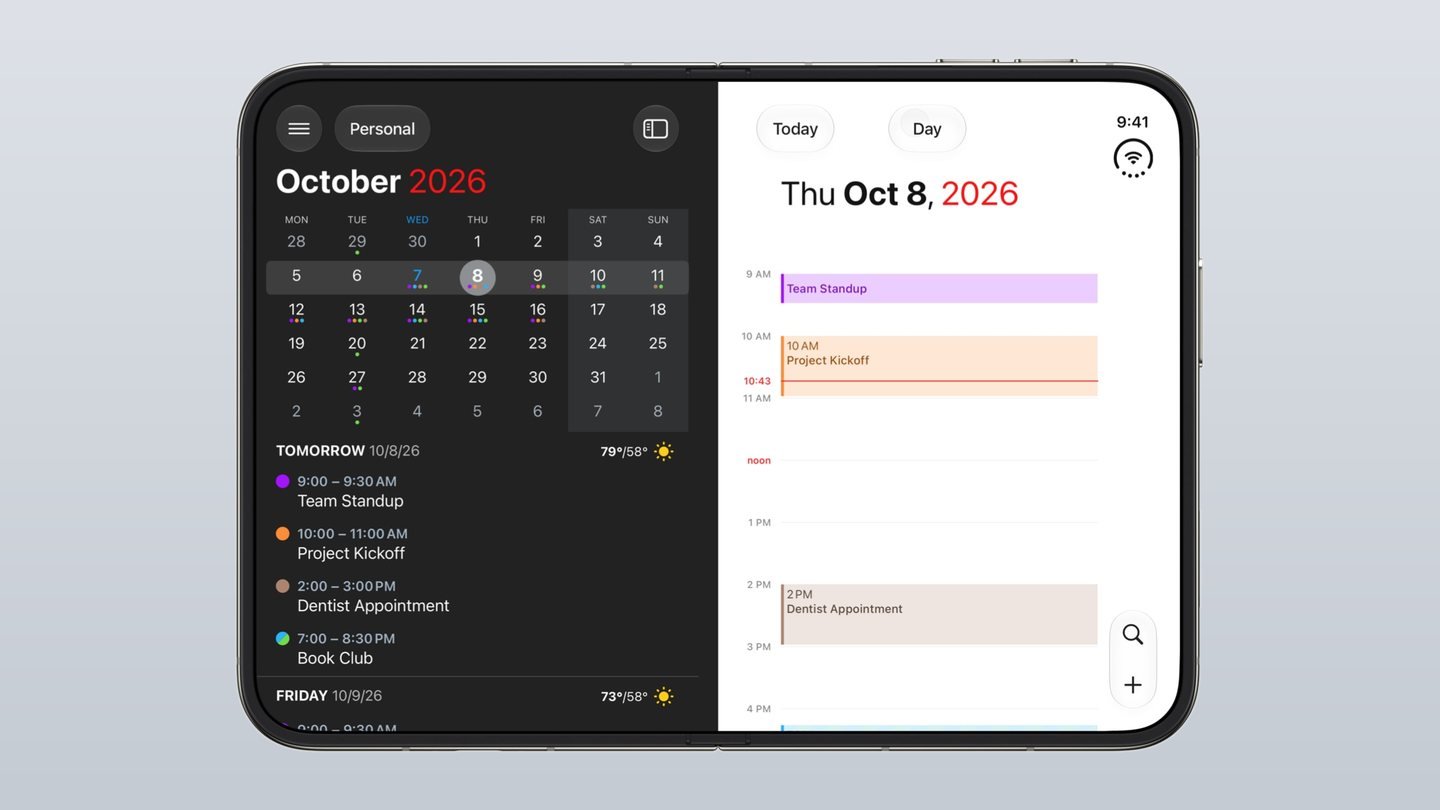
Apple said on November 6, 2026 that well over 100,000 apps built for iPhone Duo are already live on the App Store, about two weeks after the foldable went on sale on October 23, 2026. 9to5Mac reported the milestone the same day, and Apple added that thousands of optimized apps are landing in the store every day.
The number comes from Susan Prescott, Apple’s vice president of Worldwide Developer Relations. MacRumors confirmed that the figure counts apps built with the iOS 27.1 SDK or later. Those apps fill the full width of the iPhone Duo’s inner and outer displays and put vertical controls in the status bar.
For a first-generation foldable, software readiness decides whether the hardware feels finished. Apple has already told buyers it cannot predict how fast it will restock the phone, as our iPhone Duo shortage report explains. This analysis covers what the 100,000 figure confirms, what it leaves out, and what it means for developers, rivals and buyers.
Don’t miss new tech stories on Google
Add Tech Insider once in the Google app and our stories appear in your news suggestions.
Add Now
iPhone Duo Optimized Apps: What Apple Announced
The announcement is short on detail and long on momentum. Apple gave one headline number (well over 100,000), one rate (thousands per day) and one definition of what counts. It did not publish a breakdown by category, by developer size or by country.
The timing matters as much as the count. The phone shipped on October 23 and the statement landed on November 6, which makes the window exactly 14 days. The announcement spoke to the app catalog and said nothing about sales, which tells you where the confirmed story ends.
Several outlets carried the news within hours. ETV Bharat framed it as over 100,000 apps ready for the device with thousands more added daily, and GSMArena ran the same figure under a headline about optimization. All of them trace back to Apple’s own statement, so treat the coverage as one source repeated, not several independent counts.
The Prescott Statement, Line by Line
Prescott’s comment, as relayed to CNET, is the only official wording behind the milestone. She said: “Today, there are well over 100,000 apps built for iPhone Duo already live on the App Store, and thousands of optimized apps are being added to the store each day.”
The statement also carried a thank-you to developers. In the version 9to5Mac published, Prescott said: “It’s been wonderful to see how quickly developers have embraced iPhone Duo, and we’re grateful for their creativity and innovation.” That line frames the story as a developer success, not a marketing number.
Two word choices deserve attention. “Well over” signals the real count is above the round number, but Apple did not say by how much. “Built for” and “optimized” appear in the same sentence, which tells you Apple treats the two as the same thing for this milestone. No other executive was quoted, and no sales figure came with the announcement.
What Counts as an Optimized App
The definition is narrower than the headline suggests. Per MacRumors, the count covers apps built with the iOS 27.1 SDK or later. An app that merely runs on the phone does not qualify, because almost every iPhone app runs on it. The qualifying apps fill the full width of both displays and move vertical controls into the status bar.
That is a useful bar. It separates apps that stretch to use the inner screen from apps that sit in the middle of it with dead space on both sides. Apple’s developer pages, which our research surfaced, also describe a “Made for iPhone Duo” badge on App Store listings so shoppers can spot compliant apps without opening each one.
Why the SDK version is the real gate
Tying the milestone to a specific SDK makes the number auditable in principle. A developer either rebuilt against iOS 27.1 or later, or did not. It also means every optimized app represents a deliberate engineering decision, a rebuild and a fresh App Store submission. A bare 100,000 sounds large, but the real signal is that 100,000 teams already did the work.
Reading the 100,000 Figure Without Overreading It
Divide 100,000 by 14 days and you get roughly 7,100 apps a day. Do not publish that as a rate. The count is cumulative and Apple did not say how many apps qualified before October 23, so some share of the total may have been ready on launch day. The “thousands per day” claim is the only rate Apple actually stated.
The figure also lacks a denominator. Apple did not say what share of the App Store, or of the most-downloaded apps, now meets the bar. A hundred thousand apps could mean a long tail of small utilities, a deep layer of top titles, or both. Readers should hold that question open until Apple or a third-party analytics firm answers it.
| Item | Status | Source |
|---|---|---|
| Apps built for iPhone Duo | Confirmed: “well over 100,000” | Apple, via 9to5Mac and CNET |
| Announcement date | Confirmed: November 6, 2026 | Apple, via MacRumors |
| Release date | Confirmed: October 23, 2026 | Apple |
| Daily additions | Confirmed: “thousands” per day | Susan Prescott |
| Qualifying SDK | Confirmed: iOS 27.1 SDK or later | MacRumors |
| Sales figures | Not established | No reporting |
| Launch price, display size, chip, storage | Not established in this coverage | No reporting |
| Share of top apps optimized | Not established | Apple gave no breakdown |
That table shows how little of the story rests on hard numbers. Four data points are confirmed, and they all come from Apple itself. Everything about demand, pricing and hardware stays outside this announcement. Our earlier piece on the iPhone Duo price as Apple set it covers the pricing side separately.
The Developer Toolkit Behind the Milestone
Apple’s developer documentation, cited in our research, explains why the count rose so quickly. Standard SwiftUI and UIKit components adapt across the Duo’s displays without extra work. On the larger inner display, supported interfaces can expand into multiple columns. When the phone is partly folded, interfaces can move buttons away from the fold and keep controls within reach.
Apple also ships new and updated APIs in the iOS 27.1 SDK for teams that want more control. Arrangement and reserved-region APIs let developers split content across the fold or run it edge to edge. A hinge API lets an app respond to the opening and closing angle, and scene accessories can show related content on both screens.
The pattern is familiar. Apple lowers the cost of the first 80 percent of the work through standard components, then offers deeper hooks for apps that want to stand out. Teams using standard controls get a decent result from a rebuild and a resubmission, which explains how thousands can ship in a day.
Why App Readiness Decides a First-Generation Foldable
Foldables have a long record of strong hardware paired with awkward software. A tall outer screen and a wide inner screen mean apps must handle two layouts, plus the half-open poses in between. When an app ignores that, the inner display shows a small app floating in a large black frame, and the premium price starts to feel unjustified.
Apple knows this, which is why it put a developer relations executive at the center of the announcement. A reviewer can forgive a thick hinge or a short battery day if the apps look right. Nobody forgives the apps they open fifty times a day looking wrong. The 100,000 figure is Apple’s attempt to retire that complaint before it hardens into the story of the product.
CNET’s review, as the outlet described it, noted that Apple arrived late to foldables, and that lateness cuts both ways. Apple skipped the early-adopter chaos of its rivals, but it also gave developers no head start. Two weeks of fast catch-up is a better result than the platform’s critics predicted.
Historical Context: Apple’s Playbook for New Form Factors
Apple has run this play before. When the iPad launched in 2010, it leaned on iPhone apps in a compatibility mode while developers built native versions, and the gap between the two experiences shaped early reviews. A decade later, the move to Apple silicon on the Mac followed the same arc, with a translation layer to bridge the gap and a push to get developers to rebuild.
The iPhone Duo version of the playbook is faster and more public. Apple tied the optimization bar to a specific SDK, published a running count, and attached a badge to the store listing. Each step turns a vague quality problem into a measurable one. A rising public count is the easiest argument Apple can make that the platform is keeping pace.
| Date | Event | Why it matters |
|---|---|---|
| 2010 | iPad launches with iPhone apps in compatibility mode | Set the template for slow native adoption |
| 2020 | Mac moves to Apple silicon | Showed developers would rebuild when given tools |
| October 23, 2026 | iPhone Duo goes on sale | Apple’s first foldable iPhone |
| November 6, 2026 | Apple cites well over 100,000 built-for apps | 14 days from release to milestone |
| Ongoing | Thousands of optimized apps added daily | Count rises until it hits the long tail |
Competitive Comparison: iPhone Duo vs Samsung’s Fold8 Series
Samsung’s newest foldable generation is the Galaxy Z Fold8 series, which includes the Galaxy Z Fold8 Ultra and the standard Galaxy Z Fold8. According to Samsung’s product pages, the standard Fold8 has a 4:3 main display, weighs 201 grams, carries a 4,800mAh battery and runs the Snapdragon 8 Elite Gen 5 Mobile Platform for Galaxy. Samsung has been building foldables for years, and its pitch rests on that maturity.
| Factor | Apple iPhone Duo | Samsung Galaxy Z Fold8 |
|---|---|---|
| Position | Apple’s first foldable iPhone | Newest in a long-running foldable line |
| Release | October 23, 2026 | Current generation |
| Main display shape | Not established in cited reporting | 4:3, per Samsung |
| Weight | Not established | 201 grams, per Samsung |
| Battery | Not established | 4,800mAh, per Samsung |
| Chip | Not established | Snapdragon 8 Elite Gen 5 for Galaxy |
| App readiness signal | Well over 100,000 built-for apps | No comparable public count found |
The table has gaps on the Apple side because the cited reporting does not establish the Duo’s display dimensions, chip, battery or storage. Do not fill those gaps with rumor. What the table does show is that Apple is competing on software readiness, the one area where it can publish a flattering number, while Samsung competes on specs and track record.
Market Impact: Developers, the App Store and Supply
For developers, the milestone raises the cost of waiting. Once 100,000 competitors have shipped optimized apps, a stretched or letterboxed app looks neglected in a store that now shows a badge. That pressure usually moves faster than any marketing campaign, and it favors teams that already use standard SwiftUI and UIKit controls.
For Apple, the number supports a narrative that the platform is ready even if the hardware is hard to find. Our report on the January 22 delivery date that is not a restock shows demand running ahead of supply. A strong app catalog helps Apple keep buyers waiting rather than switching to a rival.
Games and subscription services sit in the middle of this shift. A title with a native two-display layout earns longer sessions on a larger screen, and Apple’s own services get a showcase. Our look at Crossy Road Rush on Apple Arcade shows how first-party and partner titles arrive on Apple platforms with careful timing.
What the Headline Leaves Out
Not every app is ready, and the coverage says so. MacRumors titled its report with a pointed phrase about what is still missing, and CNET reported that some new owners found favorite apps poorly optimized for the larger inner display. Both outlets credit Apple’s count while noting the experience is uneven.
That tension is normal for a launch month. A count of apps says nothing about which apps. The ones people open most, such as messaging, banking, maps and delivery, shape daily satisfaction more than a hundred thousand niche titles. Apple’s number proves momentum, and it does not prove completeness.
Expect the debate to continue on social channels. The more useful measure is how fast the most-used apps in each category move over. Watch for per-app updates in release notes over the coming weeks rather than another round number from Apple.
The Hardware Angle: Accessories and Storage
A foldable changes the accessory market as well as the app market. A hinge is a moving part that traps dust and takes stress, so case design matters more than on a slab phone. Our guide to iPhone Duo case protection, hinge clearance and drop testing covers what to look for.
Bigger inner screens also change how people use storage. Multi-column apps invite photo editing, document work and video capture, all of which fill a drive quickly. If you plan to offload footage, our comparison of an external SSD for iPhone weighs magnetic cases against USB4 drives. For wider coverage of the category, browse our hardware section.
Five Predictions for the iPhone Duo App Ecosystem
These are analysis, not reported facts. Each one follows from the confirmed numbers above.
- Apple will cite a higher figure soon. With thousands of apps added daily, the next milestone should land before the holiday shopping peak, and Apple will likely time it to a marketing moment.
- The badge becomes a ranking factor in buyers’ minds. Shoppers on the device will filter for “Made for iPhone Duo” listings, and developers without it will see the effect in downloads.
- Big consumer brands move first, long-tail apps follow. Companies with dedicated mobile teams already ship against new SDKs, while smaller studios take longer.
- Rivals will counter with their own readiness claims. Samsung has years of foldable app work behind it and little reason to let Apple own the narrative.
- Hinge and multi-pose features become the new differentiator. Once basic layout is solved, apps that use the hinge API and two-screen scenes will stand out.
What Developers and Buyers Should Do Now
Developers should rebuild against the iOS 27.1 SDK or later and test on both displays and in partly folded poses. Teams on standard SwiftUI and UIKit components get most of the benefit for little work, so start there before touching the new APIs. Then submit the update and check that the listing shows the badge.
Buyers should check the apps they use daily before they commit. If a key app has no optimized update yet, look at its release notes or ask the developer. Apple’s pace suggests most popular titles will catch up, but the timing varies by team.
The takeaway: 100,000 is a real signal of developer buy-in, and it is also a number Apple chose to publish. Read it as evidence of momentum, not proof that every app on your home screen is ready.
FAQ: iPhone Duo and Its Optimized Apps
How many apps are optimized for iPhone Duo?
Apple said well over 100,000 apps built for iPhone Duo were live on the App Store as of November 6, 2026. It did not give an exact count.
When was the iPhone Duo released?
The iPhone Duo was released on October 23, 2026. Apple made the 100,000-app announcement 14 days later.
What does optimized for iPhone Duo mean?
According to MacRumors, it means the app was built with the iOS 27.1 SDK or later. Those apps fill the full width of the inner and outer displays and place vertical controls in the status bar.
How fast are new optimized apps arriving?
Apple said thousands of optimized apps are being added to the App Store each day. The company did not publish a more precise daily figure.
Are all popular apps ready for the iPhone Duo?
No. CNET reported that some new owners found favorite apps poorly optimized for the larger inner display, and MacRumors framed its report around what is still missing. Check each app’s listing for the badge.
What is the iPhone Duo’s price and spec sheet?
The reporting behind this milestone does not establish display dimensions, processor, storage or sales figures. For Apple’s pricing, see our separate coverage and Apple’s own announcements.
Who is Susan Prescott?
Susan Prescott is Apple’s vice president of Worldwide Developer Relations. She provided the statement behind the 100,000-app milestone.