
Quick overview
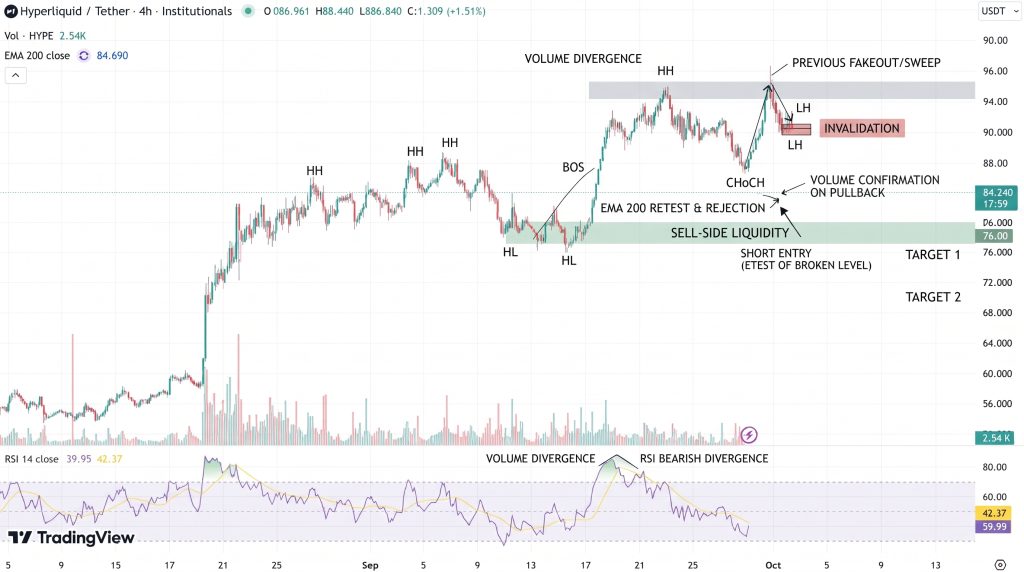
- HYPE’s price action remains bearish, losing over 5% yesterday and currently trading around $86.
- Heavy futures activity is evident, with approximately 2.91 billion futures contracts traded and a market cap of roughly $21.97 billion.
- ETF flows showed no inflows on Monday, with September outflows totaling $1.83 million, while support levels are identified at $84.40 and $83.56.
- Recent developments in tokenization projects may attract interest, but HYPE’s liquidity issues and bearish outlook persist.
Price Action on HYPE remains bearish as participants fume at diminishing returns across the DeFi landscape. Yesterday, HYPE lost over 5% of its value and as of the time of writing, trades for ~$86. Mayvolume books show a brief recovery to just under $87.61, though today HYPE is still down almost 1.47% from where it was 24 hours prior. Today’s figures demonstrate different temporal value and should not be read in conflict with one and other.
HYPE Trading Shows Heavy Futures Activity
Bearish pressure on HYPE has persisted, evidenced by a 4.23% loss in the last week. Recent rallies have proven to be short lived.
- Yesterday’s value and volume weighted averages included:
- Approximately 2.91 B in futures contracts were traded across various exchanges.
- Spot market turnover totaled 160.51 million.
- The total amount of contracts that were opened, or outstandning, was 3.32 B.
- The current market cap of HYPE is roughly 21.97 B.
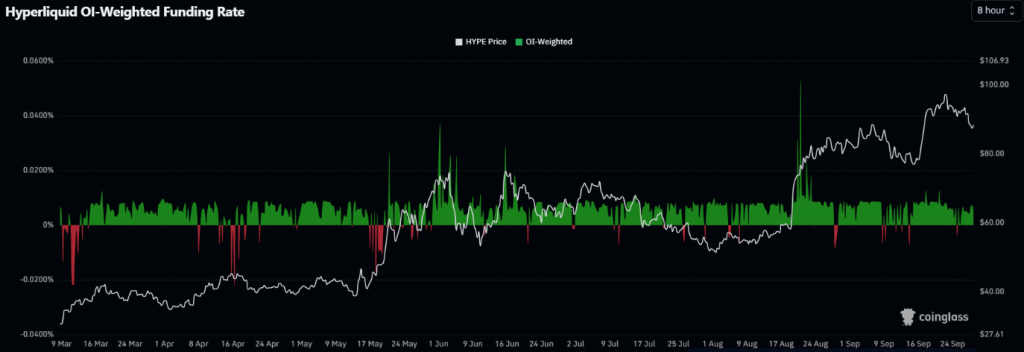
Annually, the futures market turned over approximately 18 times the amount of the spot market. Historically, derivatives have enhanced financial markets, but this statistic doesn’t tell us if investors are bullish or bearish. Transactions and turnovers can be a result of risk management activities.
ETF Flows and HYPE Support Levels
According to the fund flow data, there were no ETF inflows on Monday and September ETF outflows totaling $1.83 million. Support was expected at $84.40 and $83.56, and lower at $77.02. Higher, support was expected at $88.81 and $90.77.
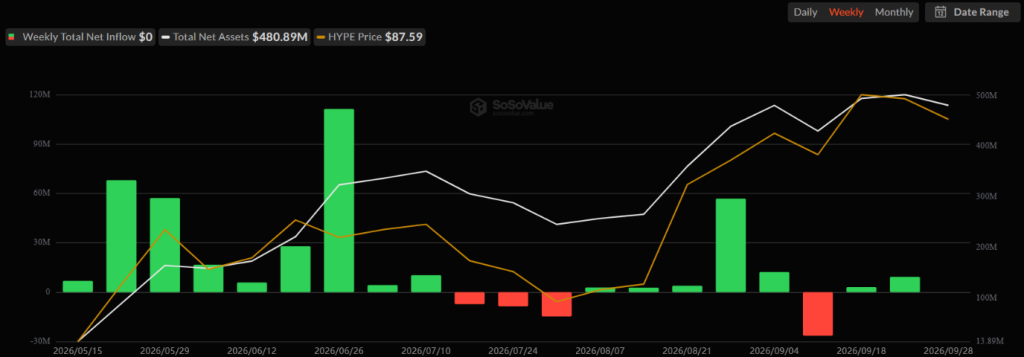
These levels are areas of interest, and are not expected levels of support and resistance. A trade or a series of trades that touch support is not a break of support. This is particularly the case when there is rapid, large variance in price.
Fund flows are one of many factors that can influence the price of a security, and a lack of reported fund flows does not mean that there has not been any trading activity.
Tokenization Projects Attract Attention
There are at least two recent developments that may help explain renewed interest in tokenized finance. First, Quant announced on September 24 that it was selected by The Clearing House to help build an interoperability network for tokenized deposits. For banks, deposits are usually denominated in various fiat currencies. Digital tokens represent such bank deposits. Thus, a banking system is integrated with a block-based payment and settlement system.
Separately, tokenized investments offered by Ondo and funded by BlackRock were announced earlier this month. Like the above example, tokenization at Ondo extends beyond individual securities to represent various asset classes in an investment portfolio.
Conclusion
While it is possible that holders of HYPE sold to purchase other tokens, price data for HYPE suggests that it is still highly illiquid. Further, there are several large buy orders for HYPE. Other tokenized securities announcements may help explain recent price action for HYPE, but they don’t prove sell side pressure for HYPE. Overall, while there are possible tail risks for HYPE, a more bearish outlook is warranted until there are signs of a bullish reversal.

Arslan Ali Butt
Lead Markets Analyst – Multi-Asset (FX, Commodities, Crypto)
Arslan Ali Butt serves as the Lead Commodities and Indices Analyst, bringing a wealth of expertise to the field. With an MBA in Behavioral Finance and active progress towards a Ph.D., Arslan possesses a deep understanding of market dynamics.
His professional journey includes a significant role as a senior analyst at a leading brokerage firm, complementing his extensive experience as a market analyst and day trader. Adept in educating others, Arslan has a commendable track record as an instructor and public speaker.
His incisive analyses, particularly within the realms of cryptocurrency and forex markets, are showcased across esteemed financial publications such as ForexCrunch, InsideBitcoins, and EconomyWatch, solidifying his reputation in the financial community.