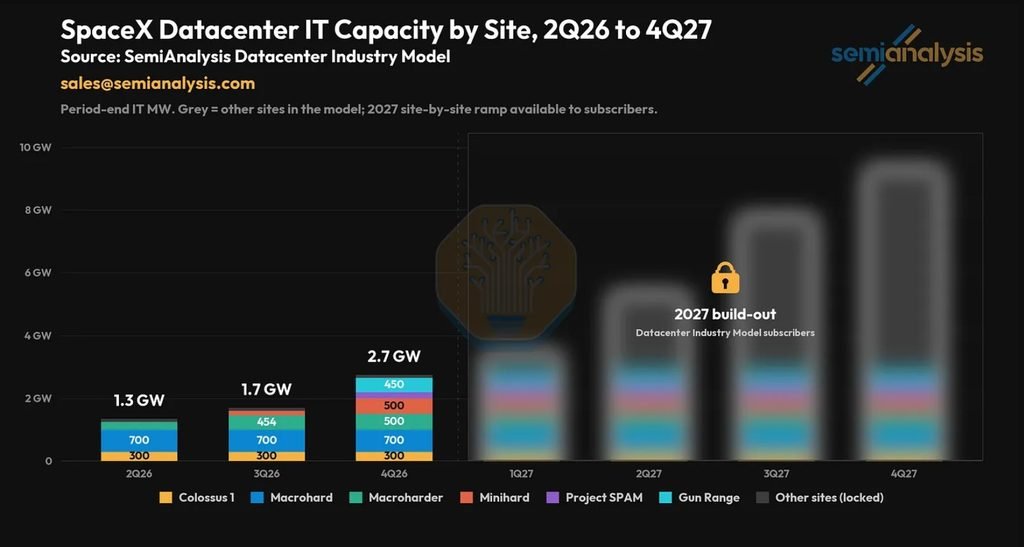
Elon Musk said he is “highly confident” SpaceX can build 10 gigawatts of data-center power capacity in 2027 alone. Analyst firm SemiAnalysis assessed that target as feasible, provided construction, power availability, permitting, GPU supply, and equipment deployment all remain unusually favorable.
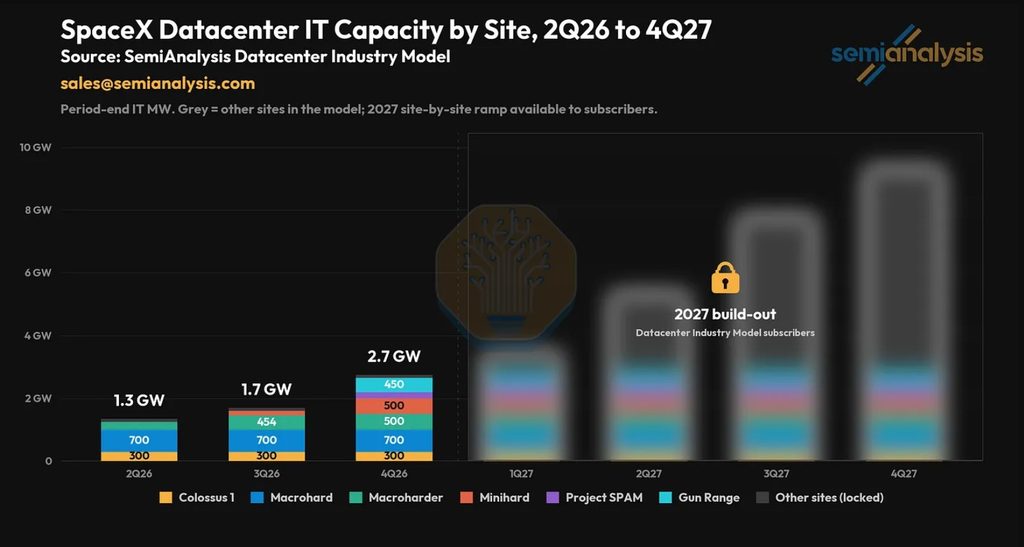
A subsequent SemiAnalysis update raised the 2027 projection to roughly 13 GW, with approximately 3.6 GW already under construction across SpaceX-associated sites, according to the firm’s estimates.
To put that in context, SemiAnalysis described the potential buildout as comparable to Google’s entire lifetime data-center capacity footprint, reached in roughly 1.5 years of SpaceX construction. That comparison measures planned facility power capacity, not equivalent AI computing performance.
Speed Is the Story, and the Numbers Back It Up
The construction timelines at existing facilities are what give analysts reason to treat the target seriously.
The Colossus 1 retrofit delivered approximately 150 megawatts of capacity in 122 days, while Colossus 2 added roughly 210 MW in just 91 days, according to SemiAnalysis estimates based on site observations.
Vertical integration explains much of the speed advantage. SpaceX’s access to Tesla manufacturing capabilities and its use of standardized, modular electrical and power-generation equipment can reduce the supplier lead times that slow conventional hyperscaler projects, SemiAnalysis argued.
Colossus 2 Shows How the Power Math Works
The facility illustrates both the ambition and the constraints that come with building at this scale.
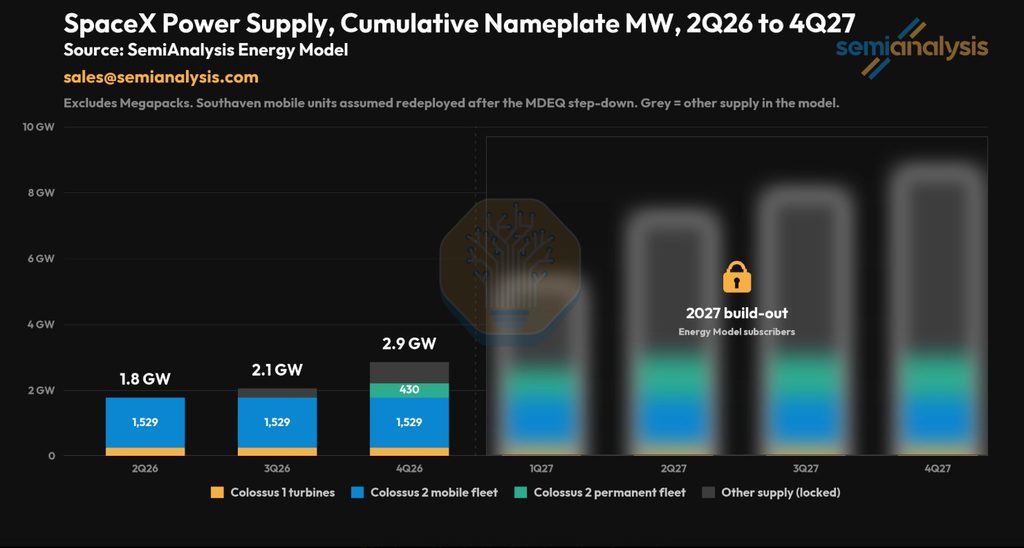
SemiAnalysis reported that Colossus 2 contains 89 gas turbines capable of producing approximately 2.5 GW and 1,377 Tesla Megapacks. The firm described roughly 5.9 GWh of battery storage as installed or planned at the site, a figure SemiAnalysis characterized as potentially among the largest battery-energy-storage deployments in the world, though that superlative requires a broader comparison to confirm.
Emissions restrictions complicate the power picture. Long-term turbine operation is capped at approximately 1.24 GW under reported operating assumptions.
A planned grid connection is expected to add roughly 1.2 GW. That still leaves an estimated 300 MW shortfall, which batteries and variable compute loads are projected to help cover, according to SemiAnalysis.
Musk reportedly stated that the Macrohard and Macroharder facilities together had 550,000 GPUs operating as of September 25. That figure is Musk’s claim and has not been independently verified.
A Building Shell Is Not a Data Center
Completed construction and commissioned AI compute are separate milestones, and the gap between them matters.
A finished structure can be delayed by GPU availability, networking hardware, cooling infrastructure, emissions permits, water access, grid interconnection approvals, and community opposition before it delivers any productive workload. For more on how power infrastructure and local resistance shape AI data centers, the broader permitting landscape presents its own challenges.
The 10 GW figure represents planned or potential power capacity across SpaceX-associated sites, not commissioned or operational AI compute. Gigawatts measure how much electricity a facility can draw, not how much AI work it can perform.
What the Competitive Stakes Look Like
The business case depends on whether capacity gets filled, not just built.
If SpaceX approaches 10 GW in 2027, the pace of expansion would be exceptional by hyperscaler standards. Business value depends on how much capacity SpaceX and xAI consume internally versus lease to external customers, and SemiAnalysis revenue projections remain contingent on utilization, pricing, GPU deployment, and commercial offtake.
SpaceX appears, based on analyst estimates, to be building data-center infrastructure faster than conventional hyperscalers. Whether that construction pace converts into productive AI compute by end of 2027 depends on power permits, GPU supply, and grid connections, all of which remain unsettled.