Oppo Find X10 Pro Max is a remarkably well-rounded flagship. The triple 200 MP cameras are the highlight, backed by a punchy, colour-accurate display, loud stereo speakers, and excellent battery life. The software is among the smoothest you’ll find on an Android phone right now. It isn’t flawless – the display resolution isn’t what you’d expect at this price and the bezels are slightly thicker than its standard sibling. Whether those compromises matter is for you to judge. But if photography is your top priority, the Find X10 Pro Max is easily one of the best phones you can own right now.
Pros
- Extravagant triple 200 MP rear cameras
- Bright, smooth and vivid screen
- Exceptionally well built with IP66/68/69 rating
- Long-lasting battery
- Loud, deep and clear audio output
- Feature-rich OS experiences
Cons
- Display resolution limited to 1.5K
- No UWB support
Ultra phones are getting too expensive to see, leading a few brands to quietly drop them. Oppo did something similar this year – instead of skipping the top tier, it introduced a Pro Max in the Find X series. It’s got a wild specs sheet, but more importantly, the wildest camera setup ever seen in a Find X phone. But does it all justify the very obvious corners Oppo has cut? Let’s find out in this Oppo Find X10 Pro Max review.
Oppo Find X10 Pro Max Unboxing
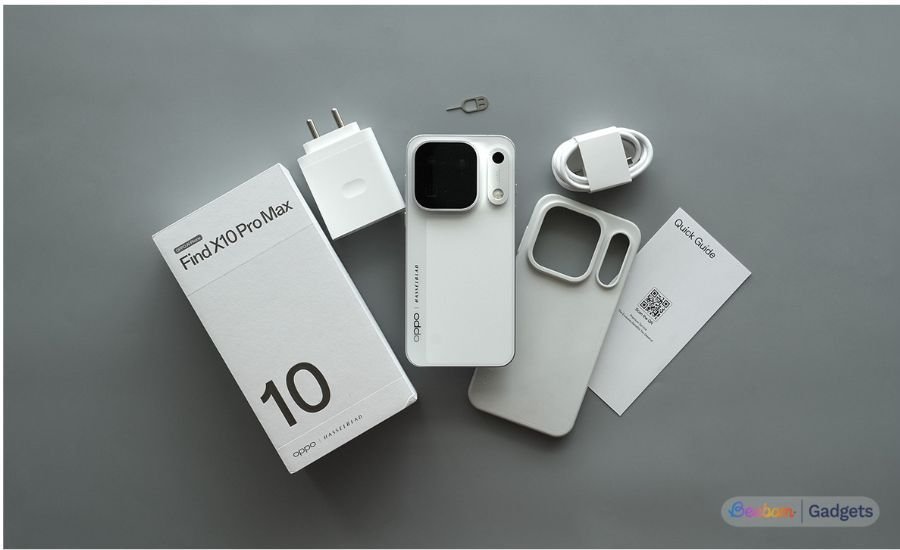
The Oppo Find X10 Pro Max retail box is quite understated this year. It boasts a paper-like finish and a Make in India mark, which reminded me of how Pixels are packaged. Inside the box, you get:
- Oppo Find X10 Pro Max
- A protective case
- 80W SuperVOOC charger
- USB-A to USB-C cable
- SIM ejector tool.

The unboxing experience was clean, but I can’t wrap my head around the USB-A-to-C cable. With the industry clearly moving toward USB-C to C, it’s about time all Android manufacturers adopted the same for a consistent experience.
I know we haven’t transitioned to the meat of the review, but this is something worth bringing up. I was disappointed to see the exclusion of an anti-reflective screen protector on the Indian variant when the Chinese variant gets it. Oppo says it’s due to a “difference in product strategy”, but I’ll let you all be the judge.
Oppo Find X10 Pro Max Key Details

Processor
Dimensity 9600 Pro

Display
6.78 inches 2K AMOLED (144Hz)

Rear Camera
200MP200MP200MP
Wide-angleUltra-wideTelephoto

Front Camera

RAM/Storage

Battery
8000mAh (80W)

OS
Android 17 (ColorOS)
See full specifications
Processor
Dimensity 9600 Pro
Display
6.78 inches 2K AMOLED (144Hz)
Rear Camera
200MP200MP200MP
Wide-angleUltra-wideTelephoto
Front Camera
RAM/Storage
Battery
8000mAh (80W)
OS
Android 17 (ColorOS)
See full specifications
Note: Our testing, opinion, and rating for this review are based on the phone’s launch price. We recommend checking the current price before making a purchase decision.
Related Articles

Design and Build
- 8.4 mm thick, 233 grams Aluminium Alloy frame, Velvet Glass Back with Armor Shield protection
- IP66/68/69 water resistance and SGS Five Star drop certification
- Titanium Grey and Luna White colours
I think of all colours, Luna White is a sight to behold. The matte, fabric-inspired texture and dual-tone finish keep the vibe minimal while also attracting a lot of attention. The Titanium Grey’s cameras sit on top of another rectangular camera island similar to recent iPhones.

The front of the phone is just as minimal, with 1.15 mm symmetrical bezels all around and a hole-punch as small as the Find X9 series. It’s worth pointing out that the standard Oppo Find X10 has slimmer bezels (0.99 mm) than the Find X0 Pro Max. While not a deal breaker, we do wish Oppo kept this parity, and the reason behind this decision is unknown.
What surprised me the most is that despite the humongous camera upgrades (which we’ll get to in a bit), the cameras don’t protrude much. In fact, it’s noticeably smaller than the Find X9 Ultra and results in great weight balance, giving the phone an excellent grip to hold.
As someone with OCD and a fear of scratching up the lenses while cleaning them, I also love that the design keeps fingerprints off the lenses. It does all of that while still retaining the proper flagship camera phone look.

All in all, the overall design is similar to the Find X9 Pro, with the Danxia colour sensor and flash now shifted to the right. The main lenses, flash and Danxia lens each get their own metal frame (Luna White only).
The toothed lens-style ring and the matte orange Hasselblad accent remain, and the Hasselblad logo has moved to the bottom, as on the X9 Ultra.

LUMO Camera System branding now sits on the colour lens frame. It’s unmistakably a heavy phone, but the design is so thoughtful that it doesn’t let you feel its weight. Lastly, the Find X10 Pro Max packs substantial IP66/68/69 ratings for protection against water and dust, alongside a five-star SGS drop protection rating.
Related Articles

Display and Audio Quality
- 6.78-inch LTPO 120 Hz OLED, 1.5K display
- 3,600 nits peak, 2,000 nits HBM, 1 nit minimum; Dolby Vision and HDR Vivid
- 10-bit colour, 95% BT.2020, 3,840 Hz PWM dimming, Crystal Shield Glass
While the display size remains unchanged, the second-gen Tianma substrate brings four key upgrades. First, the refresh rate has been bumped to 144 Hz. Then comes better colour accuracy with BT.2020 gamut coverage. Similarly, the PWM dimming has doubled to 3,840 Hz, reducing eye strain.

All these improvements translate to an excellent visual experience. The colours are punchy, contrasty enough and accurate. The phone shipped with Vivid mode enabled, in which the colours were popping a bit too much for my liking. So I went ahead and switched it to Natural mode. HDR content has a more immersive feel to it.
Brightness was never an issue indoors or outdoors. In our testing, the display hit 3,076 nits in HDR and 1,600 in SDR. Adaptive Tone is on board, and PWM dimming kicks in below 70 nits. It dims down to 1 nit, like iPhones.

Unfortunately, the 144 Hz mode is reserved for BGMI and CODM, while everything else tops out at 120 Hz. Combined with LTPO, that helps battery life too. However, two things that held the phone back for me were the lack of a 2K panel and the bezels, which are slightly thicker than the standard Oppo Find X10 we reviewed recently.
The visual experience is well complemented by the audio experience, with 50:50 split speakers that are loud, deep and clear even at full volume. Besides, there’s also Dolby Vision support on Netflix. Similarly, haptics were crisp and well implemented across the ColorOS 17 experience.
Related Articles

Performance Tested
- Mediatek Dimensity 9600 Pro (2nm, TSMC)
- 12 GB LPDDR5X (16 GB option), 512 GB UFS 4.1, 4,650 mm² vapour chamber
The Dimensity 9600 Pro chipset features great performance. While it’s not at the level of the Apple A20 Pro or Snapdragon 8 Elite Extreme Gen 6, it’s close to the Snapdragon 8 Elite Gen 5 processor.
It’s a big step up compared to the Dimensity 9500 processor. The phone did trail behind the likes of the Realme GT 8 Pro, but after a software update, it was at the same level, if not better, in some areas.
Still, for a 2 nm chip, it does not fully beat last year’s Snapdragon 8 Elite Gen 5 and Snapdragon 8 Elite Extreme Gen 6 chipset. The “Pro” in the name sure sounds enticing, but there’s no wind to sail it ahead of the competition.
Day-to-day performance was smooth. From using Google Maps under direct sunlight to multitasking, everything was a breeze. The phone retained apps in memory, and there was no stutter. Apps opened quickly, and animations were fluid. It gets a bit warm under heavy use, but not enough to cook your palms.
Gaming-wise, we tried BGMI and CoDM at 144 FPS, and there were hardly any frame drops. Wuthering Waves offers native frame generation up to 120 FPS. Fights pulled it down to 90-100 FPS, and the phone passed 40°C, but it throttled, cooled down and returned to around 119 FPS within a minute or two. Genshin Impact only supports 60 FPS and held it even in fights.

And with ColorOS 17, there are gaming tools including Performance Modes, Hyper Frame Rate, High Resolution, Hyper Touch Response Engine, Championship Mode, Bypass Charging and Aim Assist, plus the usual off-screen autoplay, DND and screen recording.
Related Articles

Software and Updates
- ColorOS 17 based on Android 17
- 5 major Android updates, 6 years of security patches
ColorOS 17 ties up the overall experience of using the Find X10 Pro Max beautifully. As someone coming from using OxygenOS 16 on a OnePlus 12R, there are clear improvements in the overall animations and the design language.

App opening is a tad bit snappier, haptics are well integrated, and it is, by far, the best implementation of Liquid Glass-like aesthetics I’ve tried in any UI yet. Additionally, ColorOS 17 brings more customisation options to the lock screen, including a redesigned Control Centre and Notifications panel.
The Liquid Glass-like revamp, which Oppo calls Living Flow design, feels thoughtful and something Oppo gave significant thought to, instead of blindly copying from Apple. The way the corners curve, the Dynamic Clock’s nimble transition, and the shift and flow of the UI elements all come together very well.
While there’s no way to put Oppo’s “25% less RAM usage” and “55% stable app launches” to the test, we did notice the phone was keeping apps in its memory longer.

What we weren’t particularly fond of is the pre-installed bloatware. The UI comes with apps like Amazon, Facebook, Instagram and a Glance lock screen. The latter is turned off by default, which is great, but for a phone that costs a fortune, we’d have preferred it if Oppo steered clear of these things.
All in all, the software is great. It’s faster, smoother, and gives you a more polished experience.
Related Articles

Cameras Reviewed
- Main: Hasselblad 200 MP Samsung ISOCELL HPC 1/1.3″, f/1.5, 24 mm, OIS
- Ultra-wide and Periscope: 200MP, ISOCELL HP5, 1/1.56″, f/2.2 (124° FOV, 3x Optical Zoom)
- Selfie: 50 MP ISOCELL JN5
Buckle up because there’s a lot to uncover in this section. Steering clear of my main gripes, there’s no OIS on the ultrawide and no Hasselblad tuning on the selfie camera. Rest, here are my views on the camera performance.

Main Camera – Daylight Shots
The Oppo Find X10 Pro Max blows the iPhone 18 Pro Max out of the water. Starting with the shots from the main camera, there are excellent details in the images.
The colours are punchy but not to a level where they start looking boosted, like Pixel’s oversaturated look. What really surprised me is the 17-stop dynamic range and how well it was able to retain the shadows and the sky in the first image.
Because the HDR processing lifts the shadows so aggressively, everything in the frame ends up evenly lit, which pulls attention away from the subject.
That works for landscapes, but it’s a problem when you want one object to stand out. Shadows aren’t the enemy, and sometimes they help immensely in subject separation.
Main Camera – Nighttime Shots
The main sensor also performed brilliantly at night time, with the colours being slightly more punchy, contrasty and boasting a warm tone. It’s a tad too warm for my liking, but that’s very subjective. The dynamic range comes in handy again, keeping everything well lit up, including the post-sunset moonlit sky.
Ultra-wide Camera
The good things carry over to the ultra-wide sensor, where the images we shot were consistently ahead of the iPhone 18 Pro Max. For example, the way the Find X10 Pro Max handled the LEDs in the mall while preserving the detail deserves praise.

iPhone 18 Pro Max

Oppo Find X10 Pro Max
The vehicle number plates were readable, and it’s something the iPhone 18 Pro couldn’t match. Sure, there is a warm tint on most shots, so colour is not always accurate, but details and HDR are strong at 13mm.
Telephoto Camera
Coming to the 3x Periscope, it’s the same sensor and a similar story. The images are crisp, and the colours are punchy and contrasty, with ample dynamic range and a hint of warmth to them.
The warmth carries over to the portraits, which boast exceptional subject separation and colours indoors. Outdoor shots were a mixed bag, with the photos coming out too warm. It’s something Oppo needs to work on.
The wide selfie camera misses out on Hasselblad tuning but ironically produces better skin tones and pictures than the periscope camera. There are enough details, dynamic range and shadows, and the overall images feel more natural.
Selfie Camera
Video Quality
The Find X10 Pro Max shoots excellent videos too. Clips are social-ready, with crisp detail and slightly saturated colour. Skin tones, colour and face lighting are better than the latest iPhones, but Oppo adds a warm tint.
There’s support for up to 4K Cine Grade HDR recording with the same 17-stop HDR. The videos were crisp, and the LUMO True Image Engine does a fine job of capturing true-to-life skin tones by leveraging the LUMO Colour Palette. There’s 4K @ 60 FPS support on all three lenses, but 4K @ 120 FPS slow motion is only supported on the main lens.
The star of the show is the Ultra Steady mode on the main camera, which smoothed out obvious hand shake. Despite the lack of OIS, the ultrawide stayed very steady, and the periscope produced stable footage even while resting on a cab’s window frame with the car vibrating. The 17-stop range kept leaves in the background visible while light fell directly on the subject.
Lastly, there’s Oppo’s Master Mode and support for portrait video at up to 4K @ 30 FPS. Overall, the Find X10 Pro Max does a fine job overall. Sure, the colours are slightly boosted, but the amount of detail retention, HDR handling and stability make it an A-tier camera, just short of iPhone videos.
Battery Life and Charging
- 8,000mAh battery
- 80W fast charging
- 50W wireless charging
In my heaviest test, with benchmarks, gaming and lots of camera use in Performance mode, I got around 6 hours of screen-on time with 10% left. During regular usage, the phone easily lasted me through a day and a half without any issues.

Overnight drain was about 4% with mobile data on or off, a little high, though a software update could fix it. Overall, you can reach the next day without topping up. With the bundled charger, 10–100% took 1 hour and 17 minutes.
That is respectable for an 8,000mAh cell, but 100W or 120W would have been better. Any regular PD charger can also fast-charge it at up to 55W.
Oppo Find X10 Pro Max Review Verdict: Should You Buy It?
The Find X10 Pro Max is one of the most balanced flagships around. It brings triple 200 MP cameras, MediaTek’s top chip, a larger battery, excellent speakers and very smooth software.

I’m bummed out by the exclusion of a 2K screen, the missing UWB and the bloatware and ad-style notifications. But given the competition, those are par for the course. If cameras decide your purchase, at Rs 1,69,999, the Find X10 Pro Max should be on the shortlist, and you will not feel the need for an Ultra.

₹1,99,999
Go To Store

₹1,99,999
Go To Store