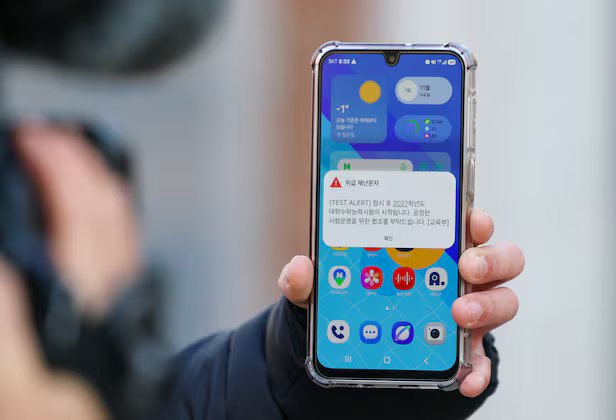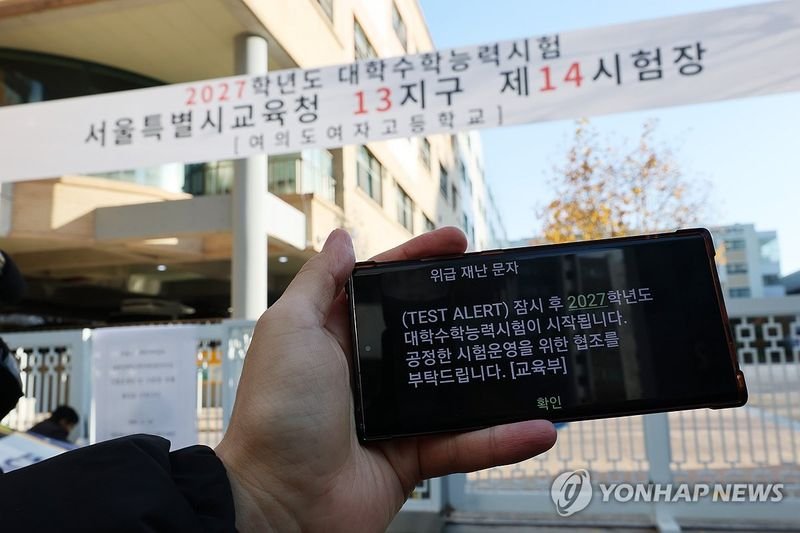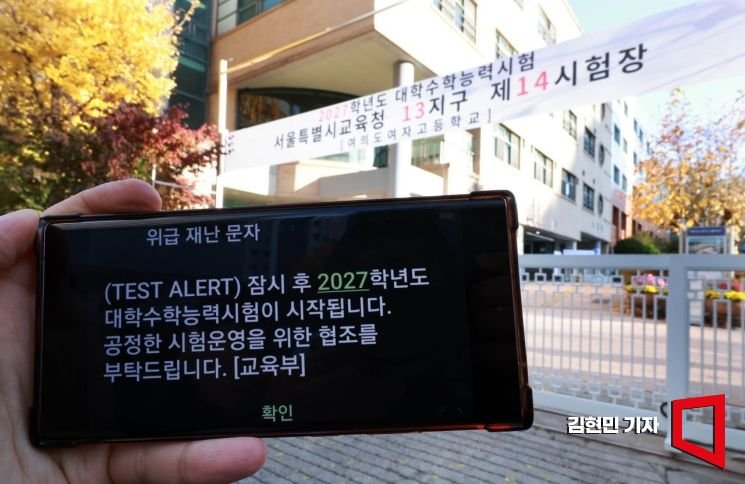
Alerts sent at 8:30 a.m., 2:21 p.m. and 2:57 p.m.
First alert detects 22 smartphones across nine cities and provinces
Emergency disaster alerts were sent nationwide three times on Nov. 19, the day the 2027 College Scholastic Ability Test (CSAT) was held, to detect cheating. As education authorities sent the alerts on the day of the CSAT to prevent cheating using advanced devices such as AI, the first alert led to 22 examinees who had not turned in their smartphones being caught.
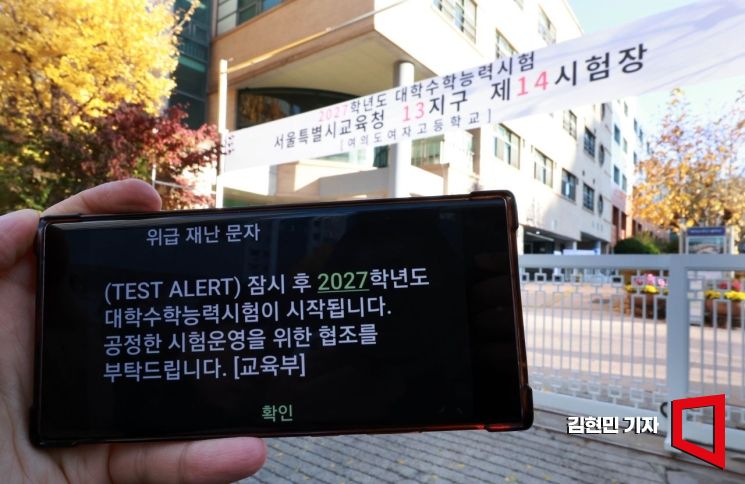
At 8:30 a.m. on Nov. 19, the day of the 2027 College Scholastic Ability Test, emergency alerts were sent simultaneously across the country. The alerts were intended to prevent cheating on the exam, and this was the first time emergency alerts had been sent on a test day. The photo shows an emergency alert received in front of Yeouido Girls’ High School in Seoul, where a test site was set up. Nov. 19, 2026. Photo by Kim Hyunmin.
View original image
According to the Ministry of Education and the Ministry of the Interior and Safety, the first emergency disaster alert was sent nationwide at 8:30 a.m. on Nov. 19. It was sent 10 minutes before the start of the Korean section of the first CSAT session. The measure was intended to identify examinees who had not turned in their mobile phones, and the alert tone sounded for 10.5 seconds.
The Ministry of Education said the first emergency disaster alert led to the detection of 22 smartphones across nine cities and provinces. However, as of Nov. 19, no cases of examinees among the 22 caught cheating using advanced devices other than smartphones had been reported. Nor had any cases been confirmed in which the start of an exam was delayed during the process of detecting smartphones.
The second emergency disaster alert was sent at 2:21 p.m., immediately after the English section of the third session ended, while test papers and answer sheets were being collected. The Ministry of Education said, “2:21 p.m. is a time that does not interfere with examinees’ tests,” adding, “The alert is being sent to ensure the fair administration of the CSAT, so we ask the public to cooperate despite any inconvenience.”
The Ministry of Education then announced via a safety guidance text message at 2:45 p.m. that an additional emergency disaster alert would be sent at 2:57 p.m. The third alert was scheduled for the time slot during which the Korean history exam in the fourth session was taking place.
Meanwhile, on Nov. 19, a number of people claimed that they had not received the emergency disaster alert.
In response, the Ministry of the Interior and Safety explained that although emergency disaster alerts generally cannot be blocked, there may be exceptional cases in which they are not received.
Hot Picks Today

“Two Spend 500,000 Won in a Flash, Yet Wait Two Hours?” … ‘Dreamland’ Shunned by Kids and Foreign Tourists
The ministry said, “Mobile phones released in compliance with international and domestic standards receive emergency disaster alerts without exception.” However, alerts may not be received in the following cases: when an older 3G phone is being used; when a mobile phone has been illegally modified; when the phone signal is weak, such as when the recipient is in a signal dead zone; or when the phone is not functioning properly, such as when an error or conflict occurs in its internal software during an update or the installation or deletion of an app.
This content was produced with the assistance of AI translation services.
© The Asia Business Daily. All rights reserved. Unauthorized AI training and use prohibited.