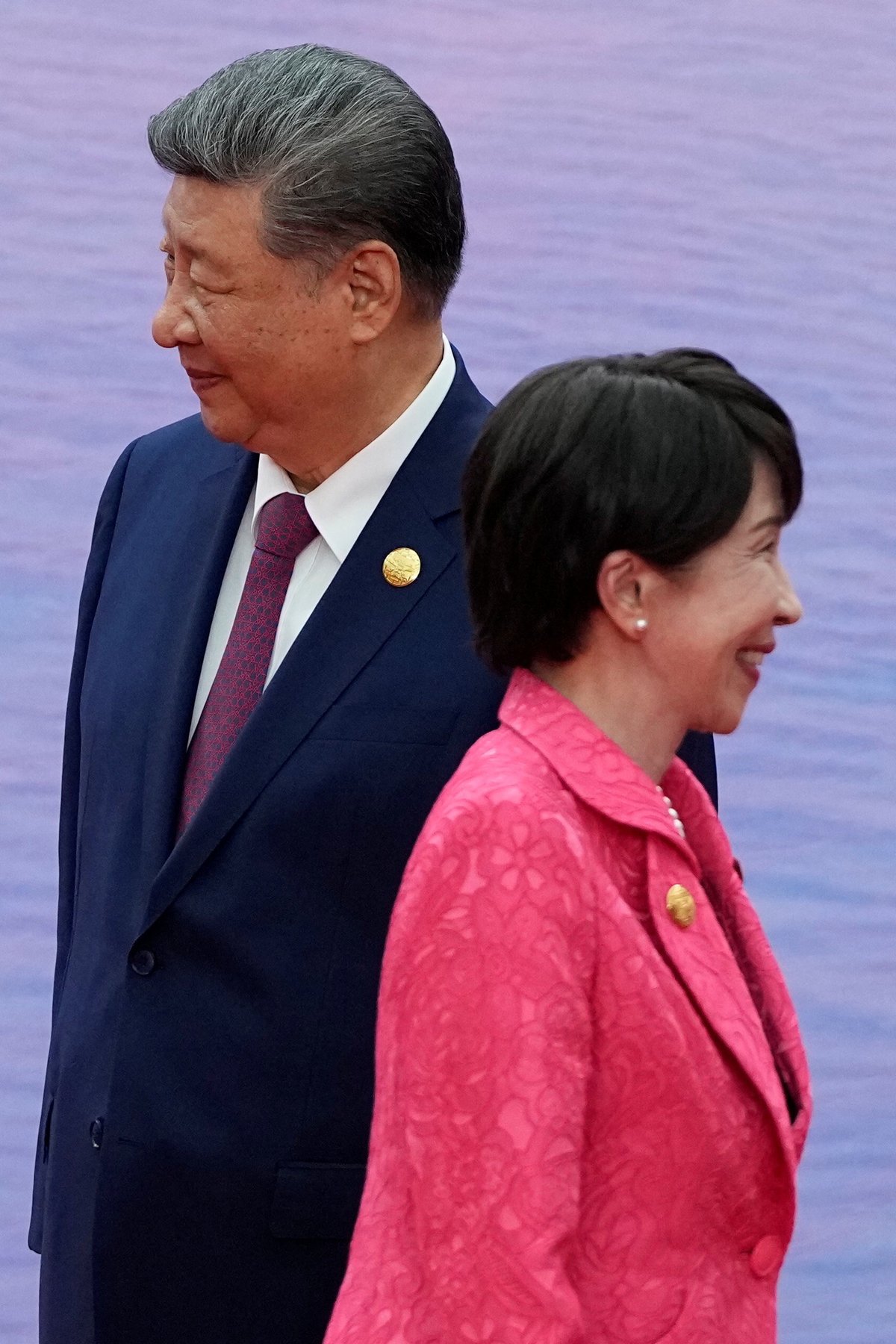


Japanese Prime Minister Sanae Takaichi received a pared-down welcome compared with other leaders when she arrived in Shenzhen, China, for the Asia-Pacific Economic Cooperation summit. Analysts said the treatment laid bare Beijing’s displeasure following her remarks on a possible Taiwan contingency.
Takaichi landed at Shenzhen airport on the 18th to attend the APEC leaders’ meeting, according to Hong Kong’s South China Morning Post and Japan’s Asahi Shimbun on the 19th.
The crowd on hand to greet her, however, consisted of only a small honor guard and a handful of officials. Comparing the receptions China arranged for Takaichi and for South Korean President Lee Jae-myung, the SCMP said the scene “stood in stark contrast to the warm welcome extended to President Lee.” When Lee and his wife arrived at the airport, young people waved red flowers, danced and shouted words of welcome.
The absence of a senior leadership figure among those meeting Takaichi also drew attention. Zhang Qiyue, who greeted her, is a veteran female diplomat who served as a Chinese Foreign Ministry spokesperson for seven years from 1998 and retired after a final posting as ambassador to Greece in 2021. She has ties to Japan: her father, Zhang Shu, served as China’s ambassador to Tokyo. Zhang is serving as China’s protocol ambassador for the APEC meeting, according to Kyodo News. Kenji Kanasugi, Japan’s ambassador to China, also accompanied her.
Lee, by contrast, was met at the airport by Lin Keqing, chairman of the Guangdong provincial committee of the Chinese People’s Political Consultative Conference and a key figure in the leadership of the province hosting APEC, along with Zhang and Dai Bing, China’s ambassador to South Korea. U.S. President Donald Trump was welcomed in person by Chinese President Xi Jinping, while Russian President Vladimir Putin received the second-highest level of protocol, greeted by Cai Qi, the Communist Party’s fifth-ranked official and a member of the Politburo Standing Committee who serves as director of the party’s General Office.

Takaichi attended the APEC leaders’ dinner and shook hands with Xi. But while she smiled and exchanged a few words after the handshake, Xi kept smiling without speaking, according to the SCMP, which added that Xi’s wife, Peng Liyuan, also said nothing after greeting Takaichi. Takaichi and Xi shook hands again on the 19th, the second day of the gathering.

The arrangement for the customary group photo also drew attention. Xi and his wife stood front and center, flanked by Trump and Putin, with Lee and Vietnamese President To Lam beside them in a display of closeness. Takaichi, by contrast, was positioned in a back row away from Xi, giving her a diminished presence.
Analysts said China’s response starkly illustrated how sharply relations between the two countries have cooled since Takaichi suggested last year that Japan could intervene in a Taiwan contingency. Beijing takes the view that it is up to Tokyo to work toward normalizing ties. Citing a Chinese source, Kyodo reported that Japan is the only major participant at the APEC leaders’ meeting that will not hold a separate meeting with Xi.
Japanese opinion ran hot. A Foreign Ministry official told the Mainichi Shimbun that China had failed to observe even the minimum courtesies of diplomacy, calling the treatment extremely rude. Hiroshi Yamada, a Liberal Democratic Party member of the upper house, wrote on X, formerly Twitter, that Takaichi had no need to pay any attention to China’s blatant snub, adding that sensible global citizens would applaud her for standing firm against a Chinese government that is throwing its weight around.
Russia and Japan Meet After Seven Years, With Mixed Signals
Takaichi spoke with Putin for 30 minutes on the 18th, Japanese media reported. It was the first face-to-face conversation between Japanese and Russian leaders since former Prime Minister Shinzo Abe met Putin in September 2019, seven years ago.
Friction has persisted in recent Russia-Japan relations. Tensions that grew after Russia’s 2022 invasion of Ukraine surfaced this year when a Japanese journalist was detained in Russia on espionage charges and the assets of Japan Tobacco were placed under the management of a Russian company.
In the 30-minute conversation, Takaichi conveyed Japan’s position on pending issues including the detention of the Japanese journalist and the state management of Japan Tobacco’s business, according to Kyodo News. By contrast, Kremlin spokesman Dmitry Peskov, asked whether Putin and Takaichi would hold talks, said there were no such plans, Russia’s Tass news agency reported, underscoring the continuing gap between the two sides.
With ties to both China and Russia chilled, Japan is also on alert over the U.S.-China-Russia talks set for the 19th. Tokyo has focused its diplomacy on Washington, but is watching for the possibility of being sidelined as the United States pursues improved relations with Beijing and Moscow. The Nihon Keizai Shimbun reported that Takaichi has arranged to hold a telephone call with Trump after the three-way summit, a move seen as an attempt amid that unease to demonstrate the strength of the U.S.-Japan alliance.

