By the end of the ’90s, video games had largely moved away from arcade settings and into the home. By then, there were a greater variety of games to play on consoles or computers than in arcades. Case in point, there were many more gamers playing Doom on PC or Super Mario 64 on the N64.
That being said, the ’90s still saw some of the greatest arcade games ever made. From legendary cooperative beat ’em up romps like Teenage Mutant Ninja Turtles: Turtles in Time to iconic competitive fighting classics like Marvel vs. Capcom: Clash of Super Heroes, arcade gaming had its last big hurrah in the decade.
Street Fighter II Put the Franchise on the Map

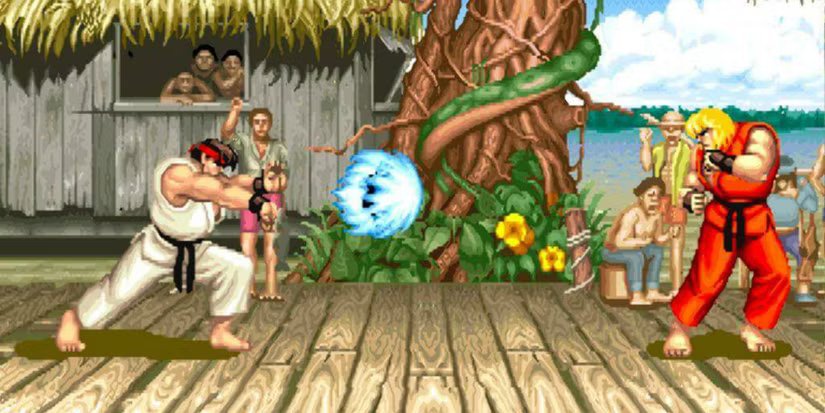
The first Street Fighter game was a revolutionary, if somewhat quaint, fighting romp that nevertheless couldn’t hold a candle to its widely acclaimed successor, Street Fighter II: The World Warrior. As the name suggests, Street Fighter II has players taking on other fighters from around the world. These include Japanese fighter Ryu and American fighter Ken.
Street Fighter II made a big splash in arcades and is still held in high regard today, helped by the release of the game’s many variants. It never gets old making the most of the fighters and their special abilities, especially when attacks land with perfect precision.

Marvel vs. Capcom: Clash of Super Heroes is a highly unorthodox arcade fighting game. It takes some of Marvel’s greatest characters, including Spider-Man and the Incredible Hulk, and mingles them with Capcom’s legendary characters. All put together, players get a game that pits characters from entirely different companies and franchises against each other.
As it turns out, this works to Marvel vs. Capcom: Clash of Super Heroes’ benefit. For one, it takes the classic “who would win a fight?” scenario and applies it to the question of which Marvel or Capcom character would reign supreme. It’s a truly fascinating thought that’s enough to get players to huddle around the arcade cabinet.
Crazy Taxi Is the Wildest Race Against the Clock

Crazy Taxi truly lives up to its name. It’s an arcade racing game where players don’t race other drivers; they race the clock. The gist of it is, within a time limit, players must transport up to three passengers to their destinations. The goal is to collect as high of a cab fare as possible.
There is no better word to describe Crazy Taxi than breakneck. Given its nature as an arcade racer, it can get pretty hard to make precise maneuvers across the San Francisco-like city the game is set in. Nevertheless, Crazy Taxi is still fun regardless of whether players know how to handle it.
Teenage Mutant Ninja Turtles: Turtles in Time Is the Turtles’ Greatest Arcade Adventure

Teenage Mutant Ninja Turtles: Turtles in Time — released for the SNES as Teenage Mutant Ninja Turtles IV: Turtles in Time — is by far the titular turtles’ greatest arcade adventure. The turtles, who have been sent into a time warp by Shredder, must put a stop to their perennial adversary’s dastardly plans.
The game has up to four players taking on Shredder’s goons in different periods of time. The game is playable as a single-player romp, but the most fun players will have is with its multiplayer mode. As with most arcade beat ’em-ups, Turtles in Time is especially fun with multiple players, and they’ll need all the help they can get.
The House of the Dead 2 Is the Greatest Light Gun Shooter Ever Made

The House of the Dead 2 is the direct follow-up to the previous House of the Dead game. The latter’s protagonist, Agent G, is killed while fending off a zombie infestation in Venice, Italy. It is up to his fellow agents, James and Gary, to take on the zombies and other eldritch monstrosities, all of whom were unleashed by the nefarious business executive Caleb Goldman.
The House of the Dead 2 is, by far, the greatest light gun shooter ever made. At home, it’s more than playable with a Dreamcast controller, but it’s no substitute for the light guns. Especially if one were to play it alone or with a friend in the arcades, The House of the Dead 2 makes for an exciting action romp.
Dance Dance Revolution Changed Musical Games Forever

Think of any modern music-oriented video game such as Just Dance or especially something like Guitar Hero. These two game franchises can trace their roots to Dance Dance Revolution, which changed the face of musical games forever.
For the uninitiated, Dance Dance Revolution has players choose from a selection of hit dance singles. They must then step on arrows on the dance pad that correspond to the on-screen prompts. It may sound daunting, but not only is Dance Dance Revolution easy to get into, but it also will give players a good workout as well.
The Simpsons Is the Family’s Greatest Gaming Adventure

The Simpsons: Hit & Run is one of the best video games based on the Simpsons franchise. However, it is nothing compared to the GOAT of all Simpsons video games: the 1991 Konami arcade beat ’em up hit. The premise is that little Maggie Simpson has been kidnapped by Mr. Burns and Mr. Smithers, and it is up to the rest of the Simpson family — Homer, Marge, Lisa, and Bart — to rescue her.
As expected out of a Simpsons game, the arcade romp takes wild turns, with all sorts of zany enemies to fight against. They include zombies, devils, and firefighters. The settings of each level, combined with the quirky bonus stages, help elevate Konami’s Simpsons like nothing seen before.
Daytona USA Has High-Octane Thrills

The ’90s saw a slew of arcade racing titles, including Cruis’n USA and Crazy Taxi. However, none are as technically intricate and thrilling to play as Daytona USA. The game has players racing state-of-the-art vehicles against others. Naturally, the goal for players is to outrace others, up to achieving pole position.
Daytona USA is about as high-octane as a arcade racer can get. It’s crucial, and satisfying, for players to earn time extensions in order to continue racing as long as possible. Being able to figure out how to properly drift along the racetrack only adds to the fun.
Killer Instinct Has Style and Substance

In the lead up to the release of the N64, then known as the Nintendo Ultra 64, Nintendo collaborated with Midway to release arcade games that supposedly used the console’s advanced hardware. Among these games is Killer Instinct, which sees ordinary people compete against superbeings in the titular tournament.
Killer Instinct may have a lot of flash, especially with its still-impressive fully-rendered 3D models, but it has plenty of substance to go along with it. This is mainly with the game’s combo system, wherein defensive players who block a domineering fighter’s combos end up scoring combo breakers. In all, Killer Instinct is as nice to look at as it is satisfying to play.
Mortal Kombat II Is as Delightfully Violent Now as It Was Back Then

The first Mortal Kombat game helped to revolutionize fighting games, and Mortal Kombat II cemented the franchise’s pillar in the genre. On top of the likes of Johnny Cage and Sub-Zero, the game also introduced characters like Jax and Kitana. All of Mortal Kombat’s characters are known for their fatality moves, which are fun to make use of.
Indeed, Mortal Kombat II is a lot more fun than the first game. From the ability to trigger the iconic “Toasty!” quote by doing uppercuts to the ability to trigger joke finishers like “Friendships” and “Babalities,” Mortal Kombat II is as delightfully quirky and violent now as it was back then.