Like Wallpaper*, Paris’ MEP (Maison Européenne de la Photographie) is celebrating its 30th anniversary this year, with ‘Penn & Fashion’, a standout tribute to Irving Penn that retraces his mastery of fashion photography from 1947 to 2008.
Penn is one of MEP’s foundational figures. It began acquiring one hundred of his prints in the early 1990s, with an additional 198 donated in 2023 by the photographer’s son Tom Penn. Irving Penn visited the site of the museum in 1993, while it was under construction. The gallery bearing his name was inaugurated at its opening in 1996.

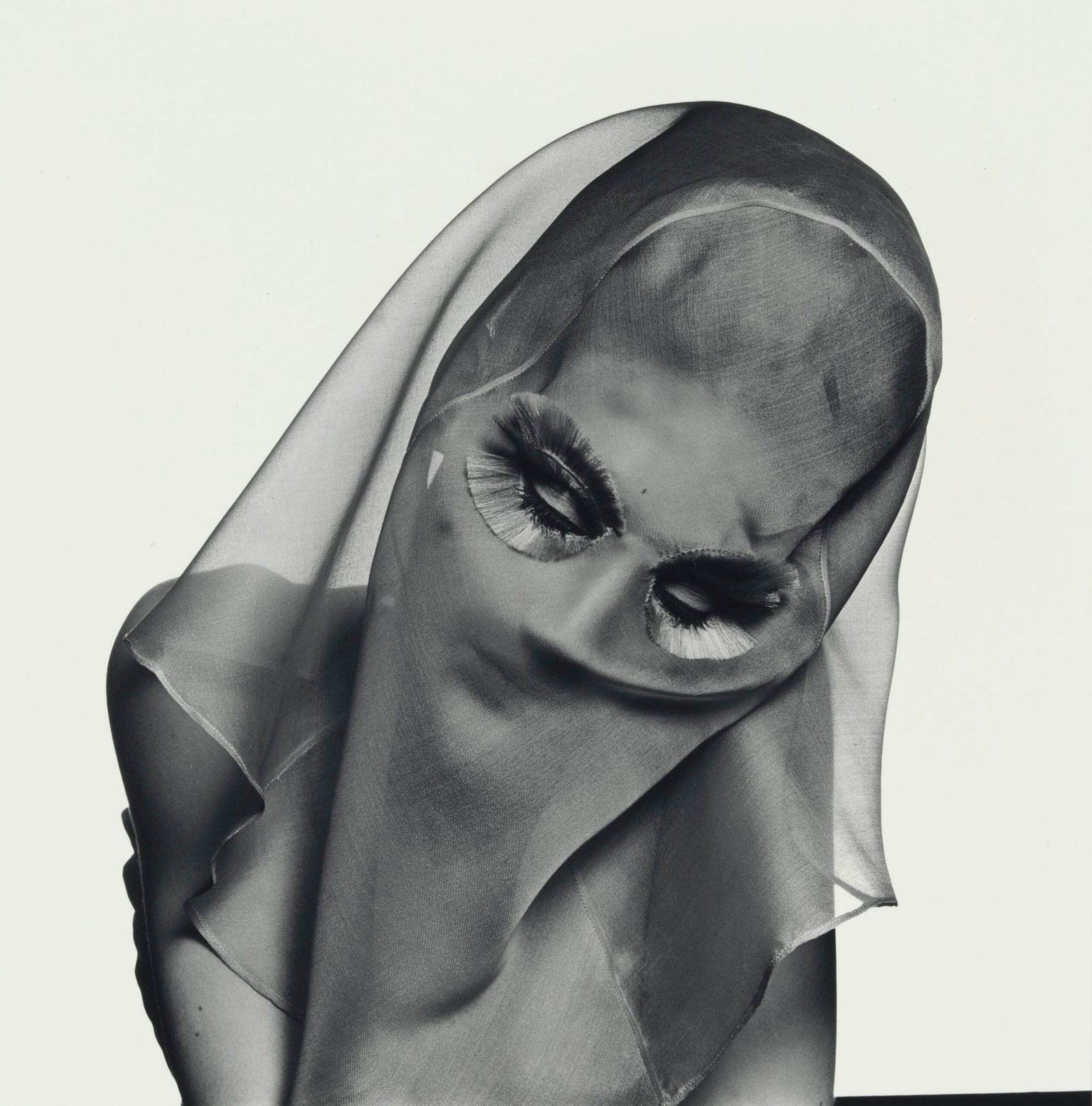
Irving Penn, Woman with Heavy Veil, New York, 1966. Collection The Irving Penn Foundation, New York
(Image credit: © The Irving Penn Foundation)
‘Penn & Fashion’ (showing until 17 January 2027) is comprised of works from MEP’s permanent collection, and exceptional loans from the Irving Penn Foundation, the Nicola Erni Collection, and the Miyake Issey Foundation.
Penn (1917-2009) transformed fashion photography with his Vogue magazine collaboration spanning almost seven decades, the longest in the magazine’s history.
Born in 1917 in Plainfield, New Jersey to Russian-Jewish immigrant parents, Penn studied at the Pennsylvania Museum School of Industrial Arts. He studied graphic design under Alexey Brodovitch and became his assistant at Harper’s Bazaar.
In 1943, he was hired by Vogue’s art director, Alexander Liberman, to develop cover concepts for the magazine’s photographers. Impressed by the clarity of his vision and ‘a mind, and an eye that knew what it wanted to see’, Liberman urged Penn to take the photographs himself.

Irving Penn, 12 Models Moving Their Heads, New York, 1947. Nicola Erni Collection, Zug
(Image credit: © The Irving Penn Foundation)
The exhibition unfolds chronologically. By the late 1940s, Penn had become Vogue’s preeminent photographer. He helped define the relaunch of haute couture with the revolution announced by Christian Dior’s ‘New Look’. He worked with the era’s most famous models – Jean Patchett, Dovima, Dorian Leigh, Suzy Parker, and Lisa Fonssagrives, the world’s first supermodel.
In 1948, Liberman sent Penn on his first outdoor fashion shoot on location, in Lima, Peru. ‘Flying Down to Lima’, featuring Jean Patchett as a tourist discovering the city, appeared in the February 1949 edition of Vogue. It was a huge success.
After the shoot, instead of returning directly to New York, Penn headed south-east to Cuzco, the former Inca capital, where he rented a studio lit by natural light from a local photographer, and shot portraits of the Quechua people in their traditional dress. He used a theatre curtain as a neutral backdrop, and shot 2,000 portraits of the Quechua, who lined up outside the studio for three days.

Irving Penn, Ballet Society, New York, 1948 (Corrado Cagli, Vittorio Rieti, Tanaquil Le Clercq and George Balanchine). Collection MEP, Paris
(Image credit: © Condé Nast)
It proved a decisive moment in Penn’s career. It confirmed his preference for the controlled environment of the studio over the distractions and unpredictability of outdoor shoots. The neutral backdrop distilled the image to its essentials. Each image was composed after a deep preliminary reflection, where he could focus on his subject, resulting in timeless compositions.
Penn first met Swedish artist, dancer and model Lisa Fonssagrives in 1947, during a Vogue group portrait of the 12 most photographed models in the United States. She became Penn’s ultimate muse, the subject of his greatest photographs. His portrait of Fonssagrives in a harlequin dress for Vogue’s ‘The Black and White Idea’ issue in April 1950 encapsulates his mastery of composition and contrast.
They married the same year, their son, Tom, was born in 1952. ‘That image of my mother in the harlequin dress was very rewarding. He was so in love with her, it came through so beautifully in that particular image,’ said Tom Penn.

Irving Penn, Harlequin Dress (Lisa Fonssagrives-Penn), New York, 1950. Collection The Irving Penn Foundation, New York
(Image credit: © Condé Nast)
The 1960s was a time of major change in fashion. Diana Vreeland became Vogue’s editor-in-chief in 1963, ready-to-wear replaced couture, and a new generation of photographers joined the magazine. Penn remained imperturbably faithful to his method of working. He photographed Birgitta af Klercker in a swimsuit, Marisa Berenson in Emanuel Ungaro’s metal wedding dress, André Courrèges’ futuristic designs, with a new generation of models that included Verushka, Lauren Hutton and Naomi Sims.
Practically, Penn had a great deal of leeway in selecting the designers and models featured in Vogue. In the 1970s, he shot Ungaro and Courrèges, in the 1980s, Yves Saint Laurent and Karl Lagerfeld for Chanel.
He shot the magazine’s beauty pages in colour, wittily surreal images that sometimes verged on the grotesque. Liberman called them ‘stoppers’: images so arresting that they stopped the reader from turning the page.
During the last three decades of his career, secure in his stature at Vogue, Penn became increasingly selective in the designers he chose to photograph. At the age of 90, he photographed John Galliano for Christian Dior, Karl Lagerfeld for Chanel, and Christian Lacroix, capturing their extravagantly theatrical haute couture in breathtaking images.

Irving Penn, Issey Miyake Fashion: Face Covered with Hair, New York, 1991. Collection The Irving Penn Foundation, New York
(Image credit: © The Irving Penn Foundation)
He consistently applied his emphasis on the silhouette, volume and texture.
His collaboration with Japanese designer Issey Miyake was unusual. Penn never attended Miyake’s runway shows, Miyake never attended Penn’s shoots. Miyake would send his creations to New York and then receive the transparencies in Tokyo. Miyake’s sculptural garments perfectly complemented Penn’s minimalist style. It worked for them both. ‘Penn’s photographs allow me to see my own designs,’ Miyake remarked.
‘My father was the living example of dignity in the pursuit of one’s work, to find the path of something that one wanted to do in life, and to do it as the best one could. He had a way of noticing details others overlooked,’ said Tom Penn. ‘I try to honour that in the way we care for his work and how we carry it forward, not by holding it still, but by letting it live.’
Penn & Fashion at MEP, Paris, until 17 January 2027