
Image Source: Getty Images
This article is part of the series, “Red Carpet, Red Lines: Xi–Trump and China’s Near-Peer Moment“
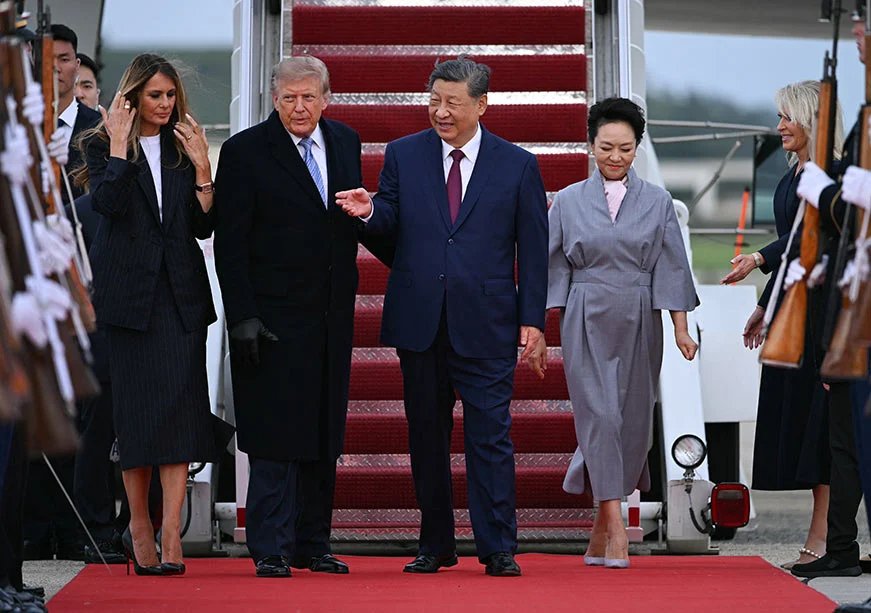
From 23 to 25 September 2026, Chinese President Xi Jinping was in the United States for his second state visit in 11 years, during which President Donald Trump accorded him great ceremonial importance. Trump received Xi and his wife, Peng Liyuan, on the tarmac at Joint Base Andrews, where two B-1B bombers conducted a flypast; the next day, a B-2 Spirit, accompanied by four F-22 Raptors, flew over the White House. Melania Trump hosted Peng while Xi and Trump held talks at the White House that covered trade, technology and artificial intelligence, Taiwan, and the broader strategic competition between the two powers. The summit was notable for its spectacle, yet it also revealed a relationship caught between deepening rivalry and growing interdependence. Washington and Beijing appear willing to engage directly, especially through leader-level diplomacy, to manage their differences, preserve strategic stability, and avert confrontation while buying time to strengthen their respective leverage.
The Rivalry and Washington’s Reckoning
The US-China relationship has undergone a fundamental transformation. Decades of economic engagement and interdependence that marked the post-Cold War era gave way to strategic competition during the first Trump administration, and this competition became systemic and institutional under Joe Biden. In his second term, Trump has sought to weaponise economic interdependence, imposing high tariffs and demanding greater Chinese investment, while using access to America’s large market as leverage to extract concessions from Beijing.
In response, Beijing, which had prepared for this contingency, restricted trade in rare earths and critical minerals, reduced magnet supplies, shifted its soybean purchases from the US to Brazil, and adopted broad-based economic restrictions. At the peak of the confrontation in April 2025, the US and China had imposed tariffs of 145 percent and 125 percent, respectively, on each other’s goods.
The trade war, however, exposed multiple realities that Washington grudgingly acknowledged. First, Trump realised that America’s dependence on Chinese supply chains was deep and that Beijing’s restrictions could be debilitating for the US, particularly its markets and high-tech industries. Despite years of decoupling and de-risking efforts, building alternative supply chains would require considerable time and investment. Second, Washington observed, and later acknowledged in its 2025 National Security Strategy, that China was no longer simply an economic competitor but a near-peer, capable of retaliating, weaponising economic dependencies, and imposing high costs on its adversaries.
Finally, the tariff war’s peak in April exposed the limits of escalation as a means of leverage, prompting Trump to shift towards managed competition. The May 2025 Geneva meeting and subsequent negotiations led to the October Busan summit, where Xi and Trump agreed to a one-year trade truce. Trump’s May 2026 Beijing visit further institutionalised economic engagement, while the September summit continued negotiations on AI, Taiwan, technology, narcotics, and global security, with concrete outcomes yet to emerge.
The Chinese Evaluation
The eight-point agreement released after the Xi-Trump summit last week affirmed that both sides would build a “constructive China-U.S. relationship of strategic stability on the basis of respect, fairness, and reciprocity.” This strategic stability requires respect for each other’s sovereignty, territorial integrity, political systems, development paths, and core interests. Fairness demands pursuing mutually beneficial cooperation, resolving differences through consultation, and rejecting zero-sum approaches or unilateral advantage. Reciprocity calls for sovereign equality, rejects hegemonic or bullying practices, addresses concerns on an equal footing, and maintains balanced cooperation.
This formulation is significant because it reflects China’s view that Washington has, albeit grudgingly, come to recognise Beijing as a near-peer. Xi reinforced this point during his visit by frequently calling for a new type of major-power relationship that would overcome the Thucydides Trap, the danger that rivalry between an established and a rising power will lead to conflict.
Some Chinese commentators argue that if China purchases more US agricultural and energy products, and even Boeing aircraft, these purchases could give Trump an economic win to take to voters, helping the Republican Party in the midterm elections and, in turn, strengthening his presidency.
Moreover, China has an interest in easing tensions with Washington because the US remains important to its economic growth. After the two recent summits, a strand of Chinese thinking has focused on Trump’s predicament on several fronts, including Ukraine, Iran, and Korea, and on how Beijing might benefit from it. Some Chinese commentators argue that if China purchases more US agricultural and energy products, and even Boeing aircraft, these purchases could give Trump an economic win to take to voters, helping the Republican Party in the midterm elections and, in turn, strengthening his presidency.
Beijing is also looking beyond the midterms. A Republican defeat could give Democrats greater leverage to press Trump to resume arms sales to Taiwan, which he has held back for some time, partly under Chinese pressure. However, Taiwan has already approved a US$25 billion budget for buying US arms, and Congress appears keen to see more sold. Against this backdrop, Trump appears to Beijing as the more manageable option in Washington on Taiwan, even if the underlying dispute remains unresolved.
Xi appears determined to change how Washington assesses China, signalling that where intent is friendly, large deals, cooperation, and investment pose no difficulty, and competition for interests remains acceptable. Yet Xi conceives of a major-power relationship as one between two states, whereas Trump frames the G2 in terms of his personal rapport with Xi. This difference may shape how the two leaders engage in future.
Xi’s US visit was striking for what it lacked: no business delegation and no military officials accompanied him. Even as senior economic teams negotiated, Xi kept his attention on Trump, turning the trip into an exercise in strategic persuasion. Every time he spoke, his message was consistent: Washington and Beijing must find a new path for coexistence as two major powers. Diplomats can discuss disputes and trade representatives can negotiate commerce, but only leaders can shape the politico-strategic intent that drives the relationship. Xi appears determined to change how Washington assesses China, signalling that where intent is friendly, large deals, cooperation, and investment pose no difficulty, and competition for interests remains acceptable. Yet Xi conceives of a major-power relationship as one between two states, whereas Trump frames the G2 in terms of his personal rapport with Xi. This difference may shape how the two leaders engage in future.
Red lines vs Red Carpet
Although both states appear to be making small gains through frequent high-level meetings and summits, the battle lines in the economic domain have already been drawn. The US has banned Chinese robots and drones from its market, accused China of distilling from its AI models, and kept the Lindsey Graham Act, with its potential 100 percent tariff, hanging over Beijing. China, for its part, has maintained its control over rare earths, fulfilled only two-thirds of its commitments from Busan, and criminalised the unauthorised movement of key high-tech personnel and manufacturing capabilities out of China, while continuing to detain US citizens and support Iran.
On outcomes, Beijing had wanted to extend the trade truce until the end of 2028, but the US agreed to extend it only until January 2027. Washington is therefore adopting a watch-and-wait approach, keeping its options open as the midterm elections approach. Even on AI, the two sides agreed to establish a dialogue and incident communication mechanism but made no move to ease the strategic competition. The arrangement is closer to AI risk management than to arms control.
The direct engagement between Xi and Trump emerged as the crucial outcome, preserving the broader trade truce and focusing on managing competition rather than spiralling into open economic confrontation.
The summit also produced a series of narrower economic gains: favourable tariffs on roughly US$30 billion of non-sensitive goods in each direction, greater agricultural cooperation, expanded Chinese purchases of US energy, and continued cooperation on fentanyl. However, these were sideshows. The direct engagement between Xi and Trump emerged as the crucial outcome, preserving the broader trade truce and focusing on managing competition rather than spiralling into open economic confrontation.
Conclusion
Beijing’s pursuit of multiple options simultaneously suggests that it places considerable weight on Trump’s personal role in managing the US-China relationship, even as the underlying rivalry remains structural and extends beyond any single president. The possibility that a future US administration could again intensify competition makes this approach a form of risk management for Beijing. Xi’s unusually sustained engagement with Trump is therefore significant, since the two leaders have already held two summit-level meetings in 2026, with two more confirmed before the year ends.
For India, the episode offers an important lesson in great-power diplomacy: even amid deep uncertainty, economic friction, and strategic rivalry, sustained top-level engagement can moderate tensions and help put relations back on track.
Xi is also approaching the 2027 Party Congress, where he is expected to shape China’s political and military leadership after several years of sweeping purges and personnel reshuffles. Even so, Xi’s willingness to invest so heavily in leader-level diplomacy with Trump suggests that he is doing more than simply buying time or consolidating leverage. He may be seeking to reshape the strategic framework of US-China relations, and choosing to begin that effort with Trump. For India, the episode offers an important lesson in great-power diplomacy: even amid deep uncertainty, economic friction, and strategic rivalry, sustained top-level engagement can moderate tensions and help put relations back on track. As a developing economy, India must remain focused on its core national interests, avoid being drawn into great-power contests, and preserve the diplomatic space needed to advance its own priorities.
Atul Kumar is a Fellow – National Security and China Studies with the Strategic Studies Programme at the Observer Research Foundation.
The views expressed above belong to the author(s). ORF research and analyses now available on Telegram! Click here to access our curated content — blogs, longforms and interviews.