“Some people will decide, ‘I can support my family working three days a week.’ That’s what productivity in the economy means,” Bezos said in an interview with Fox News aired on Oct. 7.
He also predicted that AI could make it possible for more families to live on a single income, allowing one partner to stop working if they choose. “You’re not going to need to have a two-earner household. If you want it, fine. If you don’t want to have it, one of the people might drop out,” Fortune quoted him as saying.
He argued that these changes could eventually lead to labor shortages rather than the widespread job losses that some experts fear AI will cause. “It’s going to be difficult to hire people, because the productivity in the economy will make it so that [if] people don’t want to work two jobs, they won’t have to.”
 |
|
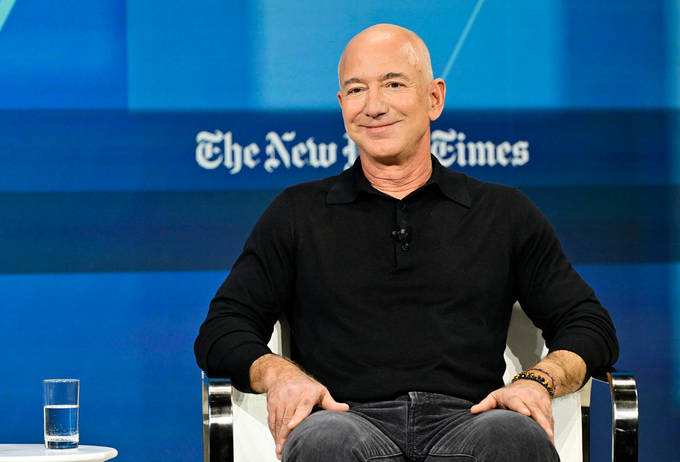
Jeff Bezos at the New York Times Dealbook Summit in December 2024, in New York, U.S. Photo by AFP |
His outlook contrasts with concerns that AI could replace millions of workers as companies increasingly automate tasks. Bezos acknowledged those concerns but disagreed that widespread unemployment was inevitable.
At Prometheus, an AI startup where he serves as co-founder and co-CEO, Bezos said the goal is to develop an “artificial general engineer” that could help people turn ideas into physical products.
“We’re going to make the tools so easy to use that anyone will be able to be an engineer.”
His optimism comes as Amazon, the company he founded, has cut about 30,000 corporate jobs over the past year. Asked about the layoffs, Bezos attributed them to the company’s rapid hiring and expansion following the Covid-19 pandemic. Meanwhile, Amazon plans to spend more than US$200 billion on capital investments this year, largely to expand data centers supporting AI and other computing services.
Bezos had an estimated net worth of $380.8 billion as of Oct. 12, according to Forbes, making him the world’s second-richest person behind Tesla CEO Elon Musk.
Several other business leaders have also predicted that AI could shorten the traditional five-day workweek.
Nvidia CEO Jensen Huang has suggested a four-day workweek could become possible, while JPMorgan Chase CEO Jamie Dimon has predicted that employees might eventually work just three and a half days a week. Microsoft co-founder Bill Gates has raised the possibility of a two-day workweek as AI takes over more tasks.
Musk, whose fortune surpassed $1 trillion again last week, has gone further, predicting that advances in AI and robotics could eventually make paid employment “optional.”