My mother paced the patio, working through that week’s crisis aloud. An office mate, she was certain, was a CIA operative sent to spy on her.
I paced back and forth with her, hoping to shift her attention by describing what happened in my third-grade class. When none of my attempts landed, I went to our mailbox to retrieve the monthly issue of Reader’s Digest. At age eight, I was in love with the English language. I tore open the magazine to a feature called ‘It Pays to Increase Your Word Power’, a list of 10 little-used words. The third item stunned me – ‘sesquipedalianism’. I laughed when I read the definition: using a big word when a small one would do.
Before I realised it, my mother was looming behind me, ever-present cigarette dangling from her mouth. Peering at the long, odd, winding word, she nodded with satisfaction.
‘Al Pacino would understand that word,’ she said. ‘We should write a letter to Al Pacino. He will be able to put a stop to this. And be sure to use that seis-qui-whatever word.’
‘You think Al Pacino would know sesquipedalianism?’
‘Without a doubt! He’s an artist. If we use it in the letter, he’ll know how serious we are.’
‘I’ll get my notebook.’
I ran to my room. It was always a big moment when my mother came out of her walking fits. The next few minutes were critical in how the rest of her day went. I grabbed a handful of the #2 pencils I always kept sharpened and at the ready.
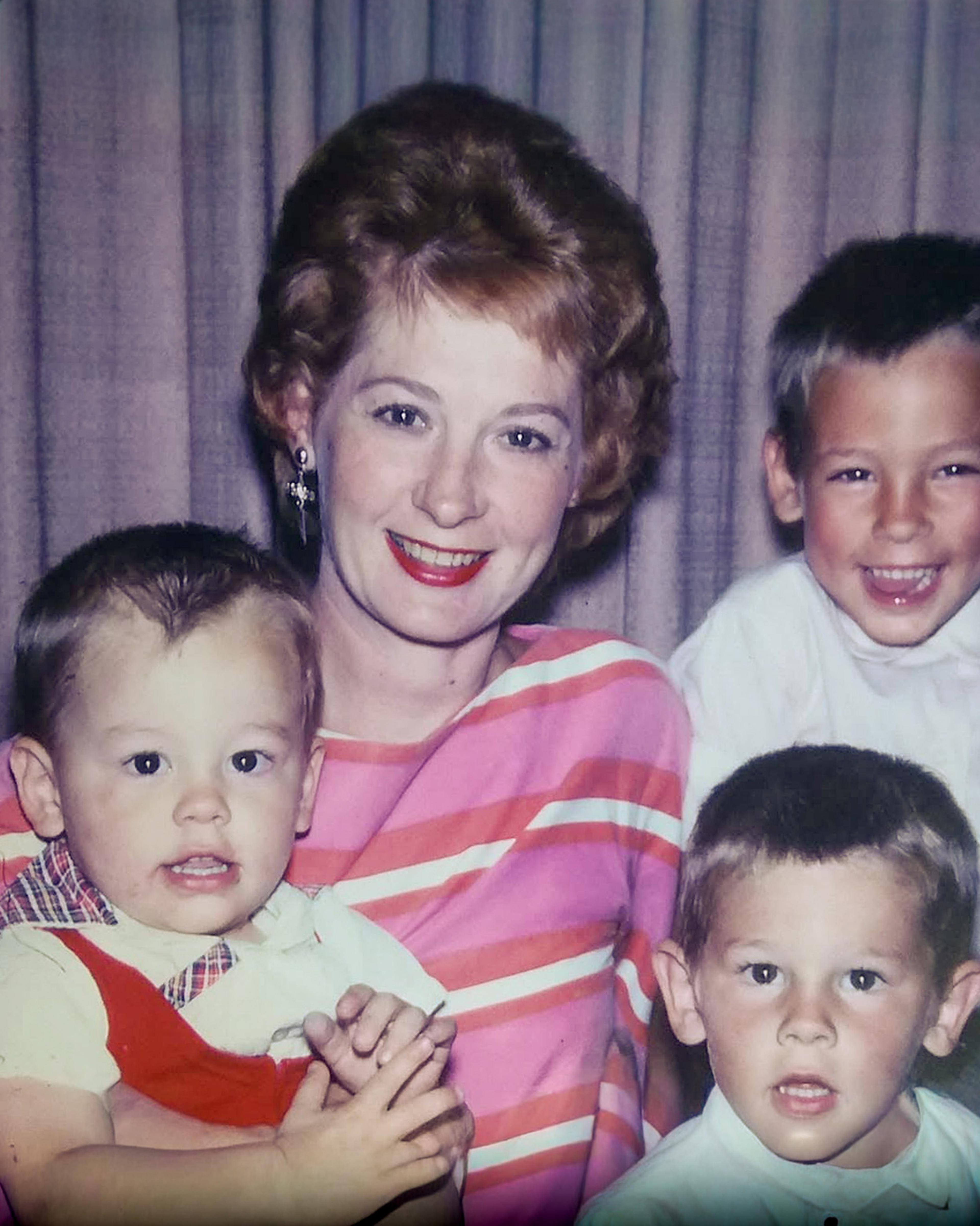
The author (top right) pictured alongside his mother and brothers. Photo supplied by the author
Initially, my mother simply had me proofread the letters she sent to celebrities asking them to intervene in the vast and ever-expanding conspiracy that was orchestrated against her. We wrote to Neil Armstrong, Walter Cronkite, Sean Connery and many people I did not recognise. Over time, my edits to her letters became so extensive that she decided to just dictate her thoughts and let me compose the missives.
When I came back, she was sitting at the breakfast nook, hands clamped at the edges of the table so tightly her knuckles turned white. I sat across from her.
‘Go ahead,’ I said.
My mother’s ramblings seemed like radio static while she spoke, and I understood her paranoia only when I translated it onto the page
She took a deep drag from a cigarette. When she looked down at the notebook, with my crisply sharpened #2 pencil hovering over it, her eyes turned into slits. She contemplated how to describe the full array of the injustices against her. In such moments, I would wait silently, sometimes for a few seconds, sometimes for 15 minutes, until the dam burst. At some point, words and thoughts would tumble out of her in turbulent currents. Sometimes the thoughts would contradict and bounce off each other, which only increased the frenzy of her telling.
When she finished, her eyes would be glassy but then focus. ‘You think we have it?’ she asked.
‘I think we have it.’
She took a deep drag on her cigarette and then snuffed it out. ‘I need to go lay down. Let me know when it’s done.’
I never took actual notes when she spoke. I just doodled on the notebook. I had learned that my mother’s meaning was never in the words themselves but in-between the words, in the tone, in the pauses, in the way her voice raised and lowered. Random and wild thoughts would fly by me like objects swirling in a tornado.
Her word salad never made sense when she was speaking. However, when I paused to put the jumble into a letter, one stray fact would jump out to me, and immediately lead me to another stray fact, forging a connection I had not noticed until then. My mother’s ramblings seemed like radio static while she spoke, and I understood her paranoia only when I translated it onto the page. In the middle of the tornado that was her mind lurked an eerily calm coherence – one I could reach only by listening and writing my way to its centre.
When I finished the letter, I called to her. She came out of the bedroom and plopped herself on the Naugahyde seats, looking both fascinated and sceptical at the paper I held in my hands. Then I read it aloud:
Dear Mr Godfather Pacino.
Only you can help me! This is a FEDERAL matter. They plot against me. I am a single MOTHER with 3 small children. No one is on my side. The father (mama’s boy) does nothing. Please use your connections. I am begging you. All I want is what everyone wants, to be left in peace.
[signed]
You Will Know
PS You are very handsome! (wink, wink)
Stripped of the frantic energy in her voice, her plea made a kind of sense. She was always complaining about how her co-workers at the US Postal Service were ‘getting in her business’ and how her supervisors would ignore her complaints. I added the underlines, capitalisation and exclamation points because I knew from past letters that she particularly liked how they looked on the page.
‘How did you know all that?’ she asked.
‘You just told me.’
She was not one for affectionate hugs, although she would occasionally goose me or my brothers
She took the yellow legal paper and held it as though it was a Gideon Bible. I had the sense that my mother didn’t really understand what she thought until I wrote it down. When it was read back to her, the magnitude of the situation would awe her. At this moment, we had the deepest connection – perhaps the only true connection – we would have in my lifetime. She stared at the letter in amazement that her pain and suffering could be made comprehensible.
‘You understand!’ she said.
‘It’s really not complicated when you get to the heart of it.’
She tipped her cigarette to me in a kind of salute and gave my hand a squeeze, a gesture that shocked me. She was not one for affectionate hugs, although she would occasionally goose me or my brothers, jabbing a middle finger into our blue jeans as we passed by. ‘Better watch out,’ she would direct. We were all very careful before entering any long, cramped hallway to make sure she wasn’t on the other side.
‘This is an excellent letter,’ she said. ‘I can’t imagine how Al Pacino won’t want to get involved. We need to get him this letter asap!’
‘You think he can help?’
She chuckled at the foolishness of my question. ‘Oh, if Al Pacino wants to help, he can help, believe you me. The government isn’t afraid of the little people, like you and me. They piss on the little people. But if the Godfather speaks, they’ll listen.’
I dragged my chair to the closet where we kept the brooms and mops. I stood on the chair to reach the upper shelf, which held a stack of phone directories. I opened up to the P section. There was a long string of Pacinos: A. Pacino, Alberto Pacino, Albert Pacino. I picked one at random.
When I wrote ‘Mr Al Pacino’ on the envelope, she said: ‘No. Make it ‘Senor Al Pacino.’ And put a little wavy thing over the N.’
‘Why?’
‘He’s Italian.’
She wrote ‘personal and confidential’ at the bottom of the letter, added three exclamation points, and circled it twice. She never put her return address on the envelope – ‘for security reasons’. Mrs Bottomfield, the neighbour my mother frequently threatened to kill for spying on her, was watering her lawn. She froze in terror at the sight of my mother. However, my mother was in such a happy mood that she let out a boisterous ‘Good afternoon, Beverly!’ and waved at her nemesis. Mrs Bottomfield waved back warily and slowly backed into her house, peering at us through the screen door until we were a safe distance away.
We walked to the mailbox three streets over. My mother believed it was safer to use ‘anonymous mailboxes’.
After depositing the letter, my mother said: ‘Al Pacino is going to lose it when he gets that letter. All hell is going to break loose. They won’t know what hit them. Let’s go get some ice cream.’
I was in the bubble of her madness, but my notebook – my words – shielded me from becoming consumed
‘Thrifty?’ I said excitedly, referencing the nearby drugstore where they would let you sample several flavours of ice cream before choosing one.
‘You bet! Don’t mention any of this to your brothers. They wouldn’t understand like you do. Let’s keep it just between us.’
‘OK,’ I said.
Another day, another secret.
When I wrote the letters for my mother, it was the only time I felt we occupied the same plane of reality. I was in the bubble of her madness, but my notebook – my words – shielded me from becoming consumed. I cared about her, but I watched from a distance, and that distance made her trust me, if only for a few minutes since trust was not something she could extend to anyone for a long period. When I started to write a letter from her perspective, everything she said made perfect sense, and it made me sorry for what she was going through.
My mother always made Don Quixote relatable to me. If you saw windmills as hulking giants out to destroy you, tilting at them with a lance was survival, not folly. Everything makes sense if you find the proper angle to view it from.
I had always been a quiet child, who liked to keep to the edges of a room or sit under a table and listen to adults talk at a party. But sitting across from my mother in that breakfast nook, I understood for the first time what I actually was: a translator. My gift was being able to listen to people and understand what they said and what they actually meant. That was the moment I found my calling.