|
4 min read
This summer, the world’s first trillionaire and this year’s biggest campaign donor was asked about his inordinate economic and political sway in the United States.
“Is this different from the past?” Elon Musk answered during an interview with Britain-based The Economist.
It’s a startling question, one that sits uneasily for a nation whose Constitution states that all men are created equal and whose government is supposed to be “of the people, by the people, and for the people,” as President Abraham Lincoln put it.
In a sense, Mr. Musk is right. Big money has long influenced American politics.
But there are also big differences between the Gilded Age tycoons and the Silicon Valley tech titans of today, historians say.
“The most important difference between then and now is that campaigns now are infinitely more expensive than they have ever been,” says David Nasaw, history professor emeritus at CUNY Graduate Center and author of a biography on industrialist Andrew Carnegie. “And the need for money to finance those campaigns and the pursuit of money to finance those campaigns is much more intense and extensive than it ever was.”
Another big difference: The federal government plays a far larger role in today’s economy than a century ago.
“Government did not have as large a role in determining who would get rich and how they would get rich,” Dr. Nasaw says. There were far fewer regulations, no federal income tax, and fewer federal contracts to hand out.
Today’s multibillionaires, by contrast, are far more dependent on government decisions at the national level. Megadonors have channeled large sums to both parties in this election cycle. On Tuesday, reports surfaced that billionaire Michael Bloomberg was donating $80 million to Democrats.
Mr. Musk is the poster boy for dependence on government. His SpaceX company relies heavily on government contracts for revenue. His Tesla car company benefited from government support of electric cars to get going. He is investing heavily in artificial intelligence, while his social media company, X, has an estimated quarter of a billion active daily users.
Should Democrats take over Congress, they could begin to push for regulation in one or all of these areas. They also might see Mr. Musk as a target for investigation. From that perspective, Mr. Musk’s moves make sense. He has so far spent $366 million in this election cycle to support Republicans, who hold small majorities in both houses of Congress. That’s more than the $290 million he spent in the 2024 presidential campaign. It also represents a minuscule slice of his net worth: about 0.04%.
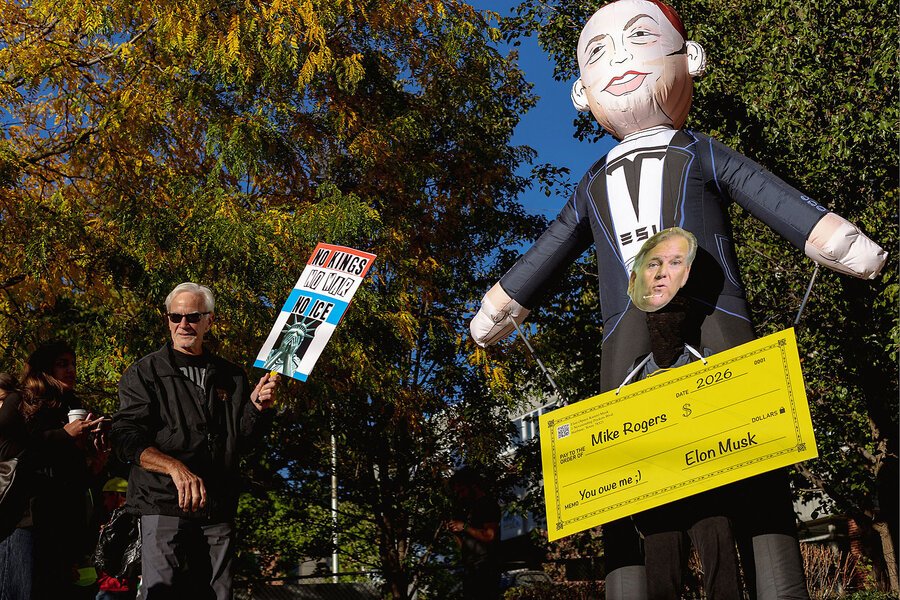
A protester wearing a cutout depicting Republican Senate candidate Mike Rogers and an inflatable depicting Elon Musk stands outside a debate between Mr. Rogers and Democrat Abdul El-Sayed, in Grand Rapids, Michigan, Oct. 8, 2026.
Mr. Musk’s biggest donation was $158 million to the GOP’s Senate Leadership Fund, which put that same amount into the Senate race in Texas – where Mr. Musk’s companies are based. On X, Mr. Musk has been urging people to vote for Texas Attorney General Ken Paxton, saying, “The fate of Texas and America is at stake.”
That’s another way that Mr. Musk stands out. He has not only relied on his money to try to influence politics. He campaigned directly for President Donald Trump in the 2024 election. He briefly joined the Trump administration to head up the Department of Government Efficiency in a short-lived attempt to slash federal spending. He has promoted far-right movements in Europe in warning about the dangers of Muslim immigration.
Like his Gilded Age predecessors, Mr. Musk may start leaning into philanthropy as a way of deflecting criticism of his outsize fortune. This week, he announced he would offer one share of his SpaceX company to every child in the U.S. “This will be the first of many,” he said in a post on X. Details about how he would distribute shares to the more than 70 million Americans under 18 have not been released, though President Trump suggested that it might be through his administration’s Trump Accounts. The move would also have favorable tax implications for Mr. Musk.
Deepen your worldview
with Monitor Highlights.
Politics with respect
Get political stories with respectful analysis.
There‘s a world of new ideas in every
Books newsletter.
There‘s more to life, enrich yours with
Culture & Learning weekly.
Follow humanity‘s discoveries with
Science & Nature stories in your inbox.
Gain a spiritual perspective
from the stories in your inbox.
Want to understand the deeper impact of critical events? Learn the Monitor‘s insight.
Already a subscriber? Log in to hide ads.
“The role of money in politics was always big, and individuals with big fortunes continued to be big players both behind the scenes and in office,” T.J. Stiles, author of a Pulitzer Prize-winning biography of Cornelius Vanderbilt, writes in an email. “But, at least in the nineteenth century, we had no one playing anything like the role of Musk in today’s elections.”
Still, history suggests the impact of billionaires on politics is sometimes less than meets the eye. Tycoon Samuel Tilden ran as a Democrat in 1876 and lost in a disputed presidential election to Rutherford B. Hayes. More recently, billionaires such as Mr. Bloomberg and Tom Steyer have poured money into political campaigns that ultimately failed. Mr. Musk himself spent millions on a Wisconsin Supreme Court race in 2025, only to see his preferred candidate lose – after which he said he planned to spend “a lot less” on politics going forward. That pledge did not last.