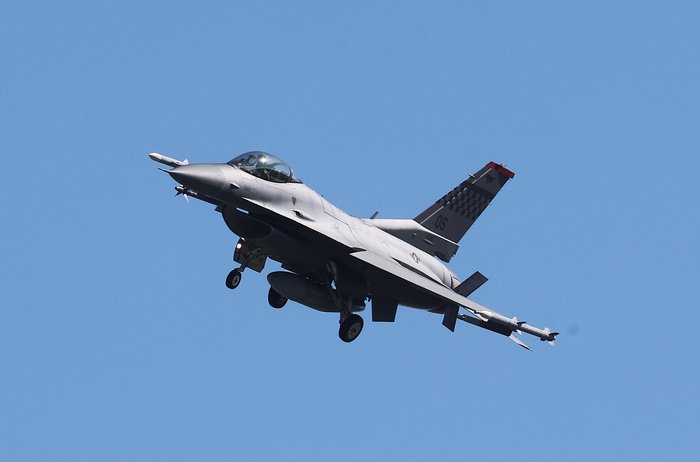
U.S. plans to improve Pakistan’s F-16 by 1 trillion won
India “concerns about strengthening the capability to carry nuclear weapons”
The U.S. “There is no balanced impact on regional military power”
The India-Pakistan conflict reignites

While the U.S. approved Pakistan’s F-16 fighter jet performance improvement project, criticism has been raised in India that the U.S. nuclear policy is a double standard.
According to the South China Morning Post (SCMP) in Hong Kong on the 8th (local time), Indian security experts are concerned that the US F-16 performance improvement project in Pakistan could strengthen its existing nuclear weapons capabilities.
The problem with Indian experts is that the F-16 can be used as a means of transporting nuclear weapons. Since the 1990s, U.S. intelligence agencies have assessed that Pakistan has modified the aircraft to be capable of carrying nuclear weapons.
“This performance improvement does not provide Pakistan with a new nuclear bomb, but it is significant in that it extends and modernizes the operational life of fighter jets, which have been evaluated as a means of transporting nuclear weapons,” said Srinivasan Balakrishnan, an analyst at the Indic Resources Forum, a New Delhi-based think tank.
The U.S. is putting strong pressure on Iran’s nuclear program, which has not yet produced nuclear weapons, but is maintaining and improving Pakistan’s F-16 power, which already has nuclear weapons, he said. “India sees this as a clear double standard.”
The Indian government is also known to have conveyed its concerns to the U.S. side. Indian Defense Minister Rajnath Singh met with US Defense Secretary Pete Hegseth late last month to raise the issue of F-16 performance improvement at the ASEAN expanded defense ministers’ meeting in Cebu, Philippines. It is also said to have warned of the possibility of sensitive military technology leaking to third countries.
However, the United States has indicated that the project is a measure to maintain counterterrorism cooperation with Pakistan. The Defense Security Cooperation Agency (DSCA) said in a notice to Congress in December last year that the purpose of the project is to extend the life of the fighter and improve flight safety, adding that “the sale of equipment and support will not change the basic military balance in the region.”

In fact, the $686 million (about 1 trillion won) Pakistan F-16 performance improvement project, which DSCA notified the U.S. Congress in December last year, focuses on extending the life of fighter jets to 2040 by improving aviation electronic equipment and encryption systems. New nuclear weapons or equipment dedicated to carrying nuclear weapons were not included in the items for sale.
Gurcharan Singh Bedi, an Indian Air Force reserve commander, also evaluated that the project will not significantly improve Pakistan’s nuclear weapons capability. However, he explained that if the fighter’s survival, situational awareness, and communication capabilities are improved, the reliability of existing nuclear weapons transportation methods in crisis situations can be increased.
Pakistan’s F-16 fighter jets were also at the center of controversy during last year’s military conflict with India. The two countries engaged in a military conflict for about 88 hours in the wake of the terrorist attack in April last year in which 26 civilians were killed in Indian Kashmir’s Pahalgam. At the time, India claimed that Pakistan had deployed F-16s and had shot down some of the aircraft. Pakistan, on the other hand, rejected claims that it mainly used Chinese fighter jets.