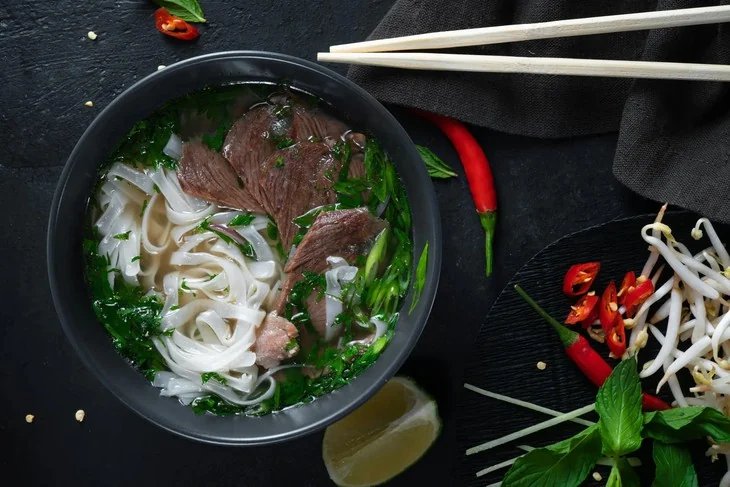

From steaming bowls of pho to crispy street-style sandwiches, Vietnamese cuisine always surprises every traveler – Photo: Unsplash
At the 25th Wanderlust Reader Travel Awards, Thailand won the Gold award in the Most Desirable Destination for Gastronomy category. Italy and France received the Silver and Bronze awards, respectively.
Notably, Southeast Asia has three representatives in the top 10 list of destinations. Following Thailand in first place, Malaysia ranks eighth and Vietnam tenth.
Vietnamese cuisine is increasingly gaining popularity.
The subsequent positions were held by Japan, Greece, Spain, South Korea, Malaysia, Turkey, and Vietnam, respectively.
Notably, the 10th place ranking in Wanderlust extends the international recognition that Vietnamese cuisine has received in recent years.
At the TasteAtlas Awards 2025-2026, Vietnam ranked 16th in the list of the world’s top 100 cuisines, up 3 places from the previous year. Several Vietnamese dishes also achieved notable rankings, with Bun Bo Nam Bo (Southern-style beef noodle soup) ranking 81st and Pho Bo (beef pho) ranking 83rd in the list of the world’s 100 best dishes for the same period.
Previously, Vietnam was also awarded the title of Asia’s Best Culinary Destination by the World Culinary Awards 2025.

Banh mi is one of the quintessential street food dishes representing Vietnamese cuisine on the world culinary map – Photo: Unsplash
Furthermore, Hanoi was honored by the World Culinary Awards 2025 as Asia’s Best Emerging Culinary City Destination.
Meanwhile, Hanoi pho was included in the National List of Intangible Cultural Heritage in 2024, recognizing the knowledge, skills in preparing, and preservation of the dish through many generations.
This is proof that the appeal of Vietnamese cuisine lies not only in its flavor but also in its connection to local life, customs, and cultural identity.
The domestic culinary industry has also seen growth in the high-end restaurant segment. According to the Michelin Guide 2026, Hanoi, Ho Chi Minh City, and Da Nang have a total of 193 selected establishments, including 11 Michelin-starred restaurants, 72 Bib Gourmand establishments, and 110 Michelin Selected locations.
These observations show that Vietnamese cuisine is being recognized from many perspectives, from street food and regional specialties to high-end culinary experiences.
Thailand leads the way thanks to its diverse culinary appeal.
According to Wanderlust magazine, the appeal of Thai cuisine is clearly demonstrated by Bangkok – the city with more restaurants featured in Asia’s 50 Best Restaurants 2026 list than any other city in Asia, including Tokyo.
The culinary scene in the capital is also defined by many distinctive experiences, from crab omelets at a Michelin-starred restaurant to the floating markets along the canals of Thonburi.
However, the appeal of Thai cuisine is not limited to Bangkok but extends throughout the country.
Each region offers its own unique flavors, from the spicy Isan cuisine influenced by Myanmar in the North to the distinctive desserts of Phetchaburi – a city recognized by UNESCO as a Culinary Innovation City.

The blend of street food, fine dining restaurants, and local specialties creates a diverse picture, making Thailand a standout destination in this year’s selection – Photo: Unsplash
Italy, on the other hand, boasts a rich culinary tradition, with each region having its own unique characteristics in terms of ingredients and cooking methods.
From Neapolitan pizza, pasta, and Northern risotto to local cheeses, cold meats, and wines, Italian cuisine reflects the diversity of its culture and natural conditions.
Besides its globally renowned dishes, the art of handcrafted pasta making, gelato production, and espresso culture also contribute to the appeal of Italian cuisine.

A hearty Italian lunch featuring pizza with ham (prosciutto), fresh cheese, basil, served with salad and roasted vegetables – Photo: Unsplash
On the other hand, France is renowned for its cuisine that emphasizes cooking techniques, quality ingredients, and artistic presentation.
From haute couture restaurants and artisanal bakeries to local markets, each experience reflects the depth of French culinary culture.
Typical dishes such as croissants, baguettes, coq au vin, bouillabaisse, along with characteristic cheeses and wines, contribute to the country’s reputation.
The culture of dining in France was also recognized by UNESCO as a Representative Intangible Cultural Heritage of Humanity in 2010.

A flaky croissant served with hot tea is a popular choice in French breakfast culture at cafes – Photo: Unsplash