I never made the connection, but Carolina Gold rice pops up several times when I list my favourite dishes in the United States.
After visiting Charleston, South Carolina earlier this year, it now makes perfect sense. The best gumbo I’ve found in America is surprisingly not from New Orleans, but Chicago.

Charleston, South Carolina Supplied/Chris Singh
James Beard-winning chef Erick Williams serves up his version of the Louisiana staple at Hyde Park favourite Virtue, a restaurant steeped in southern cooking traditions.
I think the difference is in the grains; instead of traditional white rice, Williams builds a bowl of the flavourful stew from chicken, andouille sausage and fluffy Carolina Gold rice.
When Chef Dae Kim led Nōksu, a Korean fine-diner hidden in Manhattan’s 32nd St-Herald Square subway station, he whipped me up a dish of stone-ground grits made with the rich, golden rice mixed with squid and okra.
I still salivate over it years later.

The moody dining room at Zero George. Supplied/Chris Singh
The Charleston restaurants that won me over
And so that’s the first thing on my mind when I land in Charleston. I jump on Google and immediately start searching for kitchens that use this buttery long-grain rice – the foundational ingredient of Lowcountry cuisine, beloved for its bright floral taste.
I’m hit with plenty of results, keeping me well-fed over the coming days.
There’s Michelin-starred Spanish at Malagón, an animated taperia and mercado serving crab rice with squid ink and paprika, and The Restaurant at Zero George, a fine-dining take on Lowcountry cooking.
The sweet pea tortellini with sea scallops in ham broth nods to the state’s coastal spring harvests.

The sweet pea tortellini was a big tick to kick things off. Supplied/Chris Singh
But it’s a casual eatery called The Grocery that really sings to me.
Here, chef-owner Kevin Johnson uses the golden grains in a spectacular seafood pilau with full-flavoured field peas, shrimp, clams and light crispy fish.
The rice’s naturally chewy texture makes it the perfect contender for the medley, filling my table with other local classics like smoked fish paté and okra served two ways – roasted and fried – with smoked tomato sauce and Cotija cheese.
I’m in foodie heaven.

The Grocery was where the food really shone. Supplied/Chris Singh
Carolina Gold rice is one of several examples of top-shelf US ingredients tied specifically to a state, much like Hawaii’s Kona coffee, New Mexico’s Hatch green chiles, and Washington’s Walla Walla sweet onions. Although this grain, much like Lowcountry cooking in itself, has a longer, more tragic history sitting behind it.
Complicated history behind Charleston’s southern charm
Each year, Charleston frequently appears in lists of America’s best small cities, often coming in first or second place.
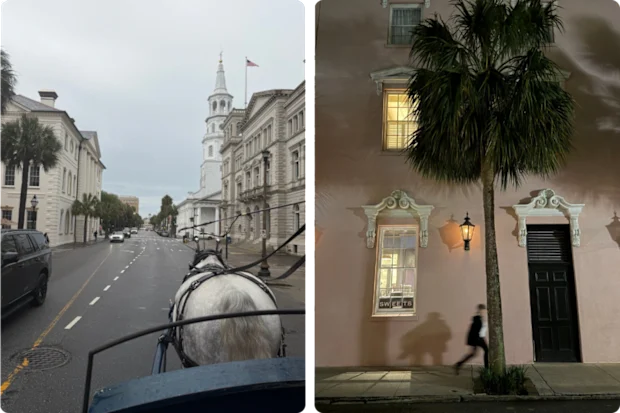
I’m not surprised as I step onto the colourful streets of the treasured French Quarter, with narrow roads lined with bright homes converted into fine dining restaurants, wine bars and luxury boutiques.
I’m staying in a building with an equally colourful history. Tucked down a nondescript alley off King Street is the 45-room Fulton Lane Inn, a historic boutique hotel fashioned from two buildings dating back to 1889 and 1912.

Fulton Lane Inn is full of old world charm. Supplied/Chris Singh
The fact that my room has a large old-fashioned key instead of a card, along with a cottage-like four-poster bed, fits the character of such a charming city.
Many of these houses have lone palmetto palm trees swaying in front of them, layering the visual oomph that makes the French Quarter one of the country’s most visually striking historic centres. It’s a romantic, expensive-looking town.
The city’s wealth came directly from a shameful part of American history. Rice cultivation expanded in colonial South Carolina during the late 1600s, becoming increasingly dependent on the forced labour and agricultural expertise of enslaved Africans.
Back then, cash crops were the primary economic drivers. Louisiana had sugarcane. Virginia had tobacco. And South Carolina’s trade centred on rice.

The city doesn’t shy away from its dark past. iStock
Profits from rice plantations helped finance Charleston’s historic architecture and church steeples. Enslaved Africans brought from West Africa’s Rice Coast, stretching from Senegal towards Liberia, possessed extensive knowledge of wetland rice agriculture that plantation owners exploited.
Growing in South Carolina’s low-lying marshlands, the crop became literal gold for the state, making it one of the wealthiest southern colonies.
The city isn’t shy about its dark past
West African influence is still felt throughout Charleston today, particularly through the Gullah Geechee, descendants of enslaved Africans who developed a distinct culture along the coastal regions of South Carolina, Georgia and neighbouring states.
Their culinary traditions helped shape Lowcountry cuisine, combining Indigenous ingredients and local seafood with West African cooking techniques and staples like rice, okra and field peas.
One-pot dishes such as red rice and seafood pilau are central to this legacy, something I can now appreciate firsthand after eating my way around Charleston.
Understanding where a cuisine comes from makes eating it a much richer experience. I learnt that from Anthony Bourdain.
And it’s true; exploring Gullah Geechee culture and the story of enslaved Africans in Charleston just makes me appreciate each dish even more. The history pushes me to eat with intention, and that naturally makes everything taste better.

The Old Slave Mart Museum in town. Supplied/Chris Singh
The city has plenty of places where such history is showcased in brutally honest fashion. At The Old Slave Mart Museum, the dehumanisation of enslaved Africans is laid bare via historic advertisements posted by slave auctioneers.
The site itself was an antebellum-period slave-auction gallery, complicating the experience and muting the surrounding beauty.
Nearby, the Aiken-Rhett House, one of the most stunning 19th-century homes I’ve seen in the American South, with its faded canary yellow facade and large rooms, makes clear the horrors of the slave trade.
Its original outbuildings, including the kitchen, laundry and slave quarters, have remained largely unaltered since the 1850s.

The Aiken-Rhett House stands out with its canary yellow facade. Supplied/Chris Singh
But it’s the International African American Museum that gives me the clearest understanding of the food I’ve been eating.
Opened in 2023 on Gadsden’s Wharf, once the primary arrival point for enslaved Africans, it explores Black history and the Gullah Geechee experience, including the agricultural knowledge that transformed the region.
By the time I leave Charleston, I think differently about the dishes that first made me love Carolina Gold rice.
I can still picture that gumbo in Chicago and the grits in New York, but now I know something of the people and history behind the grain.
And that makes each bite of that seafood pilau all the more memorable.
The writer travelled as a guest of Explore Charleston, but some meals were at their own expense.