

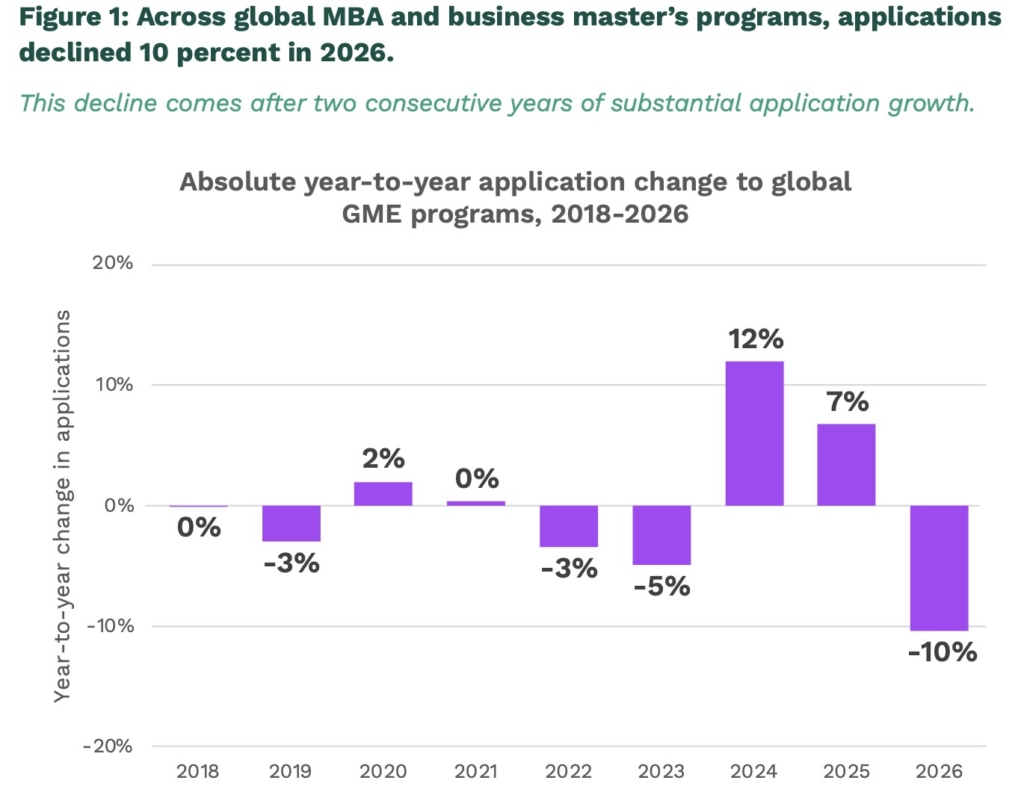
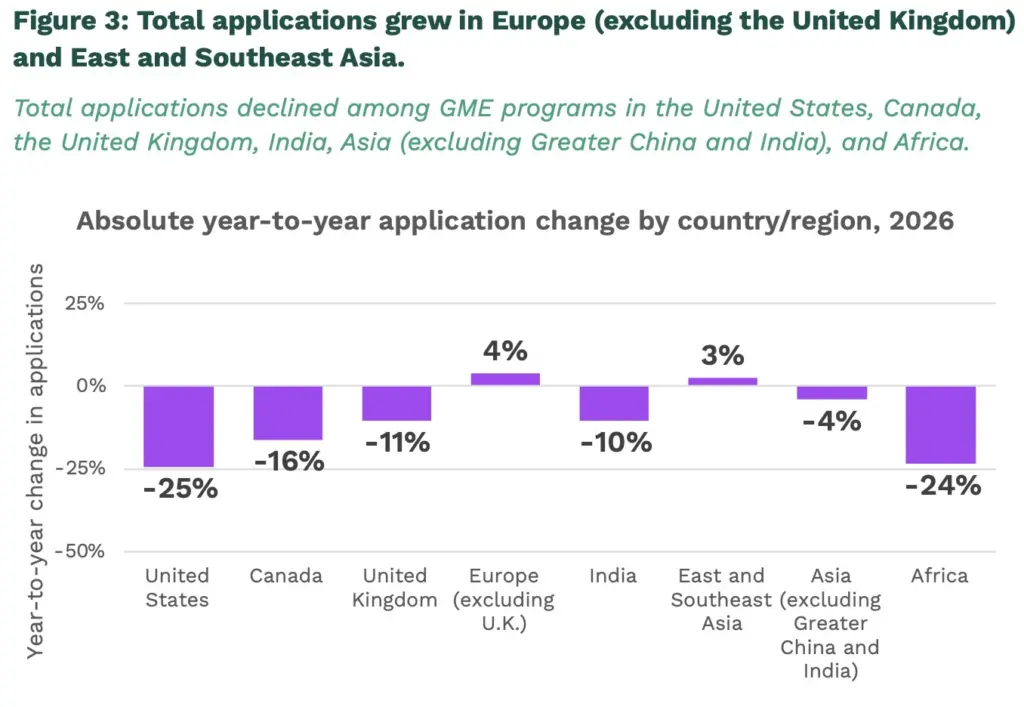
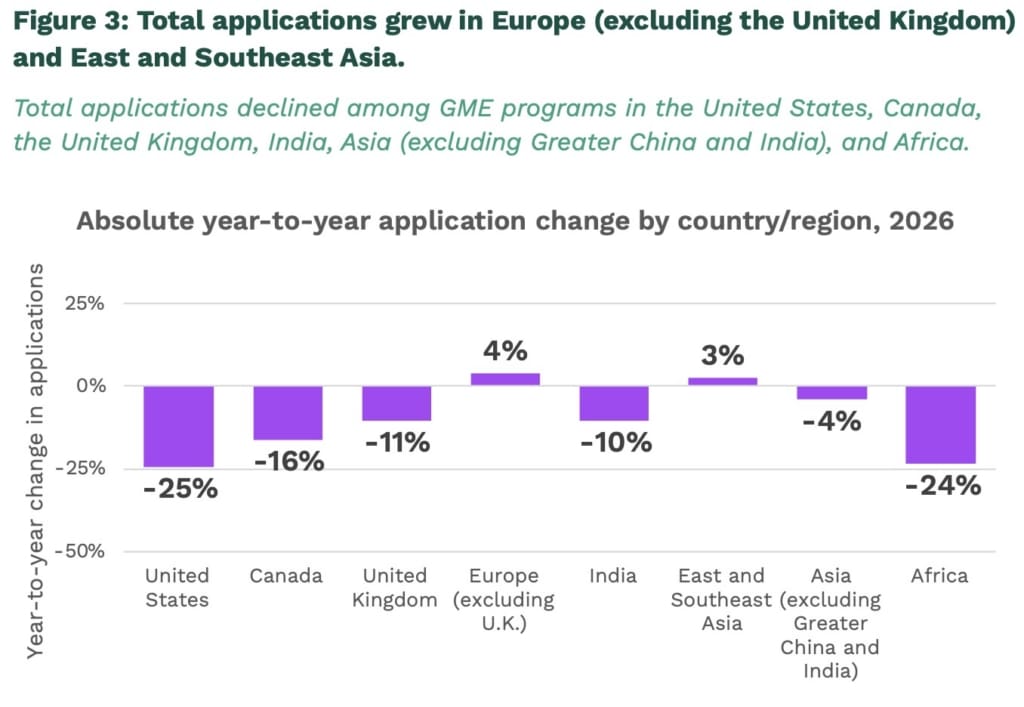
Applications to U.S. graduate business programs fell 25% this year, the sharpest drop of any region in the world, according to the Graduate Management Admission Council’s 2026 Application Trends Survey, released today (October 27). Full-time MBA programs fared even worse, with applications down 27%.
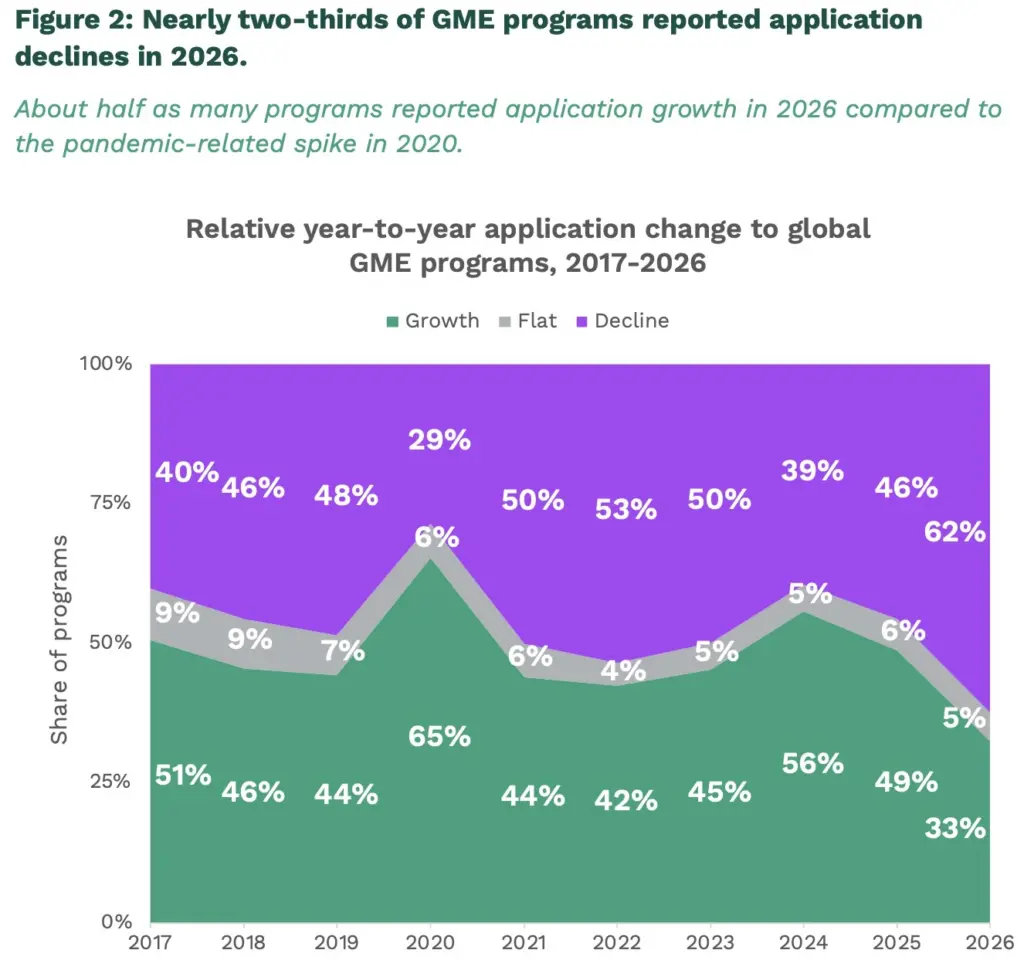
The decline ends two consecutive years of strong growth. Globally, applications to graduate management education programs dropped 10%, and MBA applications fell 13%. Nearly two-thirds of MBA programs worldwide reported fewer applications this year – the largest share in at least a decade. Business master’s programs held up better, with applications down 5%.
The losses were not shared evenly. Programs in Europe (excluding the UK) and in East and Southeast Asia grew their applicant pools, largely on the strength of international candidates. The traditional English-speaking hubs – the U.S., the UK and Canada – all lost ground. Three-quarters of U.S. programs reported declines.
“Candidates are weighing cost and return more closely than ever, and they’re being more deliberate about where they invest in a graduate business degree,” says GMAC CEO Joy Jones. “What hasn’t moved is the caliber of students schools are admitting: incoming classes are as well qualified as last year’s.”
Source: GMAC
A PERFECT STORM IN THE U.S.
U.S. schools pointed to a familiar culprit. Fifty-four percent of U.S. programs said changes in visa policies and practices had a major impact on their application volume, the top factor cited. Forty-five percent named geopolitical changes within the country, and 35% cited economic conditions.
But the U.S. problem was not only international. International applications to U.S. programs fell 38% and domestic applications fell 6%. More than half of U.S. programs reported fewer domestic applications.
GMAC points to a “low-hire, low-fire” labor market that makes staying in a job more attractive than leaving it for school. It also flags new caps on annual and lifetime federal lending for graduate students, which took effect during the survey’s data collection window. One-third of U.S. respondents said changes in government support for education had a major impact on their applications.
The loan caps appear to have hit business schools harder than other professional schools, which face less restrictive limits under the same policy. Applications to law schools rose 8% for the 2026-2027 class, and medical school applications rose 5% for the 2025-2026 class.
Within the U.S., online MBA programs posted the smallest decline, down 12%. Master of Business Analytics programs took the biggest hit, down 32%.
WHERE THE INDIAN CANDIDATES WENT
The survey suggests that many international candidates didn’t give up on business school – they simply went elsewhere. India offers the clearest example. Forty-one percent of U.S. programs said India was the country where they lost the most applicants. Meanwhile, just over half of European programs now name India as their top source of international talent, up from 41% last year. In East and Southeast Asia, 39% of programs said the same.
Canada saw a similar shift with Chinese candidates. Fifty-four percent of Canadian programs said Greater China was where they lost the most applicants. U.K. programs reported losses from both countries.
Mobility within Europe is also rising. This year, 26% of applications to European programs came from candidates in other European countries, up from 22% in 2025.
Whether the shift lasts is the central open question, according to the report. It notes that visa rules can change quickly, but the recruiting relationships, employer ties and alumni networks that grow around a redirected pipeline do not.
“A candidate who chooses Singapore or Milan this year becomes an alumnus there, hires from there, and tells the next cohort about it,” the report says.
Source: GMAC
ELITE SCHOOLS FARED BETTER – BUT ARE MORE EXPOSED
Selectivity mattered. MBA programs that admit fewer than 40% of applicants saw applications fall 9%. Programs that admit more than 85% saw a 21% drop, and their international applications were nearly cut in half, down 43%.
The more selective schools may be less insulated than the headline numbers suggest, however. International candidates make up 43% of applications to highly selective MBA programs and 57% at selective programs (those admitting 40% to 65%), compared with 21% at open-admission programs. Highly selective programs lost 22% of their international applications this year. Even so, one-third of those programs reported international growth, so the tier’s combined figure masks wide variation from school to school.
Among full-time, two-year MBA programs – the format most associated with top U.S. schools – domestic applications fell 11% and international applications fell 28%. Because domestic candidates make up roughly two-thirds of those pools, GMAC says both groups contributed about equally to the overall decline.
HOW STEADY IS ‘STEADY’?
GMAC’s release leads with stability. Despite the drop in applications, it says selectivity, projected yield, class size and academic qualifications all held consistent with last year. The report itself is more cautious. It notes that the small shifts in acceptance rates and class size fall within the margin of error and may reflect a different mix of responding programs rather than real change.
Some signals point in a less comfortable direction. Projected yield – the share of admitted students who enroll – has fallen worldwide over the past decade, and in the U.K. it dipped below 50% this year. The survey runs from June to August, before most classes begin. GMAC also says schools increasingly report students who pay deposits but never show up, sometimes because their visas were not approved or because they put down deposits at more than one school.
And while Jones says incoming classes are as well qualified as last year’s, the survey measured the academic profile of applicant pools, not enrolled students. On that measure, 19% of U.S. programs said their pool was more academically qualified than last year, down from 28% in 2025.
Source: GMAC
MERIT AID RISES
For the first time, the survey asked about tuition and financial aid. The share of incoming students receiving merit-based scholarships rose from 37% to 45% globally, a statistically significant increase. In both the U.S. and Canada, 56% of incoming students are expected to receive at least some merit aid.
GMAC presents this as good news for candidates who may be put off by sticker prices.
“In many ways, this is an excellent time to consider a graduate business degree,” says Jones. “Programs are covering a meaningful share of tuition for the students who need it most.”
The survey does not say how large those awards are, and rising merit aid may also reflect sharper competition among schools for a shrinking pool of candidates.
MASTER’S PROGRAMS WIN AT HOME
Business master’s programs, which have long depended most on international students, grew their domestic applications this year – a multi-year trend. Every master’s degree type except the Master of Marketing reported domestic growth. The Master in Management was the only degree to grow both its domestic and international pools, and its total applications rose 2%.
The Master of Accounting is a striking case. In the U.S., domestic applications rose 3% despite changes to CPA exam eligibility rules. But international applications fell 38%, pulling total applications to U.S. accounting programs down 18%.
Women also reached parity among applicants to Master of Business Analytics programs for the first time. In MBA programs, they still make up about 42% of applicants – roughly where they have been for a decade.
AI IN THE CLASSROOM, LESS SO IN ADMISSIONS
Nearly every program now teaches AI in some form. Only 8% of programs reported no way of incorporating it into the curriculum, down from 16% last year. Hands-on simulations and applied projects are now the most common approach, used by 71% of programs.
Admissions policies have lagged. A plurality of programs still have no formal policy on applicants’ use of AI, and such policies are least common in the U.S. and in continental Europe. Where policies do exist, most are conditional, typically asking candidates to disclose when and how they used AI.
GMAC’s 2026 survey drew responses from 1,162 programs at 314 business schools in 39 countries between June and August.
Read GMAC’s 2026 Application Trends Survey report here.
© Copyright 2026 Poets&Quants. All rights reserved. This article may not be republished, rewritten or otherwise distributed without written permission. To reprint or license this article or any content from Poets&Quants, please submit your request HERE.