
Starting Nov. 3, employers in 186 occupations will be able to back a foreign worker’s bid for permanent residency without first proving they couldn’t find a Canadian to do the job. Economists who spoke to The Hub warn it could hold down wages and squeeze young Canadians already struggling to find work.
Critics of the immigration policy of the previous Liberal government—where the skills-based point system was largely scrapped for wide-scale acceptance of low-skilled immigrants—have welcomed the Carney government’s return to prioritizing highly educated newcomers. However, the federal government allowing employers to completely bypass hiring from the domestic workforce for certain occupations could also result in adverse effects for the Canadian workforce they warn.
Pierre Fortin, an economics professor at the Université du Québec à Montréal (UQAM), was frank about the main shortcoming of the revision to the Express Entry system. “A priori, I don’t like the idea of giving Canadian businesses a free ride on importing foreign labour, which will obviously be paid lower wages than native labour,” he told The Hub. “This is what business lobbies want.”
The end of the local-hire test
Immigration Minister Lena Metlege Diab announced Oct. 16 that Express Entry candidates will earn up to 100 extra points for a job offer in a “high-wage” occupation, one whose median pay is about $74,000 annually or at least 1.3 times that of the overall workforce. A qualifying offer will no longer need a labour market impact assessment (LMIA), the test in which an employer must show it advertised the job and could not find a Canadian to fill it.
As The Hub reported last week, eligibility rests on the occupation, not only on what the candidate will earn. IRCC’s high-wage occupations list includes software developers, civil engineers, accountants, web developers, teachers, social workers, retail trade managers, and even authors and writers.

‘I am not optimistic’
Fortin said he does not yet know what dropping the LMIA will mean “on wages and job prospects for Canadian workers, but I am not optimistic.”
“After all, business is about maximizing profits, and maximizing profits requires minimizing labour costs,” he said.
That same incentive could go beyond holding down wages. Without the LMIA’s requirement to first look for Canadian workers, employers able to bring in cheaper hires from abroad could also choose to replace existing Canadian staff to reduce payroll costs.
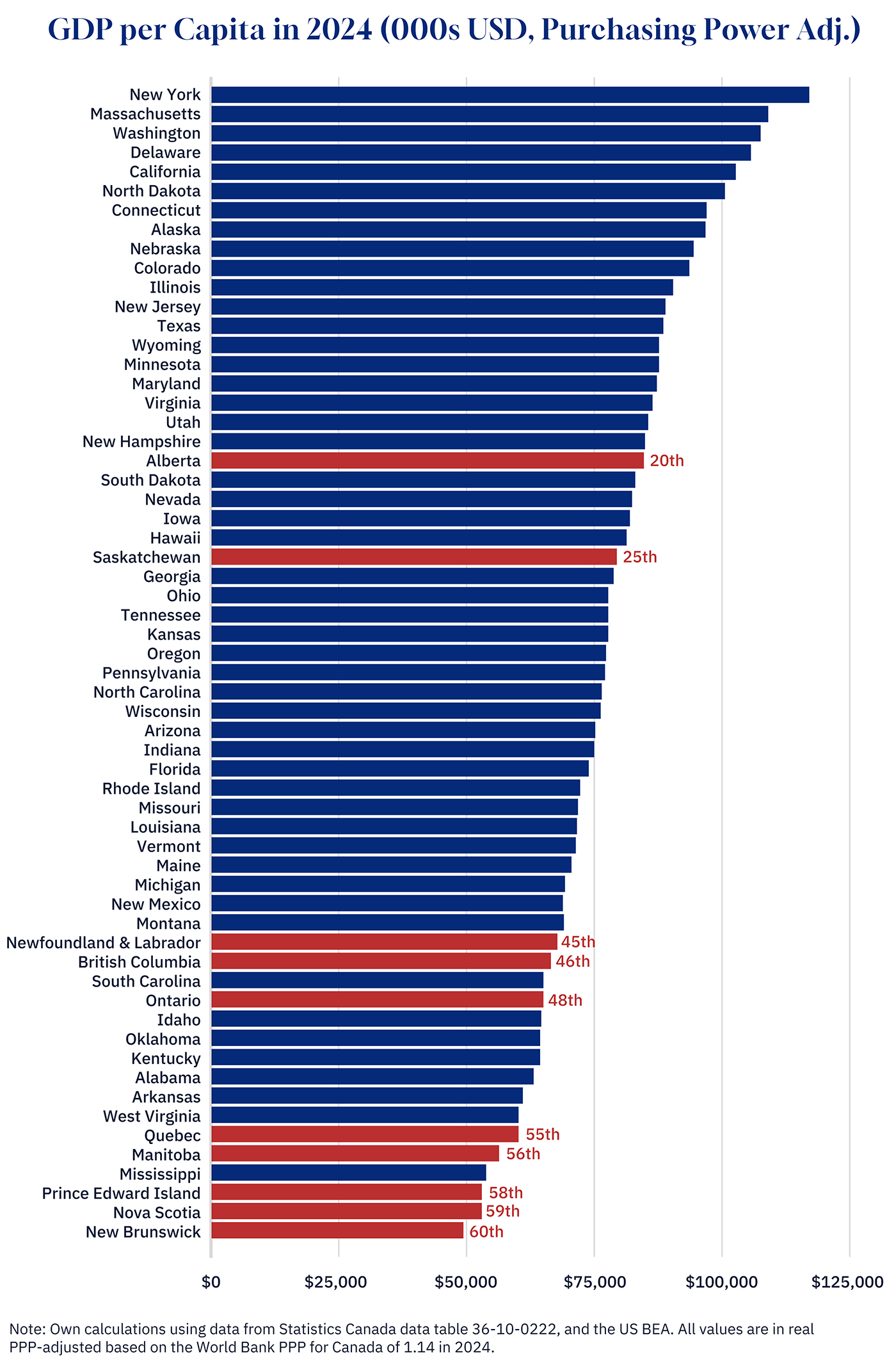
Fortin also pointed to recent economics studies that have found the rapid pace of immigration to Canada in the past decade hurt Canada’s stagnant per capita GDP and the relative wealth of many Canadians. “There is compelling evidence that the Trudeau migratory explosion of 2016–2024 has affected Canadian productivity and income inequality among Canadians negatively,” citing various recent economics studies.
He blamed two forces. Investment went to housing and equipping newcomers rather than raising productivity. And Statistics Canada researchers found nearly half of employed temporary workers are in low-skilled, low-paid sectors such as agriculture, accommodation, and retail.
Fortin credits Diab for moving away from “this huge concentration of admissions of cheap labour in low-qualified occupations,” calling it “a step in the right direction.” But overall volumes must also come down, Fortin argues. He also warned that tying points to occupational codes rather than strictly earnings will add red tape.
Canadian professional jobseekers face added competition
For jobs requiring a bachelor’s degree or higher, the education level behind much of the list, Statistics Canada counted 4.9 unemployed people for every vacancy in the second quarter. Those vacancies fell 5.9 percent from a year earlier, even as openings requiring a high school diploma or less grew year over year for the first time since 2022.
Young Canadians are bearing the brunt of a weaker job market. The youth unemployment rate sits at 13 percent, and fewer jobless Canadians are finding work each month than before the pandemic.
Many of the listed occupations show no sign of shortages. Teachers at every level make the list, yet employment in educational services is down 67,000 from a year ago. Second-quarter vacancies for software developers and programmers numbered just 3,500. Ottawa’s own projections from early 2025 expected more jobseekers than openings through 2033 for data scientists (12,300 versus 10,000), other professional engineers (17,400 versus 12,400), and college instructors (76,000 versus 60,600).
The case is stronger for skilled trades and health care. For jobs requiring a trade certificate or diploma, Statistics Canada counted just 1.7 unemployed people per vacancy, the lowest of any education level, and vacancies in trades, transport, and equipment operator jobs rose by 7,100 from a year earlier. Ottawa’s own occupational projections rate heavy-duty equipment mechanics and air pilots at strong risk of shortage through 2033, and industrial electricians, gas fitters, sheet metal workers, and bricklayers at moderate risk.
Health care is the clearest fit for the policy update, as 21 of the 22 health occupations on the list, from family physicians to pharmacists, are projected to face shortages. For registered nurses, Ottawa expects 179,800 openings against 159,500 job seekers over the decade.
A job title is not everything
Parisa Mahboubi, a senior policy analyst at the C.D. Howe Institute, told The Hub that economics research has generally found little harm to Canadian earnings from high-skilled immigration of the past. Where wage pressure or displacement occurs, it is more often concentrated among “lower-skilled or lower-paid workers who compete more directly with newcomers in specific occupations.”
“[But] a high-wage occupation does not guarantee that a candidate will earn a high wage in Canada,” she said.
She also flagged fraud as a major concern. “A substantial points advantage for job offers can create incentives for fraudulent or non-genuine offers,” Mahboubi said, noting Ottawa scrapped job-offer points in 2025 amid concerns about the buying and selling of LMIAs. She added that Ottawa lacks the data to tell whether current LMIA-exempt foreign workers are “complementing Canadian workers or putting pressure on wages and job prospects.”
However, Mahboubi, through her research, believes Canada inviting more highly educated immigrants in the past to live and work here has almost always been a net gain for Canadians.
“High-skilled immigrants can complement the skills of existing workers, raise productivity and support innovation,” she explained. But that doesn’t mean the latest policy, pinpointing specific occupations, is the best policy to do that.
“Category-based selection can also prioritize particular occupations without adequately accounting for candidates’ expected earnings and long-term economic contributions. By prioritizing candidates in designated occupations without sufficient evidence of their long-term economic benefits, it risks undermining the objective of attracting top talent and raising productivity and living standards,” Mahboubi told The Hub.
As of August 2026, there were 1,298,350 work permit holders in Canada under the International Mobility Program (IMP), which already allows immigrants in certain categories (e.g., recent graduates, spouses, intra-company transferees, working-holiday youth) to get work permits without an LMIA.
The latest changes by the Carney government to the Express Entry system will allow foreign workers outside the country to compete for high-paying jobs and have a points advantage in applying for permanent residency over other applicants with job credentials or earnings not prioritized by Ottawa.
Slower raises, not pay cuts
Mikal Skuterud, a University of Waterloo economist, told The Hub the likelier risk is not falling paycheques but “earnings not growing over time in the same way they otherwise would have.”
“The economics literature is very clear that those effects exist,” he said. Like Mahboubi, he is most concerned about the bottom of the labour market, where suppressed earnings widen inequality and erode support for immigration.
That risk grows if employers fudge occupational codes, a potential loophole Skuterud warned The Hub is likely exploitable by employers with the imminent federal policy change.
If that were to become commonplace, more and more of Canadian professionals may be competing not only against fellow Canadians and immigrants living in Canada in their field, but much of the rest of the world’s talent.

Graeme Gordon is The Hub’s Senior Editor and Podcast Producer. He has worked as a journalist contributing to a variety of publications, including CBC,…
The Carney government’s immigration overhaul, effective Nov. 3, allows employers in 186 occupations to support foreign workers’ permanent residency without proving they couldn’t find a Canadian. Critics warn this could suppress wages and exacerbate job competition for young Canadians. While the policy aims to prioritize highly educated newcomers, economists express concern that bypassing the local-hire test may lead to lower wages and job displacement. The changes could also affect productivity and income inequality, with significant implications for the Canadian workforce, particularly in high-wage occupations where job vacancies are already limited.