(TNND) — Experts have mixed expectations for President Donald Trump’s historic three-way meeting this week with Chinese President Xi Jinping and Russian leader Vladimir Putin.
The three leaders will meet face-to-face Thursday when Trump attends the Asia-Pacific Economic Cooperation summit in Shenzhen, China.
Steven Lewis, the senior China fellow at the Baker Institute for Public Policy at Rice University, said the meeting is “a big deal, potentially.”
Lewis said Trump, Xi and Putin are “certainly capable of coming up with a whole host of side deals that we won’t hear about until much later.”
But he said the leaders are most likely just “opening the door” to future talks, possibly with small “confidence-building measures that they can agree on.”
Lewis isn’t expecting breakthroughs this week on hot-button issues surrounding Iran, Ukraine, Taiwan and more.
Plus, Xi, at least, is expected to attend the G20 summit next month in Miami. Putin has reportedly been invited but hasn’t committed to attending.
“So, the fact that they have another meeting coming potentially within a month, I think suggests that they might take this one kind of slow,” Lewis said.
Russian foreign policy expert Mark N. Katz has low expectations for this week’s meeting.
Katz, a professor emeritus of government and politics at George Mason University, said it’s not clear that there’s much Trump, Xi and Putin can agree upon.
“And then even if there is, can the three of them enforce it on others? And if they anticipate that they can’t, then what’s the point of making it?” Katz said.
Katz described this week’s meeting as potentially not much more than a “photo opportunity” for the three leaders.

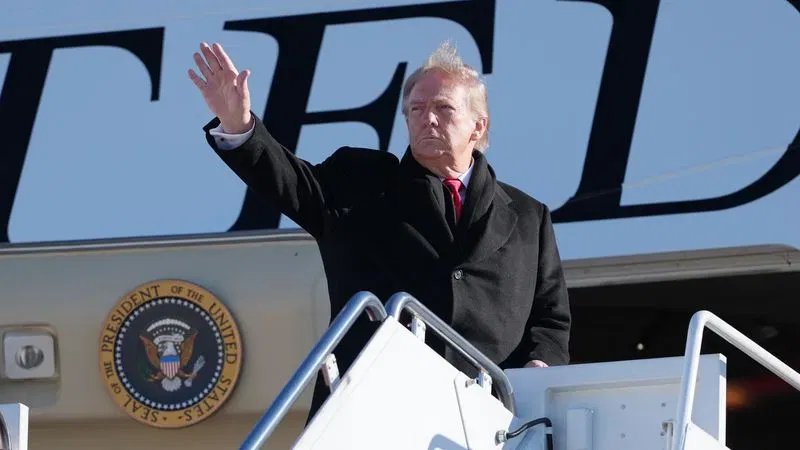
President Donald Trump waves as he boards Air Force One at Joint Base Andrews, Md., on his way to attend the 49th ASEAN Summit in Manila, Monday, Nov. 16, 2026. (AP Photo/Mark Schiefelbein)
Trump told reporters Monday that he would discuss denuclearization with Xi and Putin, along with the wars in Iran and Ukraine, and economics and trade.
Trump said he might also meet with North Korean leader Kim Jong Un while in China.
“We have a chance to accomplish a lot,” Trump said as he departed the White House for his Asia trip.
Trump will make a stop in the Philippines before arriving later this week in China.
“But then in December, as you know, we have the G20 in Miami,” Trump continued. “So, we have a lot of very important meetings.”
Trump said he might talk to Xi about the controversy surrounding Jensen Huang, the ousted Nvidia CEO accused of having an affair with a suspected Chinese spy.
Trump, however, said he’s not seen proof that the woman is a spy.
Lewis said he expects Taiwan to also find its way on the agenda for this week’s meeting.
“Xi Jinping very recently has talked about that he’s sure that China and Taiwan will be reunited,” Lewis said. “He does say peacefully, but I have a feeling that what he wants is more of an acknowledgement from the United States that it’s in a weaker position now and that if China were to really assert itself, maybe the U.S. couldn’t defend South Korea or Japan and certainly not Taiwan, given the fact they’ve had to pull weapons systems out of that area.”
China’s Foreign Ministry spokesperson Mao Ning told the press that the Trump, Xi, Putin meeting was “of groundbreaking significance.”
She said the meeting would deal with “safeguarding world peace and enabling strategic stability in major-country relations,” though she opted not to get into specifics of what would be discussed from the Chinese perspective.
Trump said the denuclearization talks would be tough.
“Because it’s very hard for any of us to say we’ll get rid of our nukes, right?” Trump said to reporters.
Katz didn’t express optimism that the three countries would make much progress on nuclear arms control.
“I think the Chinese have made clear that they’re not going to talk about this until their arsenal is a similar size to that of the U.S. and Russia,” Katz said. “Why should they agree to be permanently smaller size? So, China is just not going to play ball here, and Putin will not push China on this.”
Katz said that Putin may share America’s concerns about the Chinese arsenal, but he “has no incentive to annoy them.”
Both China and Russia want to “discomfort the United States, and the West in general,” Katz said.
To that end, Katz said that Russia and China may agree that Iran should not have nuclear weapons but would likely cite Tehran’s claim that it is not pursuing them and question why they should pressure Iran. Katz said neither country sees an Iranian nuclear weapon as a direct threat to its own security.
And Katz doesn’t expect much traction on ending the Ukraine war, either.
Katz expects that if Trump raises Ukraine, Xi will likely offer a vague response calling for peaceful conflict resolution and respect for territorial integrity while opposing the expansion of hostile alliances.
“It’ll say something that means nothing,” Katz said.
And American and Russian officials, including Trump and Putin themselves, are already talking about how to end the Ukraine war.
Katz expects Putin to simply reiterate his position that he wants the war to end, but on his terms.
Lewis said Trump, Xi and Putin do share at least one thing in common: a perspective that “great-power relations” should be able to shape entire regions.
Katz said America’s allies might be nervous about Trump’s meeting with Xi and Putin, but they’re also probably “annoyed.”
“In other words, why is this taking place? Who are these three?” Katz said of the perspective of some U.S. allies. “And it’s basically Trump once again distancing himself from traditional Western allies to somehow hang out with the authoritarians.”