ASM, Philippine Canadian Inquirer
November 17, 2026

Photo courtesy: Global News
Canadians across all provinces and territories will receive a test emergency alert on Wednesday, November 18, as the country checks its national warning system through mobile phones, televisions and radios.
The scheduled test of Alert Ready, Canada’s public emergency alert system, will send notifications to compatible wireless devices connected to LTE or 5G networks, while also interrupting television and radio programming.
The messages will begin with a recognizable emergency warning signal and clearly indicate that they are part of a test.
No action is required from the public.
What time will the emergency alert arrive?
The test will take place at different times depending on the province or territory.
Most jurisdictions will issue their alerts at 1:55 PM local time, while Ontario, New Brunswick, Prince Edward Island, and Newfoundland and Labrador have earlier schedules.
According to the official Alert Ready announcement, the November 18 test times are:
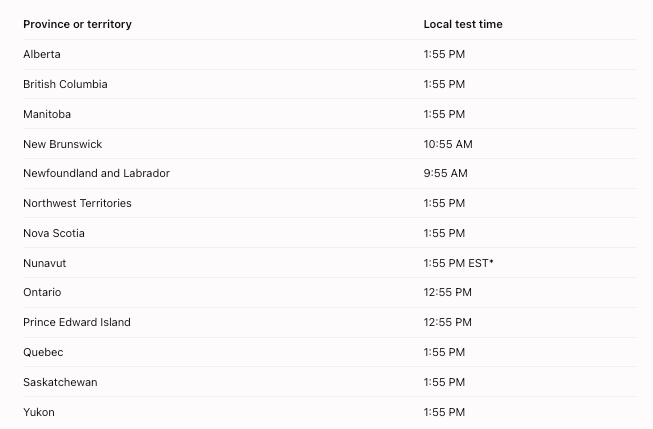
Source: Alert Ready’s November 16, 2026 announcement.
The alerts will be issued by provincial or territorial emergency management organizations rather than being delivered simultaneously across Canada.
What happens when the alert appears?
People with compatible smartphones can expect a loud notification accompanied by an emergency message on their screens.
Television and radio broadcasts may also be interrupted to carry the test.
The notification will identify itself as a test, allowing recipients to distinguish it from an actual emergency warning.
The exercise is designed to familiarize Canadians with the alert system and verify that emergency messages can reach the public through broadcasters and wireless service providers.
It is Canada’s second regularly scheduled national alert test of 2026, following the earlier testing period in May.
Will every cellphone receive the alert?
Not necessarily.
Although the test covers every province and territory, whether a cellphone receives the notification depends on several factors, including device compatibility, network connection, software settings and cellular coverage.
Compatible phones must be connected to an LTE or 5G network to receive wireless Alert Ready notifications.
Someone whose device does not receive the test should not automatically assume their phone is defective or that the emergency alert system has failed.
Canadians can check their phone’s compatibility through the official Alert Ready website.
The system does not offer an opt-out option for emergency notifications, including public tests.
Why Canada regularly tests emergency alerts
Alert Ready is designed to warn people about serious and potentially life-threatening situations, including wildfires, floods, tornadoes and AMBER Alerts involving missing or abducted children.
The system allows authorized government agencies to distribute urgent warnings through television, radio and compatible wireless devices in affected areas.
More than 1,200 emergency alert messages have been issued across Canada so far in 2026, reflecting the system’s role in communicating urgent public safety information.
Regular testing also helps emergency management organizations identify technical problems, assess the reliability of message delivery and prepare for actual emergencies.
The Canadian Radio-television and Telecommunications Commission requires broadcasters and wireless service providers to participate in at least one public alert test annually.
In Nova Scotia, residents using the province’s NS Alert mobile app may receive two notifications if their devices are connected to LTE or 5G, since the provincial app and the national system operate separately.
Those connected through Wi-Fi or 3G may receive only the app notification.