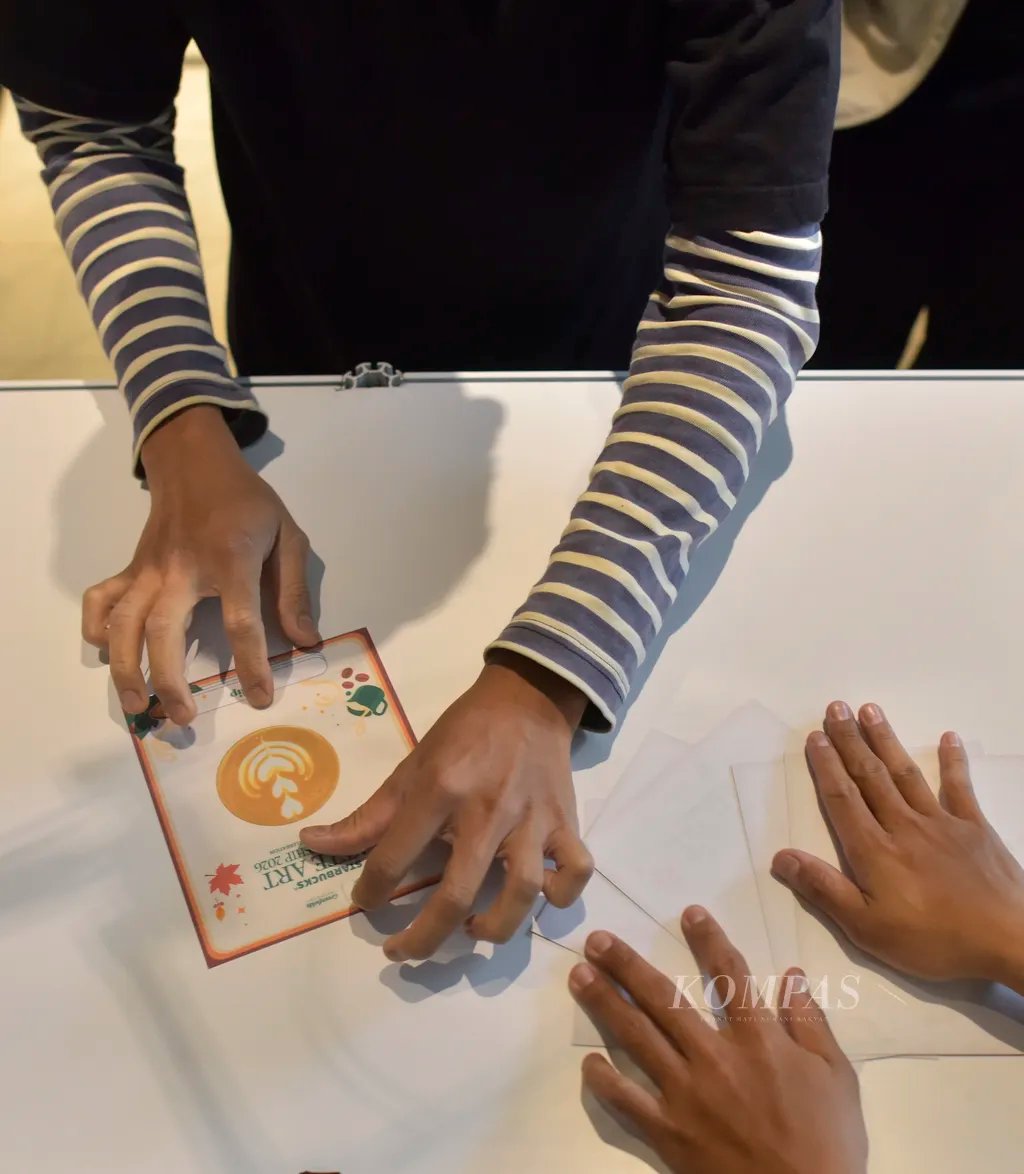
For a barista, the ability to create latte art isn’t just about creating beautiful images on coffee. More than that, latte art must create an experience for the customer.
So, what happens when such a complex art form is executed in just three minutes? This is where the champions of milk foam art emerge.
Barista champions came from all corners of Jakarta on Saturday afternoon (October 24, 2026). They participated in the Latte Art Throwdown, one of the competition categories in the Starbucks Latte Art Championship (SLAC) 2026. The competition was organized by Starbucks Indonesia in collaboration with Greenfields.
Sixteen baristas from various Starbucks outlets across Indonesia came to compete not just for prizes, but for the experience of competing.
The competition rules are quite simple. In the first round, two participants compete head-to-head to create latte art based on a randomly selected image. They create basic patterns, such as tulips, rosettes, and hearts. Each participant has just three minutes to prepare espresso and milk to create their latte art.
Contestants will choose one of several cards that will determine the pattern or shape of their latte art. Two names are called to compete, and then a countdown begins. Contestants are already in front of their respective super-automatic coffee machines. As soon as the judges shout “start,” the steam from the heating machines rises, and the competition begins.
In a one-on-one match, the loser is immediately eliminated. Of the 16 contestants, eight were selected to advance to the next round.
Cheers from each barista’s supporters echoed from behind. The contestants tried their best to imitate the images or patterns presented. In the early stages, simple patterns emerged, such as rosettes, tulips, and hearts. However, as they advanced to the semifinals, the patterns began to become more complex, such as monkey heads.
Three Starbucks judges scored by pointing their hands to the pattern they deemed best. In nearly every round, all three judges consistently chose one latte art.
This format brought Rio Septianto (25), a barista at Starbucks PIM 1, and Mefiboset Dion (27), a barista at Starbucks Adhyaksa, face to face in the final. Meanwhile, those who were eliminated in the semifinals, Hasrul Bahari (31) and Jojo (26), competed once more for third place.
In this phase, the rules have changed slightly. Participants no longer draw pattern cards but are free to choose any design they wish to create. Each participant is given three opportunities to showcase their creations, with three minutes allocated for each attempt.
The long-awaited moment finally arrived. Rio and Dion were back to back, ready in front of the coffee machine. As the three-minute timer began, the espresso machine was turned on, and the strong coffee slowly flowed. While waiting for the coffee to fall into the cup, the two participants prepared the milk. This was the most crucial part: the milk was heated to produce microfoam, or fine milk foam. Therefore, before the hot milk was poured, the milk cup, commonly called the milk jug, was first steamed.
Once the milk is in the milk jug, the espresso is ready. The two of them tap the milk jug together to get the foam to fall to the surface of the milk.
Suddenly, the atmosphere fell silent. The cheering crowd fell silent. They approached the barista’s table to watch the latte art being made.
Less than three minutes later, both contestants presented their cups to the judges. Rio smiled as he looked at his own creation. He had created an eagle head. His opponent, Dion, had created a horse head.
The judges nodded and immediately determined the winner of the first phase. All three judges pointed to Rio’s cup. Rio was currently leading, 1-0.
The second phase has begun, following a similar process. Once again, within just three minutes, two cups were presented to the judges. This time, Rio created a T-Rex pattern, while Dion drew a bird’s head.
In the second phase, the judges began to struggle to determine a winner. The three of them whispered to each other, seemingly contradicting each other. Finally, they all pointed to Dion’s cup.
Dion took a deep breath. The score was tied, 1-1. Rio shook his head. The T-Rex pattern was indeed complex. Just imagine, the head of that extinct dinosaur living atop a strong cup of coffee. However, the bird’s head seemed much more realistic.
The deciding phase began. Dion’s hand muscles spasmed as he held the milk jug. He twirled the small pitcher around in his espresso cup.
Next to him, Rio’s hand appeared to tremble slightly. Both were busy, not glancing at each other. Their eyes were fixed on the cups. After just 1.5 minutes, Dion handed his cup to the judge, followed by Rio. However, within seconds, Rio took his cup back to add the final touches of milk foam on several sides.
Unintentionally, as if reading each other’s minds, they both made the same pattern: a rooster’s head. The judges slapped their foreheads, and the audience frowned. Both the judges and the audience were confused as to who would win in this situation.
It was quite a battle. The judges even debated. However, a winner had to be determined. A few minutes later, the judge pointed to Dion’s cup again. Dion covered his face. He won 2-1, a remontada (turning the tables).
Rio then shook hands with all the judges and Dion. He was satisfied with second place. Hasrul took third place.
Previously, Dion also competed in the main category of SLAC, presenting a narrative based on The Lion King. He emerged as the SLAC 2026 champion, taking home a trophy shaped like the Siren statue, the emblem of Starbucks, in gold.
One of the judges, Renauldy Darma Wijaya, said that animal patterns are known for their complexity. The more realistic the barista creates the pattern, the higher the score. However, latte art is more than just a score; it’s the art of shaping milk foam.
In art, precision is needed.
There are several basic latte art techniques that uniquely take the form of simple patterns, such as rosettas, tulips, hearts, and many others. Animal shapes are a combination of these basic techniques.
“So, it’s not just about transformation; the form of the animal is born from various basic techniques. The judges take that into account,” said Aldy, his familiar name.
One decade
Felicia Andrean, Senior Manager and Public Engagement at Starbucks Indonesia, stated that the organization of SLAC 2026 reflects Starbucks’ commitment to celebrating coffee as a commodity. This competition is part of a month-long series of events to commemorate International Coffee Day, which falls on October 1.
SLAC 2026 was divided into three competitions and participated by 600 participants. Specifically, the grand final was attended by 10 participants, all of whom were Starbucks baristas from various regions. The Latte Art Throwdown was attended by 16 participants, then Virtual Latte Art with a total of 141 participants, with eight of them being Starbucks baristas, while the other 133 were baristas from various outlets or cafes outside Starbucks.
“We didn’t expect such a high level of participation. This time is indeed special as it marks a decade since we started organizing SLAC,” said Felicia.
According to Felicia, the ability to create latte art is important for a barista not only because of the beauty of the image on the coffee. More than that, latte art is a combination of technical skill, an understanding of milk and espresso, and the barista’s approach to creating an experience for the customer.
“Providing an experience for customers is important. As judges, we position ourselves as consumers, and then we are served lattes with beautiful patterns, allowing consumers to truly savor the coffee,” he said.
A cup of coffee isn’t just about its taste and aroma, but also its appearance. Heart, rosetta, or tulip patterns on the surface of the coffee can make the drink feel even more special.
For customers, these small details can reflect the barista’s attentiveness. A well-served cup of coffee conveys that the drink was crafted with skill and care, rather than simply prepared to fulfill an order.