
After almost tripling from its 2022 bear market low point, the technology-heavy Nasdaq-100 index is now facing a big test. Investors are increasingly concerned about the sustainability of the artificial intelligence (AI) spending boom, placing pressure on semiconductor stocks like Nvidia and Micron Technology, which are among the largest members of the index.
As a result, the Nasdaq-100 was down 9% from its peak as of the market close last Friday, and the decline could get worse if investor sentiment doesn’t improve. However, history suggests this could be a great buying opportunity for investors, because the broader market has always recovered to new highs over the long term.
I’m going to share two stocks investors might regret not buying when they look back on this moment in a few years’ time.
Image source: Getty Images.
1. Zscaler: Demand for cybersecurity will only grow from here
Hackers have started using AI to stage highly sophisticated cyber attacks on corporate networks, but enterprises are also placing themselves at risk by exposing their valuable data to third-party AI models without the appropriate guardrails. Zscaler (ZS +0.71%) was one of the early pioneers of the zero trust cybersecurity architecture, which has become one of the best defenses in the AI era.
Zscaler’s Zero Trust Exchange protects the entire enterprise, starting with the identity layer. It treats every network login attempt as hostile, analyzing the user’s credentials, their location, and the device they are using, which maximizes the odds of catching an imposter. Further, the Zero Trust Exchange only allows users to access the applications they need to do their jobs, so even if a hacker bypasses the identity layer, they won’t have unrestricted access to the entire network.
ZS Zscaler
$226.69+$1.60 (+0.71%)
NASDAQ · As of 10:07 AM ET 11/04/26
Zscaler introduced new tools to the Exchange earlier this year, which protect enterprises when they are deploying AI. There is AI Broker, which constantly monitors communications between AI agents, and Endpoint AI Security, which protects the computers and devices employees are using to run AI software.
Zscaler believes a “Zero Trust Everywhere” approach is the best way to protect against AI threats. Hackers can’t attack what they can’t see, so keeping critical data, applications, and agents hidden behind the Exchange is the ultimate form of preventative security.
Zscaler had a record year in fiscal 2026 (ended July 31), with revenue growing by 25% to $3.35 billion. Its stock is trading at a price-to-sales (P/S) ratio of 11.3, so it’s already cheaper than competitors like CrowdStrike and Palo Alto Networks. Therefore, if a further sell-off in the broader market drags Zscaler stock down with it, investors might be presented with a fantastic long-term buying opportunity.
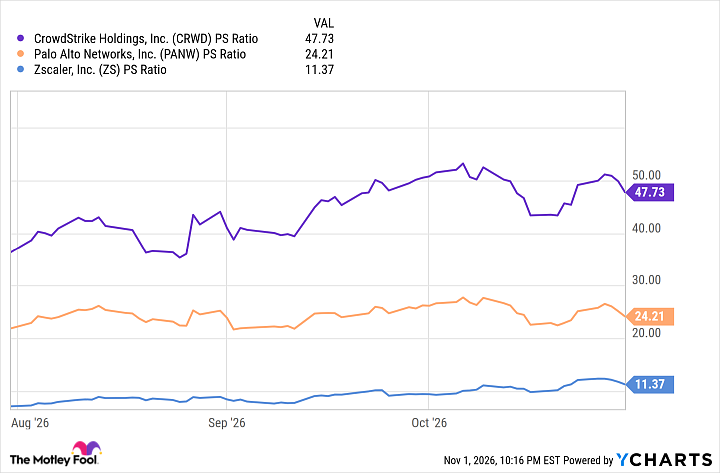
CRWD PS Ratio data by YCharts
2. Meta Platforms: AI is expanding the social media giant’s addressable market
Meta Platforms (META +2.08%) is the parent company of the Facebook, Instagram, WhatsApp, and Threads social media platforms. Over 3.6 billion people use at least one of them every single day, and considering that is almost half the world’s population, it’s getting harder for the company to find new signups. As a result, it’s trying to lift engagement instead — if each user spends more time online, they will see more advertisements, and Meta will make more money.
AI is a big part of that strategy. It’s embedded in the recommendation algorithms on Facebook and Instagram, where it learns what types of content each user likes to see, and feeds them more of it. According to Meta chief executive Mark Zuckerberg, engagement hit record highs on those apps during the third quarter (ended Sept. 30), so the AI-led strategy appears to be working.
META Meta Platforms
$633.94+$12.91 (+2.08%)
NASDAQ · As of 10:08 AM ET 11/04/26
However, there is an even bigger opportunity in the pipeline, and it transcends social media. Meta launched a personal AI agent called Muse in September, and it has already attracted over 10 million users. Zuckerberg recently said one-quarter of them are using it as a personal shopper, with an average purchase value of $200, while others are using it to manage emails, among other things.
Zuckerberg believes Muse could eventually serve billions of people, and it will be capable of improving every area of their lives, whether they want to learn new skills or automate some of life’s everyday tasks. This will substantially increase Meta’s addressable market, because it could replace the need for traditional internet search engines like Alphabet‘s Google Search.
Meta stock is down 20% from its peak amid the recent tech sell-off. It’s now trading at a price-to-earnings (P/E) ratio of just 20.9, so it’s much cheaper than the Nasdaq-100 which has a P/E of 29.9. Therefore, this already looks like a good buying opportunity for long-term investors.