Juanita Arsenault and Wilma Thibodeau’s uncle arrived in England in 1941, spending three years there during the Blitz as well as four months fighting Germans at Dunkirk.
Paul Arsenault of Saint Felix was part of the 8th Battery of the 2nd Heavy Anti-Aircraft Regiment of the First Canadian Army. His nieces visited France, Belgium, Germany and the Netherlands in September, retracing his footsteps during the Second World War.
“His son gave me a list that his father had kept while he was in the war of every place he had been to,” Juanita Arsenault said.
“He also had his service number, and that way I was able to find his regiment. And then I was able to research the regiment, and when I started researching the regiment, I found that they matched exactly what Uncle Paul had written on this piece of paper.”

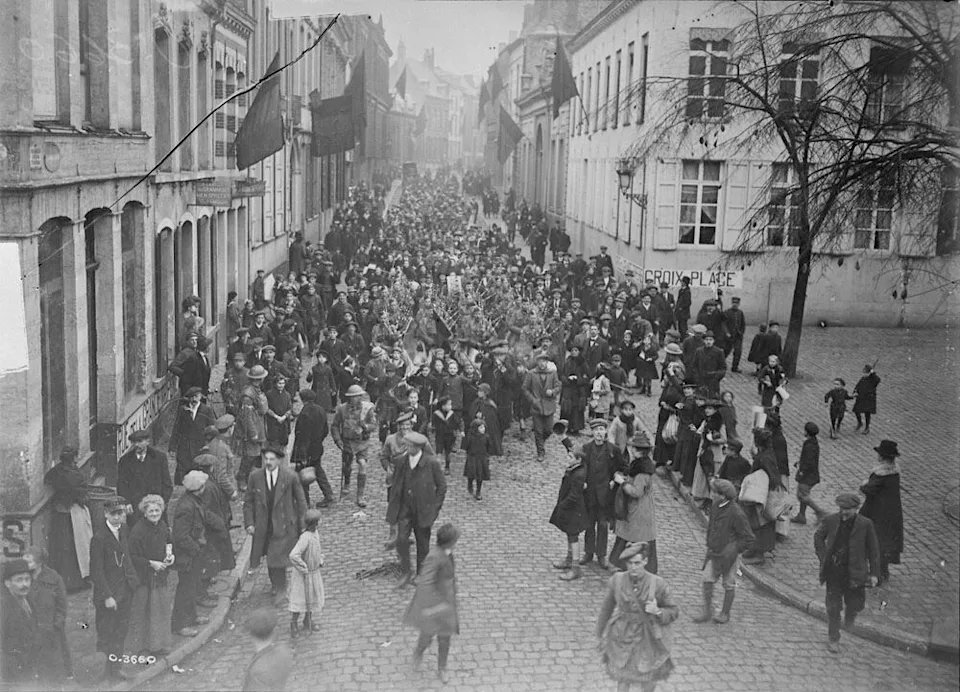
This image, from Library and Archives Canada’s photo archive, shows Canadians marching through the streets of Mons on the morning of Nov. 11, 1918. (Deptartment of National Defence/Library and Archives Canada/PA-003547)
This piqued her curiosity, and she started digging for more, eventually mapping out where Paul was and on which date.
Arsenault said her sister would read the notes as they travelled — of where their uncle was and where they were — to match his story.
“I feel like that piece of paper, it has to be over 80 years old. It’s amazing that he kept it all these years and that his children kept it,” Arsenault said.
“It was really a gift and it helped Juanita when she was doing her research because she kind of cross-referenced it, I guess, with her research to make sure that it was all the places that were listed in the documents that she found.”
The sisters visited churches, memorial sites and the graves of their grandmother’s cousins, both of whom served and died in the First World War. That all conjured up a lot of emotion, they said.
Arsenault said she imagined her uncle at 26 years old, with four years having passed since he last saw his parents and siblings.
The sisters said they wish every Canadian could have the same experience they did.
“I hope this inspires other people to maybe if they’re going to France or anywhere in Europe where there are Canadian cemeteries that maybe they will look up a fallen relative,” Thibodeau said.
“Even if it’s not a relative, maybe it’s a relative of a friend or someone you know, because it’s possible that there are many Canadians who have not been visited.”
Thibodeau said she has a greater appreciation of veterans and their experiences, as well as those who lived through the war.
She noted people in Europe lived through the First World War, which ended Nov. 11, 1918, only to see war tear through the country again when the Second World War began in 1939.
“It just must have been horrific. And visiting that little village, Oradour-sur-Glane, that really opened my eyes, too,” Thibodeau said.
“I always did have an appreciation of veterans … and the freedoms that they brought us. And I think it’s more pronounced now.”

A crowd celebrates VE Day in Montreal on May 8, 1945. (The Canadian Press)
Thibodeau said keeping the memory of veterans alive is important and she hopes their work inspires someone to do something similar — for veterans who were lost and those who returned home.
Arsenault described the trip as “a once-in-a-lifetime journey” and admitted to the fatigue she felt upon arriving home.
Having had a chance to recuperate, she said she would do it again tomorrow.
“I felt Uncle Paul with us during the voyage, and my grandmother,” she said.
“Just what she would have given to [have] been able to go to see their graves … I can’t even imagine.”