Key Points
-
Tesla’s deliveries crushed expectations in the second and third quarters, helped by soaring oil prices.
-
The company’s FSD subscriptions hit 1.74 million, with a revenue run rate approaching $1 billion.
-
At 159 times forward earnings, progress is not enough.
- Motley Fool Issues Rare “Total Conviction” Buy Alert ›
The Magnificent Seven refers to a group of prominent market leaders. It includes Alphabet (NASDAQ:GOOG) (NASDAQ:GOOGL), Amazon (NASDAQ:AMZN), Apple (NASDAQ:AAPL), Meta Platforms (NASDAQ:META), Microsoft (NASDAQ:MSFT), Nvidia (NASDAQ:NVDA), and Tesla (NASDAQ:TSLA). They have been called “magnificent” because they are among the top players in their respective industries and have crushed broader equities over the long run. However, some of them haven’t been so magnificent this year — several have lagged the S&P 500 to date. And the worst-performing, as of writing, has been Tesla (though Nvidia is a very close second). Is the electric vehicle (EV) company a buy on the dip before 2027?
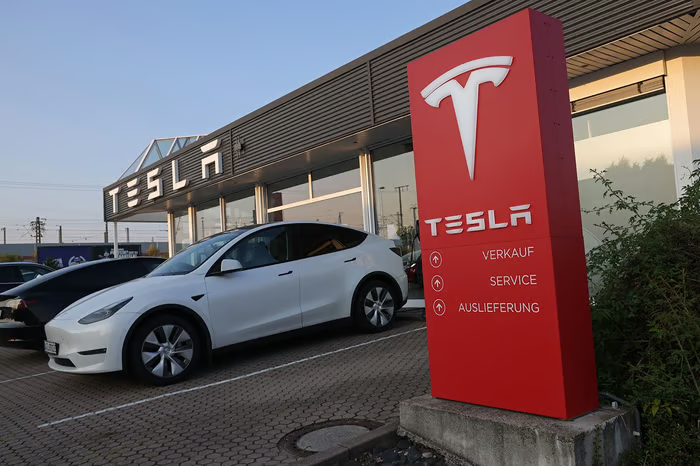
Image source: Getty Images.
Missed Nvidia in 2009? This Rare Signal Is Flashing Again. In 2009, a “Double Down” signal flashed for a little-known chipmaker called Nvidia. For the first time in years, that same “Total Conviction” signal is flashing for a company 1/100th the size of Nvidia. Continue »
Tesla’s core business has rebounded, somewhat
One puzzling fact about Tesla’s performance this year is that despite lagging the market, its core EV business has beaten expectations. In the second and third quarters, Tesla’s deliveries exceeded analysts’ projections. There were several reasons for that. Here are two of the most important. First, Tesla benefited from macroeconomic factors. Conflicts in the Middle East led to soaring oil prices and, as a result, many consumers decided to buy EVs instead of gas-powered cars.
This led to a boost in sales across much of the industry. Second, Tesla’s management has argued that the company’s Full Self-Driving (FSD) software is increasingly attracting buyers. In the third quarter, the company’s FSD attach rate (the percentage of new car buyers who opt in for the monthly FSD service) grew almost 20 percentage points quarter-over-quarter in North America, reaching over 75%.
Total FSD subscriptions for the period came in at 1.74 million, up 67% year-over-year (including lifetime subscriptions purchased upfront, though Tesla no longer offers those). On theearnings call management confirmed FSD subscriptions are now generating revenue at an annual run rate approaching $1 billion.
That’s a small fraction of the company’s trailing 12-month revenue of $103.57 billion, but at the rate they are growing, FSD subscriptions could become a meaningful growth driver over the medium term. That could matter for the bottom line, since subscription revenue arguably comes with juicier margins than car sales. Over time, it could give Tesla’s profits a lift.
Progress with the robotaxi ambitions
So why has Tesla’s stock dropped so much this year despite EV deliveries beating expectations and FSD subscriptions growing fast, which is driving demand for the company’s vehicles? One reason is that its actual financial results have been mixed. In the third quarter, Tesla’s revenue of about $28 billion remained pretty much flat year over year.
But the company’s GAAP earnings per share of $0.22 dropped 44% compared to the year-ago period. Tesla R&D spending has increased significantly as the company continues to invest in future opportunities. The question is whether these projects can pay off. Consider Tesla’s robotaxi ambitions.
It has also made some headway in that market this year. In September, Tesla launched the Cybercab, a two-seat autonomous vehicle built without a steering wheel, pedals, or mirrors. Tesla hopes it becomes the cornerstone of its robotaxi fleet. If it can scale its fleet over the next few years and attract significant business, robotaxi sales — and profits — might soar.
Tesla also recently announced it would start selling the Cybercab to select customers. It will cost about $30,000 upfront, pretax, plus a mandatory $299-per-month Autonomy Subscription (without it, the car can’t go anywhere). It can be operated only in certain geographic locations.
At that price and with those subscription fees, Tesla could collect more than $35,000 in subscription fees alone over 10 years on each Cybercab — so customers would essentially be spending a little more than the initial purchase price every decade they own it, assuming no price changes. If Tesla can attract enough customers, this business could become highly lucrative for the company.
Is the stock a buy before 2027?
With all that said, Tesla faces considerable uncertainty. First, the Cybercab may not attract the kind of business the company hopes for, whether as a robotaxi or for personal use. Second, Tesla could face significant pushback from regulators. In fact, the National Highway Traffic Safety Administration (NHTSA) opened an audit into how Tesla certified the Cybercab’s compliance with federal safety standards as soon as it hit the roads back in September.
Third, Tesla’s shares trade at a steep premium, which may be one of the most important reasons the stock has gone nowhere this year, despite progress in its robotaxi and core EV businesses. Shares are currently trading at 159.3x forward earnings. At current levels, I’d rather stay away. If Tesla stock falls much further before 2027, perhaps it’ll be worth investing in the company.
We just issued ‘double down’ alerts on 3 stocks — find out if Tesla made our list
Ever feel like you missed the boat in buying the most successful stocks? Then you’ll want to hear this.
On rare occasions, our expert team of analysts issues a “Double Down” stock recommendation for companies that they think are about to pop. If you’re worried you’ve already missed your chance to invest, now is the best time to buy before it’s too late. And the numbers speak for themselves:
- Nvidia: if you invested $1,000 when we doubled down in 2009, you’d have $404,164!*
- Apple: if you invested $1,000 when we doubled down in 2008, you’d have $67,180!*
- Netflix: if you invested $1,000 when we doubled down in 2004, you’d have $321,850!*
Right now, we’re issuing “Double Down” alerts for three incredible companies, available when you join Stock Advisor, and there may not be another chance like this anytime soon.
*Stock Advisor returns as of November 18, 2026.
Prosper Junior Bakiny has positions in Alphabet, Amazon, Meta Platforms, and Nvidia. The Motley Fool has positions in and recommends Alphabet, Amazon, Apple, Meta Platforms, Microsoft, Nvidia, and Tesla. The Motley Fool has a disclosure policy.