Robinhood (NASDAQ: HOOD) reported record third-quarter revenue of $1.42bn, up 12% on a year earlier, but diluted earnings per share fell 16% to $0.51. The retail brokerage’s shares closed up 1.85% at $94.56 today before the results.
In after-hours trading shortly after the close, the stock was down about 4%.
Revenue of $1.424bn was in line with the $1.43bn average estimate of 21 analysts, according to Yahoo Finance. The average EPS estimate was $0.55 from 22 analysts, against diluted EPS of $0.51, though the estimate’s accounting basis is not specified. Robinhood’s adjusted EPS, a new measure this quarter, was $0.60, down 3% from $0.62.
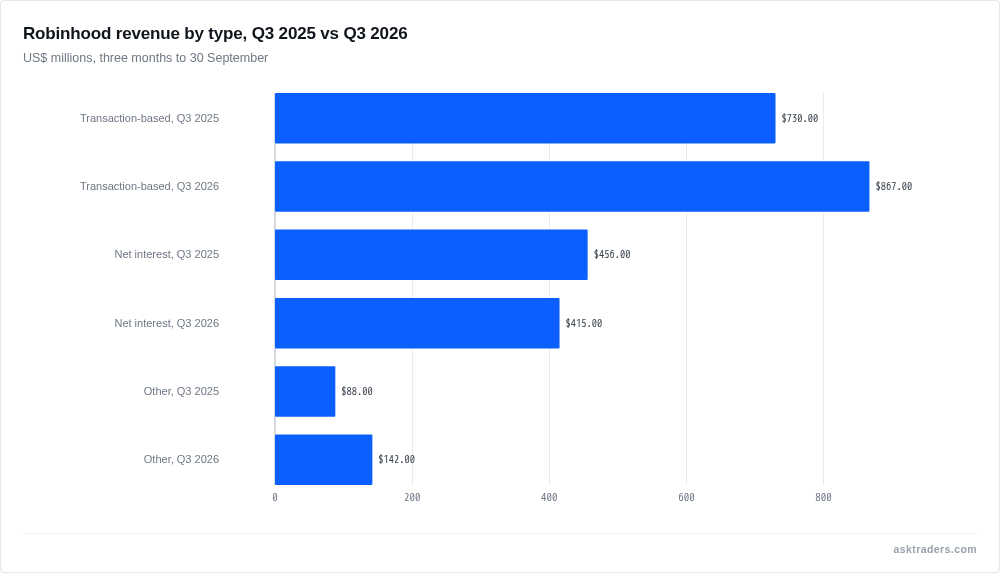
Trading activity carried the quarter. Transaction revenue rose 19% to $867m, with event contracts up more than sixfold to $173m, options up 31% to $399m and equities up 41% to $121m. Cryptocurrency revenue fell 55% to $120m.
Net interest revenue fell 9% to $415m, on lower securities lending and lower short-term interest rates. Other revenue rose 61% to $142m, driven by Trump Account service revenues and higher Gold subscription revenues.
Costs grew faster than revenue. Operating expenses rose 16% to $739m, with provisions for credit losses at $71m against $26m a year earlier as the credit card loan book grows. Net income fell 14% to $476m, including $67m of unrealised losses, mostly on Robinhood Ventures Fund I.
The customer base kept growing. Funded customers rose 7% to 28.7m, Gold subscribers rose 34% to a record 5.2m, and platform assets rose 19% to $396bn on net deposits of $15.7bn. Robinhood also launched crypto trading in the UK during the quarter.
Chief financial officer Shiv Verma said:
“We’re entering Q4 with strong momentum, as October Net Deposits have already topped $13 billion month-to-date, including $6 billion from the Dell family’s contribution to Trump Accounts.”
Shiv Verma, chief financial officer, Robinhood
Robinhood lowered the top end of its 2026 adjusted operating expenses and share-based compensation outlook by $25m, to a range of $2.675bn to $2.75bn, “to reflect ongoing efficiency gains”. The outlook excludes credit-loss provisions.