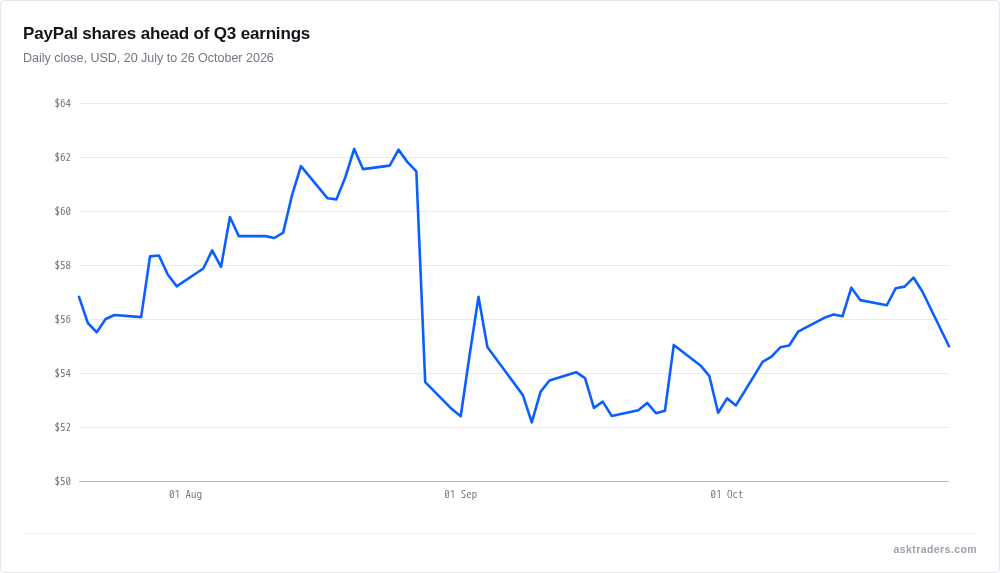
Seagate Technology (NASDAQ: STX) shares fell 8.6% in after-hours trading today after the data storage maker reported record profitability for its fiscal first quarter.
Revenue rose 61% from a year earlier, and the company guided to higher sales again next quarter.
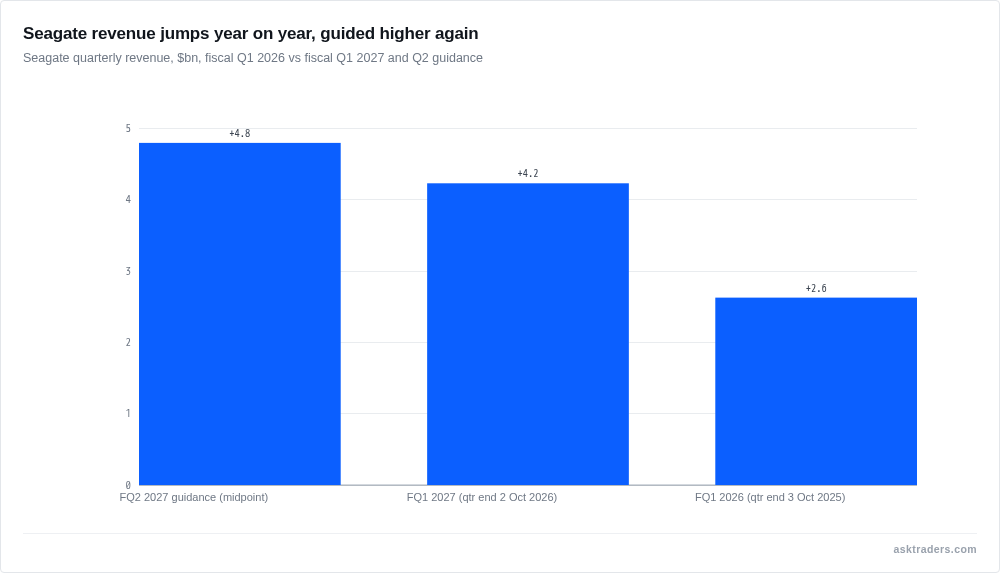
Revenue for the quarter ended the 2nd of October was $4.233bn, against $2.629bn a year earlier. The non-GAAP gross margin widened to 57.8% from 40.1%, and the non-GAAP operating margin reached 50.7% from 29.0%.
Ready to put what you’ve learned into practice?
Try IG’s platform with £10,000 in virtual funds and practise trading
without putting your own money at risk.
Spread bets and CFDs are complex instruments and come with a high risk of losing money rapidly due to leverage. 69% of retail investor accounts lose money when trading spread bets and CFDs with this provider.
Learn the markets with IG Academy
Build your knowledge with IG Academy educational content, then use a
demo account to practise what you’ve learned on the IG platform.
Spread bets and CFDs are complex instruments and come with a high risk of losing money rapidly due to leverage. 69% of retail investor accounts lose money when trading spread bets and CFDs with this provider.
See how trading works before risking real money
IG’s demo gives you access to thousands of markets and £10,000 in
virtual funds, so you can explore the platform and test your ideas first.
Spread bets and CFDs are complex instruments and come with a high risk of losing money rapidly due to leverage. 69% of retail investor accounts lose money when trading spread bets and CFDs with this provider.
Turn trading theory into practical experience
Learn with IG Academy, explore charts and market tools, and practise
strategies in a simulated trading environment before going live.
Spread bets and CFDs are complex instruments and come with a high risk of losing money rapidly due to leverage. 69% of retail investor accounts lose money when trading spread bets and CFDs with this provider.
Ready to take your learning further?
IG combines market education, analysis and an established trading platform,
giving you the tools to keep learning as you develop your trading skills.
Spread bets and CFDs are complex instruments and come with a high risk of losing money rapidly due to leverage. 69% of retail investor accounts lose money when trading spread bets and CFDs with this provider.
Non-GAAP earnings per share were $7.68, up from $2.61. GAAP net income, the standard accounting measure, more than tripled to $1.761bn from $549m, and GAAP earnings per share were $7.59 against $2.43.
Free cash flow, the cash left after capital spending, reached $1.479bn against $427m a year ago. Seagate retired about $1.2bn of debt in the quarter, leaving gross debt at $2.4bn at quarter end. It retired a further $750m after the quarter closed, taking gross debt to $1.6bn. Interest expense halved to $41m from $80m.
It returned $568m to shareholders through dividends and buybacks and raised its quarterly dividend about 3% to $0.76 a share from $0.74. That is payable on the 7th of January to holders on record on the 23rd of December.
For the fiscal second quarter, Seagate guided to revenue of $4.8bn, plus or minus $100m, about 13% above this quarter. It expects non-GAAP earnings per share of $9.20, plus or minus $0.20, roughly 20% above the latest figure.
Seagate quarterly revenue, $bn: fiscal Q1 2026, fiscal Q1 2027 and the midpoint of fiscal Q2 guidance. Source: Seagate
Chief executive Dave Mosley pointed to the company’s HAMR-based product roadmap, supply discipline and value-based pricing, and described demand this way:
Data creation, retention and reuse continue to compound storage demand with long term customer demand visibility reinforcing our view of a multi-year growth phase.