Last Updated:
Protests over living costs, public services, housing and education spread across Europe, with clashes in France and Albania and demonstrations in Italy, Portugal and Belgium.




French riot police walk past burning objects in a street amid clashes with protesters in Paris (Photo: Reuters)
Protests over rising living costs, declining public services, education standards and perceived government failures spread across several European countries on Saturday, with demonstrations in France and Albania turning violent as police clashed with protesters, public buildings were damaged, and arrests were made.
Italy, Portugal and Belgium also witnessed demonstrations, with unrest in parts of Italy prompting police to use tear gas and water cannons.
In France, hundreds of thousands of people took to the streets against rising living costs, deteriorating public services and inequality.
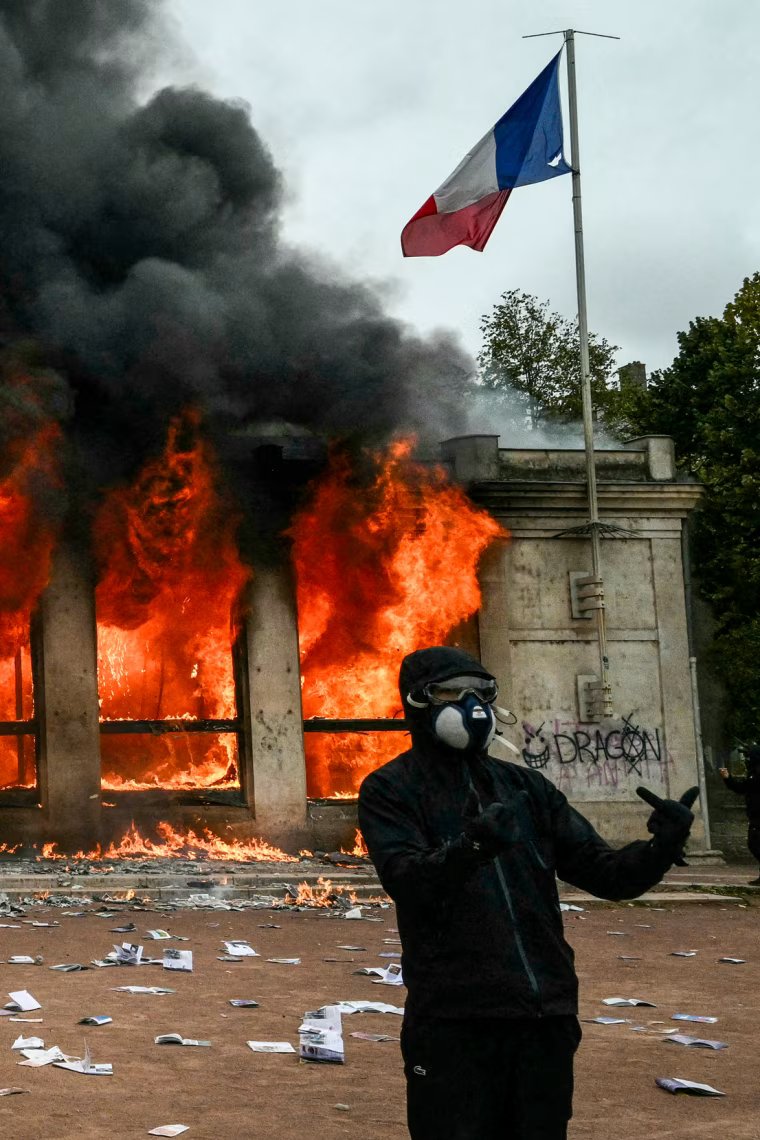
While many demonstrations remained peaceful, violent groups attacked police, looted shops and set buildings and vehicles on fire in several cities, Reuters reported.
In Albania, anti-government demonstrations entered their fifth consecutive day in the capital, Tirana, as protesters demanded the resignation of Prime Minister Edi Rama.
Police fired rubber bullets for the first time during the week-long unrest, according to AFP, while officers also deployed tear gas, water cannon and pepper spray.
The unrest reflects mounting discontent over living standards, education, housing affordability and government policies in different parts of Europe. However, the immediate triggers and demands varied from country to country.
At A Glance
France saw widespread protests, looting, arson and clashes with police, with around 550,000 participants estimated by the interior minister.
Albania’s fifth day of anti-government unrest left 35 people wounded on Saturday, according to the health ministry, while police reported 167 arrests.
Italy, Portugal and Belgium also witnessed demonstrations over living costs, housing affordability and education expenses.
France Sees Widespread Protests, Arson And Looting
France witnessed some of the largest demonstrations, with crowds gathering in cities across the country to protest against rising living costs and declining public services.
Interior Minister Laurent Nunez said around 550,000 people participated in the demonstrations, while the CGT union estimated the turnout at 800,000, Reuters reported.
Although hundreds of thousands marched peacefully, violent groups targeted public buildings, businesses and police.
In Limoges, the city hall was set ablaze. In Marseille, protesters broke into the city hall and defaced the building with graffiti, and in Lyon, demonstrators set fire to the city’s tourist office.
In Paris, police fired tear gas as they retreated in the face of protesters.
Rioters attempted to break into the Galeries Lafayette department store, smashed banks, ransacked a Lacoste store and other boutiques, and looted an SFR mobile phone shop.
Cars and other objects were also set on fire.
French Prime Minister Sebastien Lecornu said the government would not be intimidated by violence, blaming the unrest on the far left and criminals ahead of next year’s presidential election.
“To those who clearly want to use this violence as a ‘warm-up’ before the presidential election, I say clearly: We will not let ourselves be intimidated. No one will impose their political agenda through violence,” Lecornu wrote on X.
President Emmanuel Macron also vowed to prosecute those responsible for the attacks. He said the country would stand united against people seeking to undermine institutions and prevent peaceful demonstrators from expressing their demands.
Lecornu said around 1,200 people had been arrested in connection with the protests.
More than 150 police officers were injured on Saturday, he added.
The demonstrations began last month at high schools in working-class northern suburbs of Paris, where anger over teacher shortages and poor facilities developed into a broader movement focused on inequality, public spending and living standards.
Police tactics have also come under scrutiny. Reuters reported that the police watchdog was investigating at least two dozen allegations of police violence.
Interior Minister Nunez confirmed that one person had lost a hand during clashes after reportedly trying to pick up a stun grenade.
A 19-year-old protester, Lola, told Reuters that demonstrators were angry about the cost of living, high fuel prices and conditions in schools, including injuries sustained by students during protests.
Albania Protests Enter Fifth Day As Police Fire Rubber Bullets
In Albania, violent clashes continued in Tirana for a fifth consecutive day as protesters demanded the resignation of Prime Minister Edi Rama.
Demonstrators threw rocks, petrol bombs, Molotov cocktails, flares and fireworks at police, while officers responded with tear gas, water cannon and baton charges, according to AP and AFP.
The unrest escalated after high school and university students joined a broader anti-government movement.
Demonstrators set cars and rubbish bins on fire, using burning barricades to obstruct police advances. Buildings, including the Supreme Court, banks and the post office, were set on fire or severely damaged, AFP reported.
Albania’s Health Ministry told AFP that 35 people were wounded on Saturday, including 18 police officers and 17 protesters.
Police chief Skender Hita said 167 people had been arrested during the week’s protests, while criminal proceedings had been initiated against 388 people.
He also said 132 police officers had been injured over five days of unrest.
Seven officers were suspended pending disciplinary investigations into allegations that they had exceeded their authority.
Hita defended the police response, saying rubber bullets had been used in a limited manner and that officers had deployed certified equipment permitted in such circumstances.
The demonstrations have been fuelled by anger over perceived government corruption, unemployment and poor education standards.
The latest unrest follows months of protests against a luxury tourism development on Albania’s southern coast linked to an investment firm founded by Jared Kushner, US President Donald Trump’s son-in-law, AP reported.
Rama, who has been in office since 2013, has ruled out resigning and accused conservative opponents of inciting the clashes. He said the right to protest would be protected but warned that he would not allow violence to jeopardise the country’s future.
The demonstrations also spread beyond Tirana. Local media reported further protests in the coastal town of Durres, where demonstrators smashed post office windows and blocked roads with burning barricades, AFP reported.
Italy Sees Clashes During Cost-Of-Living Protests
Italy also witnessed demonstrations against the rising cost of living, with protests in Milan and Bologna turning disorderly, Reuters reported.
In Milan, a march against high living costs degenerated into clashes, prompting police to use tear gas to clear the city’s central cathedral square.
In Bologna, police deployed water cannons to disperse crowds after another demonstration turned violent. Seven people were arrested, according to the ANSA news agency, as cited by Reuters.
The demonstrations formed part of a wave of protests across Europe over living costs and economic pressures.
Portugal Sees Fresh Protests Over Housing Affordability
In Portugal, tens of thousands of people took to the streets of Lisbon following days of unrest to protest against housing and other living costs, Reuters reported.
Housing affordability has emerged as a central concern for protesters. Reuters reported that housing prices in Portugal had doubled since 2017, fuelling one of Europe’s worst affordability crises.
The demonstrations came amid broader discontent over the cost of living across the continent, with protesters in several countries raising concerns about the ability of households to cope with rising expenses.
Belgium Witnesses Clashes Over Education Costs
Belgium also saw demonstrations, with several hundred people, mostly young protesters, taking to the streets of Brussels. Some demonstrators clashed with police, Reuters reported.
Student groups said they were protesting against rising education costs and reforms they feared would make higher education less accessible.
The demonstrations were partly inspired by the protests in France, according to Reuters, highlighting how concerns over public services, education and living standards were appearing across national borders.
European Governments Face Pressure As Unrest Spreads
The protests across France, Albania, Italy, Portugal and Belgium reflect a range of grievances, from rising living costs and housing affordability to education standards, public services and allegations of government failures.
The scale and intensity of the demonstrations varied considerably.
France saw hundreds of thousands of people participate in marches, alongside arson, looting and clashes with police.
In Albania, demonstrations demanding the prime minister’s resignation resulted in injuries, arrests and damage to public institutions.
Italy witnessed violent episodes during cost-of-living protests, while Portugal and Belgium saw demonstrations centred on housing and education costs.
In France, the government has vowed to hold those responsible for violence accountable, while in Albania, Rama has rejected calls to step down.
The police response in both countries has become a significant part of the unfolding situation, with injuries among demonstrators and officers and investigations into alleged misconduct.
Quick Answers
 Ask News18
Hundreds of thousands of people in France took to the streets to protest rising living costs, deteriorating public services, inequality, and high fuel prices. While many marches were peaceful, violent groups engaged in arson, looting, and clashes with police, resulting in about 1,200 arrests and over 150 injured police officers.
Ask News18About the Author

Vani Mehrotra is the Deputy News Editor at News18.com. She has more than 10 years of experience in national and international news and has previously worked on multiple desks.
October 18, 2026, 12:20 IST
Read More