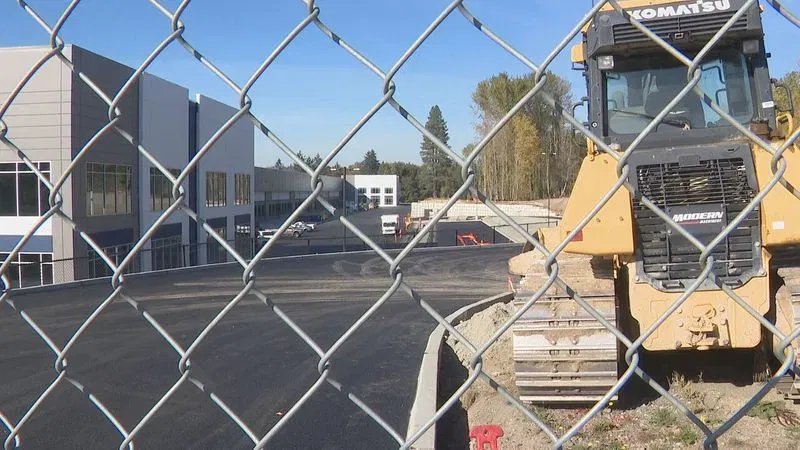
SEATTLE — In less than six months, Dallas-based defense technology company Shield AI will expand its footprint to the Seattle area, where it will build its AI-piloted fighter jet, called the X-BAT.
Shield AI says it is now in the process of hiring thousands of people to give this fully autonomous strike fighter the push it needs to successfully integrate into the U.S. military combat fleet.
The X-BAT is an uncrewed, cutting-edge combat aircraft designed to take off and land vertically from ships, small islands, and remote sites without conventional runways.
It could be a game changer when it comes to aircraft vulnerability and critical mission support.
Armor Harris, vice president of Shield AI, says, “The whole premise behind X-BAT is to reduce the vulnerability of the aircraft on the ground by making it mobile on the ground so the aircraft can land somewhere, get refueled, get rearmed, move to a different spot, launch again, and do that inside of how fast the adversary can find, fix, and target it, which enables survivability on the ground.”
Shield AI plans to set up shop at its new Des Moines facility, currently under construction, in March 2027.

In less than six months, Dallas-based defense technology company Shield AI will expand its footprint to the Seattle area, where it will build its AI-piloted fighter jet, called the X-BAT. (KOMO News)
X-BAT production will take place there, including the production of its frames, components, testing vehicles, systems, and avionics. The company plans to demonstrate mission capability by 2028 and begin full production by 2029.
“We really were looking for what has the best aerospace workforce and talent. You know, this is a pretty serious aircraft. It’s groundbreaking in a lot of different ways, so we were looking at a region in the U.S. that had the best folks that were actually going to be able to pull it off, and we found that right here in the Puget Sound,” Harris says. He tells KOMO the U.S. Navy has been driving the development program, with $200 million in development funding already behind the project.
“Shield has built and flown a variety of vertical takeoff and landing smaller-scale aircraft that actually operate off U.S. Navy and U.S. Coast Guard ships operationally all the time today, so we’ve really perfected a lot of the con-ops, a lot of the software associated with landing on a ship that’s rolling in the middle of the night in bad weather, no GPS, etc. There’s been a tremendous drive to get this highly asymmetric and game-changing capability out to the joint forces as quickly as possible. The prototype is going to actually be done in about two weeks, and then we’re going to be getting into flight testing around the end of this year. Fundamentally, what we want is for Xi Jinping to wake up every morning and say, ‘Hey, today is not the day we want to go to war with the United States because of the incredible capabilities that the U.S. military has,’” Harris said.
“What’s the concern they [China] could get their hands on something like this as well and be right there competing with us?” asked KOMO News anchor Preston Phillips.
“Safeguarding the technology is of critical importance, so, you know, the U.S. government has a robust system of classification to protect critical information,” Harris said. “Shield also has a robust set of networks to protect information that may not be classified but may be of great importance. And this is something we uniquely have to deal with because when you work in this industry, and you’re building game-changing defense products, you will have the best state-funded actors coming after you from a cybersecurity standpoint and other security domains as well, so it’s something we have to take very seriously, and it’s something we have to spend a lot of effort to ensure that there aren’t issues.”
The X-BAT’s production cost, according to Harris, is about a third of what it costs to produce a $100 million F-35 fighter jet.
“It carries the same payload as F-35, but goes about twice as far, all without a pilot, so fundamentally it opens up a lot of options for commanders and creates a lot of dilemmas for adversaries. It can operate collaboratively with other manned aircraft. Think F-35, F-22 or the forthcoming sixth-gen [aircraft]. It can also operate standalone, so think about flying over a place like Iran. Very dangerous surface-to-air missile environment. Be able to do that autonomously without putting American pilots at risk to carry out the most dangerous missions,” Harris said.
“Do you think this will replace traditional fighter jets?” Phillips asked.

A rendering of an AI-piloted X bat fighter jet. (Courtesy: Shield AI)
Harris responded, “I think it will augment for a long time. Replace is a strong word. We’re still flying B-52s that were built in the late ’50s, early ’60s, so I think manned aircraft will be around for a long time because ultimately war is a very complicated thing and there are certain missions where you absolutely have to have a person out there, but there are other missions where you don’t and you shouldn’t, and that’s the role that we see this filling.”
Part of the X-BAT’s ingenuity is the autonomous software created by Shield AI called Hivemind that powers it, allowing the aircraft to fly and execute combat or reconnaissance missions without human remote piloting.
“You’re basically giving it tasking instructions, so think about how an aircraft controller gives instructions to an airline pilot. Very similar interface to the X-BAT, where controllers on the ground or in another jet in the air will basically give it instructions and ask it to go and carry out objectives, and it will do that,” Harris said.
If all goes as planned, the development of the X-BAT in the Puget Sound region will support an estimated 8,000 jobs by 2030 and an estimated 27,000 by 2046, adding roughly $73 billion to the local economy.
Harris says, “There’s been a tremendous amount of interest from international allies and partners that will further increase the production rate of the platform and then add more jobs as we go along.”
Although much of the X-BAT’s development will take place in the Puget Sound region, flight tests will happen at Shield AI’s facility at the Newton City-County Airport in Newton, Kansas, because of the amount of open airspace available.
Every X-BAT will complete production acceptance testing in Newton before delivery, and customers will conduct their own acceptance flights there.
Newton will also support development flight testing and serve as the center for maintenance, repair, and overhaul (MRO) for the fleet.