-
Bill Connelly
Close
Bill Connelly
ESPN Staff Writer
- Bill Connelly is a writer for ESPN. He covers college football, soccer and tennis. He has been at ESPN since 2019.
Multiple Authors
What with the three-week-long international break and the Premier League‘s announcement of the 114 guilty charges against Manchester City, you’d be forgiven if you forgot that we’re actually in the middle of another Premier League season.
You’d also be forgiven if you feel confused, apathetic, or any other number of emotions about watching a competition where the current leader (A) systematically broke the league’s rules for a decade, and (B) could, at any moment, be told they’ve been expelled from the league.
We, too, feel the same way. And it is with that cloud hanging over everything that we’ve returned to rank all 20 Premier League teams for the first time since the start of the season.
Theoretically, there could be another title race between Man City and Arsenal. And beyond the top two, well, almost everything else feels totally up for grabs. Here’s where we think things stand with 33 games left to play.
The updated Premier League team rankings
Our rerankings — the combination of the individual rankings from Bill Connelly and Ryan O’Hanlon — are listed along with the last rankings from before the season began in August, and each team’s present points total and ranking in the Premier League table.
Do Arsenal have a fatal flaw?
Are the cracks finally starting to show?
First, they barely got over the line against Sunderland. Sure, the match ended 2-0, but the expected goals (xG) and shots totals were essentially even. And Sunderland managed more touches inside the opposition penalty area than Arsenal.
Then everything fell apart against Brighton. The Seagulls pressed the Gunners into oblivion and were up 2-0 by halftime. Despite leading for most of the match, they outshot Mikel Arteta’s side 17-11 and ended up 3-0 victors.
This felt like a game we see every couple years: a smaller side wonders, “Hey, what if we actually tried to take the game to the best team in the league?” And then, it actually works.
Did Brighton just reveal the how-to-beat-Arsenal blueprint to the rest of the league? Perhaps, but I wouldn’t count on it.
Last season, the Gunners averaged 1.6 non-penalty expected goals per match, and they conceded 0.7. This season, they’re averaging 1.5 non-penalty expected goals per match, and they’ve conceded 0.7. Barely anything has changed — other than a couple of stray shots finding the back of the net.
If you want to worry, here’s how I’d do it: Extrapolate that very minor decline out to a 38-game season, and you’d expect Arsenal to score four (3.8) fewer goals than they did last season. And that’s despite everyone important on the attacking end being healthy: Martin Odegaard, Bukayo Saka, Kai Havertz, and Riccardo Calafiori have started all five games after they sat out significant portions of last season.
Havertz is already injured again, and it’s unlikely the other three stay healthy for the rest of the campaign. Once that happens, won’t the attack decline by an even bigger degree?
The lack of attacking depth remains a problem, but this team also put up 26 shots and 4-plus xG, on the road, against Napoli in the Champions League a few weeks ago. On top of that, the set piece dominance hasn’t really kicked in yet — they’re just ninth in the league in xG created from set pieces so far. And new signing Bruno Guimarães, one of the best on-ball midfielders in the Premier League over the past couple of seasons, has barely had an impact across the first five matches.
In other words, Arsenal have just as many paths to improvement as paths to decline. And then, well, Manchester City suddenly has the reverberations of the 114 guilty charges to deal with — on top of a defense that frequently has been exposed:
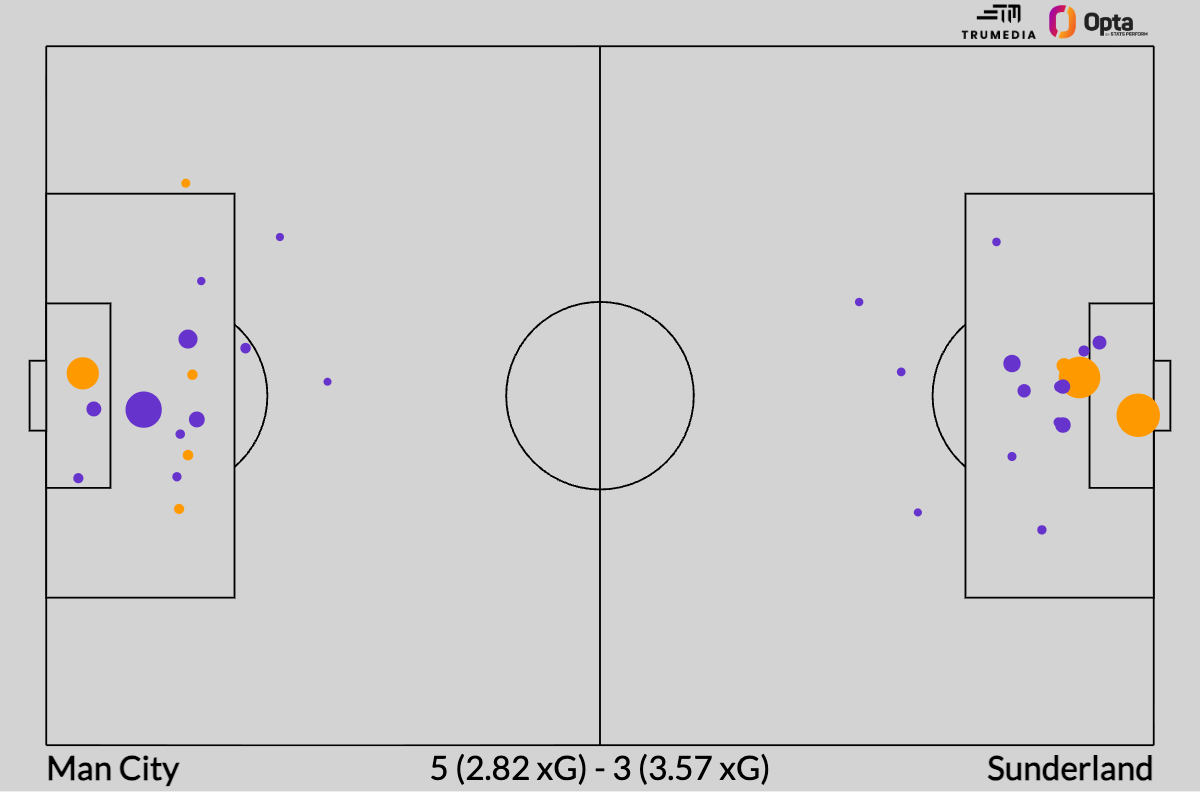
Orange are goals, purple are shots, and the larger the circle, the higher the xG value.
That’s the most xG Man City have conceded in a home Premier League match over the past five years. That, and everything else happening at the club, is a much bigger worry than Arsenal’s one bad game against Brighton. — O’Hanlon
Is Brentford’s rise sustainable?
Brentford are fourth in the standings after five matches, and maybe the most impressive thing about that is that they’ve given away points.
In a run of three straight draws — 1-1 to Leeds and Sunderland, 2-2 to Bournemouth — they led on three different occasions only to allow equalizers. But 3-0 wins over Spurs and Chelsea have given them the third-best goal differential in the league, and the fact that they rank even higher in xG differential (plus-3.6, second) tells us they aren’t here via good fortune.
Brentford are simply quite good. But are they good enough to finish in the top five?
In a league in which most teams’ plan seems to be “Prove to your fans that you’re spending money,” Brentford have crafted a plan around actually trying to make pieces fit together and having players who understand their roles and are good at them.
• Defensive midfielder Vitaly Janelt leads the league with 16 interceptions and is second in successful tackles (17). Fellow defensive midfielder (and primary new addition) Mamadou Sangare is eighth in the league in both ground duels won (25) and tackles won (14). He also leads his team in ball recoveries (22) and is second in fouls won (five). He was brought in to provide aggression and athleticism, and he’s providing it.
• Center back Kristoffer Ajer is 12th in total aerial attempts (29, of which he has won a robust 69.0%) and 18th in total defensive interventions (57).
• Left winger Kevin Schade is tied for third in the league with three goals (only Erling Haaland and Alexander Isak have scored more) and is ninth in the league in one-on-one attempts (21). Sangare is the primary aggressor in the middle third, then Schade takes over in the attacking third.
• Center forward Igor Thiago is 14th in the league in shot attempts (13) and fifth in xG (3.2). Few are better at carving out space in the box. He has scored only once, but he’s likely due some progression toward the mean in that regard.
Brentford have always been able to play the directness card during what is now a five-year run in the Premier League. But with every passing season, they seem to get better at it.
Looking at two measures — direct speed (speed per second with which the ball advances toward the goal in a given sequence) and the percentage of a team’s pass attempts that are line-breaking passes — we see that only Hull City play more direct ball than Brentford. And among the current top five teams in xG differential (Arsenal, Brentford, Manchester City, Manchester United and Brighton), they play a completely different style of ball.
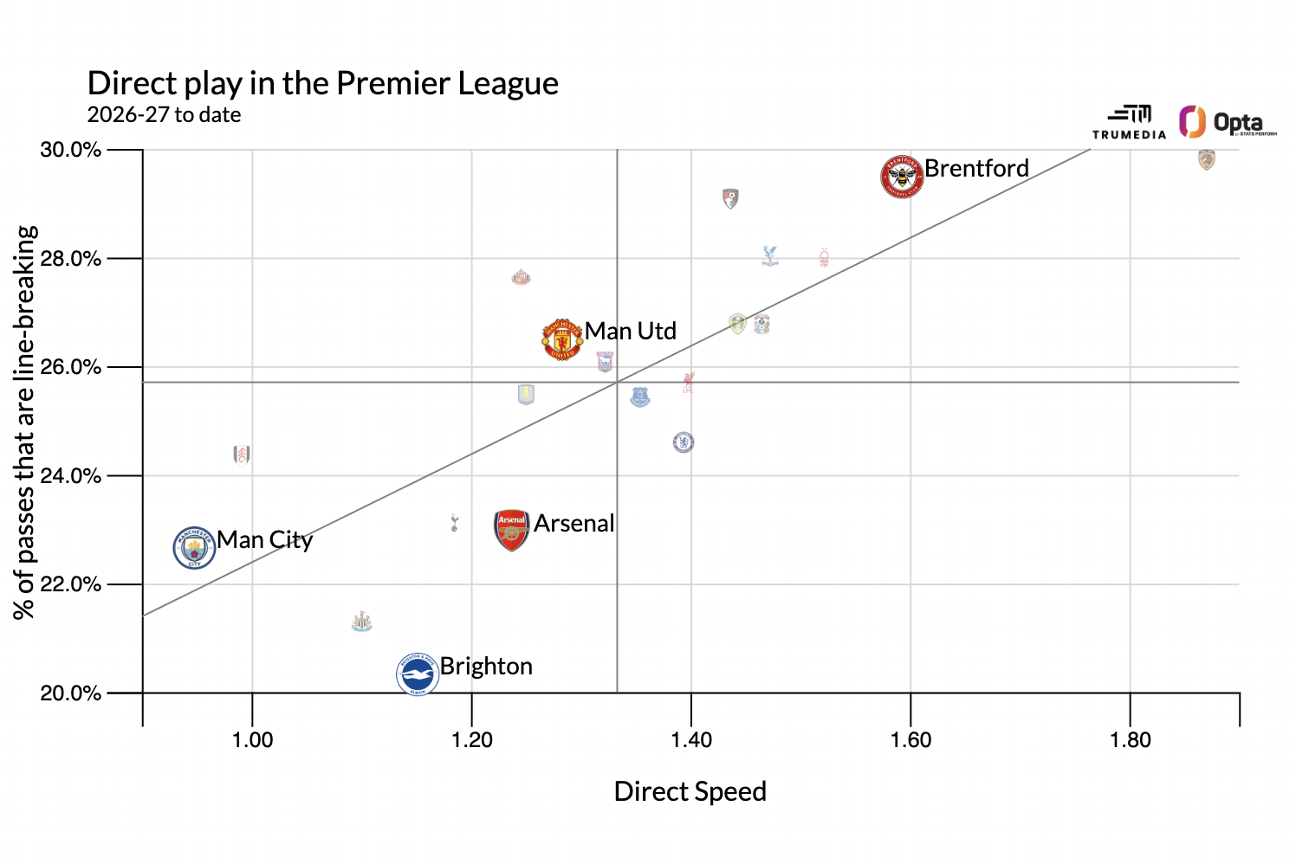
The Bees’ staying power is probably dependent on how kind or cruel the god of injuries is to them, and they’ll never have the depth of the league’s richest clubs. But neither their rise, nor their spot in the table, is a mistake. They have an identity, they’ve built around it, and manager Keith Andrews has the players he needs. — Connelly
Can Leeds contend for Europe?
In the Leeds section of our Premier League preview, I referenced the fact that from Dec. 1 onward, Leeds ranked seventh in the league in points per game and ninth in xG differential last season. Let’s update those numbers, shall we?
Since Dec. 1 of last season — a period of 30 matchdays over parts of two seasons — Leeds have generated 45 points. Only Manchester City (68), Arsenal (67), Manchester United (55) and Liverpool (48) have more. Leeds are sixth in goal differential in this span (plus-9) and eighth in xG differential (plus-3.5).
In other words, Leeds have sustained the gains they created over the second half of last season. They’ve been a bit fortunate in defense, where opponents have attempted shots worth 6.5 xG and have scored only three goals — that’s a pretty big gap to maintain, even with a great shot-stopping goalkeeper in James Trafford and a great shot blocker in new center back Tarik Muharemovic.
Most of Leeds’ good xG fortune came in a trio of draws that saw two goals allowed from 4.0 xG. So maybe they have a couple of more points than they deserve. But for basically 10 months now, Leeds have played at a top-eight or so level. If you weren’t already taking them seriously in that regard, you probably should.
This year’s Leeds have basically played like last year’s Leeds, albeit with the defensive reinforcement Trafford and Muharemovic have provided. They are selective but virulent in their defensive pressure — they rank 10th in passes allowed per defensive action (11.9), but they’re sixth in high turnovers forced (54) — and they’re happy to hoof the ball up the pitch when required: Their average pass distance (20.1 meters) is the fifth longest in the league, and they’ve attempted the second-most aerial duels (204).
But they’re supplementing this rather old-school approach with excellent athleticism and aggression: Leeds have won the second-most ground duels in the league (193) with the third-highest win rate (53.0%). And their talent in this regard is well-distributed — their three players with 20-plus ground duels won are center forward Noah Okafor, midfielder Anton Stach and center back James Justin.
As the Premier League has become more athletic overall, we’ve seen certain teams finding success by emphasizing good, old-fashioned one-on-one capabilities. Leeds are about as good as anyone in this regard.
Leeds don’t have a particularly strong possession game, and honestly they don’t counterattack as well as a low-possession team probably should. But they understand their identity, they win duels, and they can play resolute defense when they need to. And if they continue at their top-eight level, a trip to a European competition in 2027-28 — their first in 25 years — is on the table. — Connelly
What happened to Chelsea, Aston Villa, and Newcastle?
Over the previous four full seasons, only Arsenal, Manchester City, and Liverpool have won more points than Aston Villa. Only those four teams have won more points than Newcastle. And while Chelsea land closer to league average in terms of winning traditional soccer games over that stretch, they’ve spent €2.7 billion on transfer fees — €500 million more than any other club — and … OK fine, they did win the Club World Cup.
Despite all of that recent success, none of them sit higher than ninth in the table, none of them have a positive goal differential, and they’ve been outscored by a combined seven goals across the first five weeks of the season.
As you can see with a team like Bournemouth’s ranking (ninth) compared to their place in the table (17th) and their number of wins (zero), we think that’s a fluke. They have a near-even xG differential and have outshot their opponents by 14 despite already playing Manchester City, Liverpool and Brentford.
But with Villa, Newcastle and Chelsea, they’ve each fallen by at least three spots since we did our preseason rankings. These teams are bad, and they’ve all been playing badly.
So, who is most likely to turn it around and who is headed for trouble?
The obvious bounce-back candidate is Chelsea. The roster is filled with talent. They don’t have any European matches to worry about. And they have a new manager who is still implementing his own system.
But Chelsea’s start has really been as bad as it gets for a non-Tottenham big club: They don’t press, they’ve been outshot and they’re conceding better chances than they create. Given how much of a statistical outlier Chelsea are, there’s a chance that manager Xabi Alonso just isn’t cut out for the Premier League.
But the problem with Chelsea is clear, and we know what Alonso needs to solve: His team can’t defend. Per the stats app Futi, they’re toward the top of the league for dangerous attacks created — attacking-third possessions that reach the top-10 percentile of goal probability. But they’re also below average in dangerous attacks conceded.
That’s a much better position than where Villa and Newcastle find themselves:
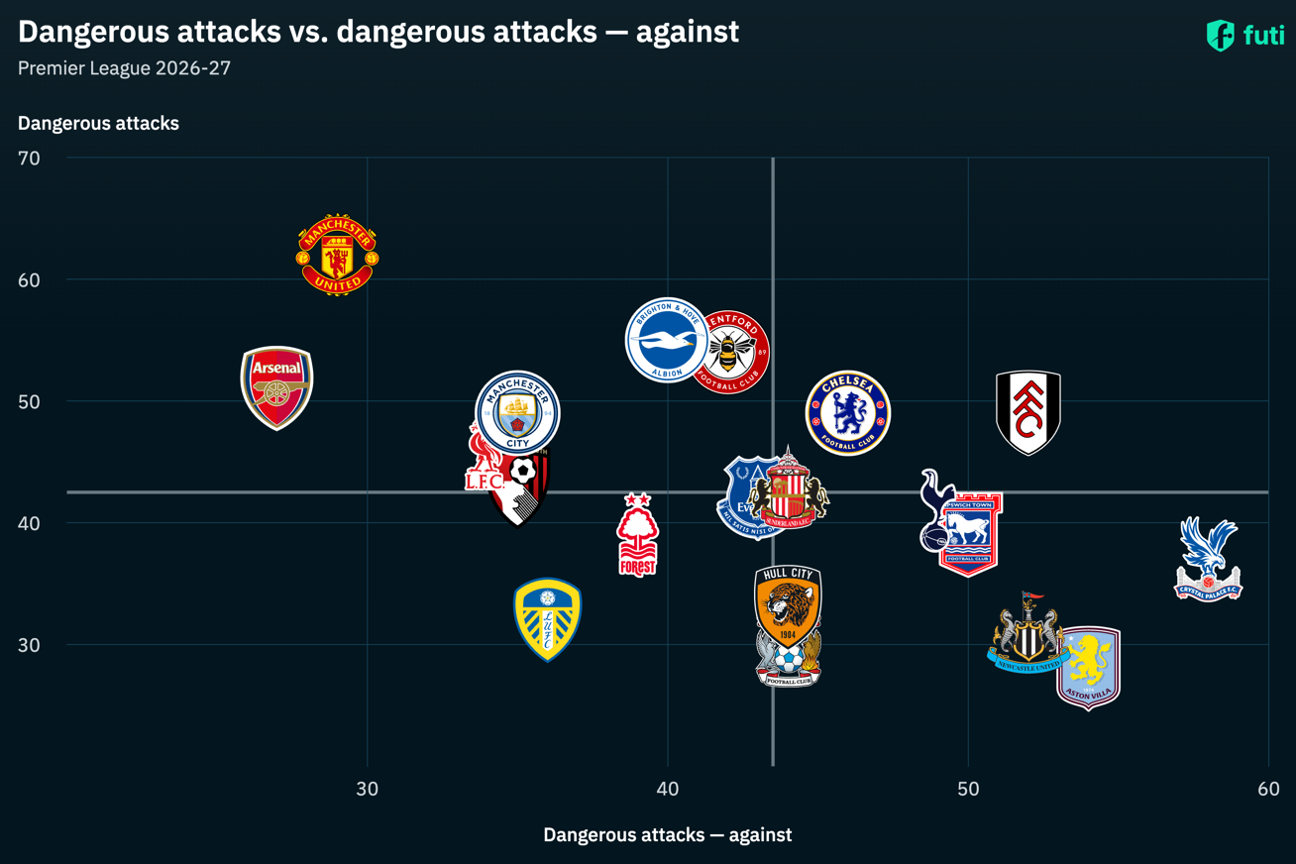
Neither team creates attacking danger or prevents their opponents from doing so. But at least Newcastle have found a way to score as many goals as they’ve allowed, and they’ve clawed into the upper half of the table. Heck, their technically only one point back of fourth place.
Villa, meanwhile, are down in 15th with a minus-5 goal differential. Their adjusted goal differential — 70% xG, 30% goals — is the worst in the league. Oh, and they have a bloated Champions League schedule with which to contend.
Yet, I’m still more worried about Newcastle.
Villa lost almost all of their key players over the summer, but they were working off of a fourth-place baseline. Newcastle lost almost all of their key players over the summer, and they’re working off of a 12th-place baseline. We’ve also seen Villa manager Unai Emery turn around a slow start — just last season. Newcastle’s new manager Matthias Jassiele, meanwhile, is completely unproven in any of Europe’s Big Five leagues — let alone the Premier League.
And despite Newcastle’s decent points haul, it all looks so fragile. They’ve been outshot by 46 through five games — by far the biggest deficit in the league. And only Crystal Palace have taken a smaller share of the penalty-area touches in their matches so far. Outside of Newcastle’s opening match against Liverpool — at home — they’ve played Leeds, Bournemouth, Tottenham and Hull City.
Newcastle haven’t been good at anything so far this season — other than turning bad performances into points. — O’Hanlon
How bad are Tottenham?
“You can’t buy mentality in the transfer market,” Tottenham Hotspur manager Roberto de Zerbi said after his team started the season looking exactly as poor as it did for most of last season, despite spending €366.4 million in transfer fees alone on new players over the summer.
Granted, it seemed as if the whole point of signing aging former Liverpool left back Andy Robertson was that his mentality would rub off on teammates, but Spurs have certainly tried as hard as they could to back up his statement in the early going.
They were pummeled 3-0 by a high-continuity and strong-mentality Brentford to start the season, then missed some pretty high-value opportunities and fell 2-0 to Newcastle. The misses continued in scoreless draws with Nottingham Forest and Everton, and when they finally did break their drought, against Aston Villa, they were already down 3-0 in an eventual 3-2 loss.
We know that over a long enough period of time, xG is a stronger predictor of future goals than actual goals are so, with two goals from shots worth 5.0 xG, we can fairly conclude that their dreadful finishing won’t continue to this level. And even if they dramatically overpaid for a lot of their new additions — openly proclaiming before the transfer window that they weren’t spending enough money probably wasn’t the greatest strategy for cost-effective signings — there’s too much talent here for results this bad, right?
Thanks in part to having midfielders who can actually pass now, De Zerbi has actually made progress this season in installing his vision of possession ball.
• Spurs’ possession rate has risen from 50.2% to 60.5% this season.
• Their pass completion rate has risen from 81.6% to 88.3%, their total passes per game from 413.6 to 545.6.
• They’ve gone from averaging 38.8 progressive passes and 59.9 progressive carries per game to 61.0 and 90.4, respectively. Their line-breaking passes per game average has jumped from 76.1 to 111.4.
• Their average buildup attacks per game (open-play sequences that feature at least 10 passes and end in either a shot or at least one touch in the box) has risen from 1.7 to 4.8, while their counterattacking attempts have fallen from 11.9 to 8.2.
These are not insignificant increases. And technically, in taking a far more patient approach in buildup, they’re creating more shots, too: They’ve gone from ranking 14th in the league in shots per possession (0.10) to ninth (0.12). The problem is that none of these new shots are any good.
Spurs ranked a dismal 19th in xG per shot last season (0.13), and now they’re a distant 20th (0.10). Only 59% of their shots have come from inside the box (17th). Their center forwards don’t actually shoot — Omar Marmoush is averaging 1.9 shots per 90 minutes, Dominic Solanke is averaging 2.6, and Richarlison has attempted zero shots in 68 minutes — so that burden has shifted elsewhere.
Defensive midfielder Sandro Tonali leads the team with eight shot attempts (two in the box), and right back Pedro Porro has attempted the same number as Marmoush: seven (two in the box). Patient possession is great, but if all it’s doing is allowing opponents to establish their defensive structure, and you don’t have the ability to break down a structured defense, it might not be worth it.
We ranked Spurs 15th, five spots ahead of their place in the table, so we clearly think they have improvement potential. But even with more stability in possession, their attack might not be good enough to save them from another year of sustained relegation stress. — Connelly
Can Hull City actually survive?
You’re probably getting sick of me writing about the growing dominance of the Premier League, how teams seven through 20 are better than ever before, and how the betting markets currently see Brighton as better than Borussia Dortmund, and Brentford as better than Athletic Bilbao.
One big reason why it seems as if so many of the Premier League’s biggest clubs are struggling — why Arsenal are the only happy fanbase among the Big Six — is that the league is simply much more difficult than it was even five years ago. Barely any clubs are going to sit back and let you press them into their own six-yard box the way we frequently saw during the Jurgen Klopp and Pep Guardiola era.
That is, unless you’re playing Hull City.
Futi measures a number of different playing-style characteristics across a spectrum, two of which are “chaos or control” and “deep block or high press.” The latter is self-explanatory while the former is basically an estimation of how often the ball is changing possession. Though there’s some relation between the two, you can press high and play chaotically, and you can defend deep but play under control.
Not Hull, though:
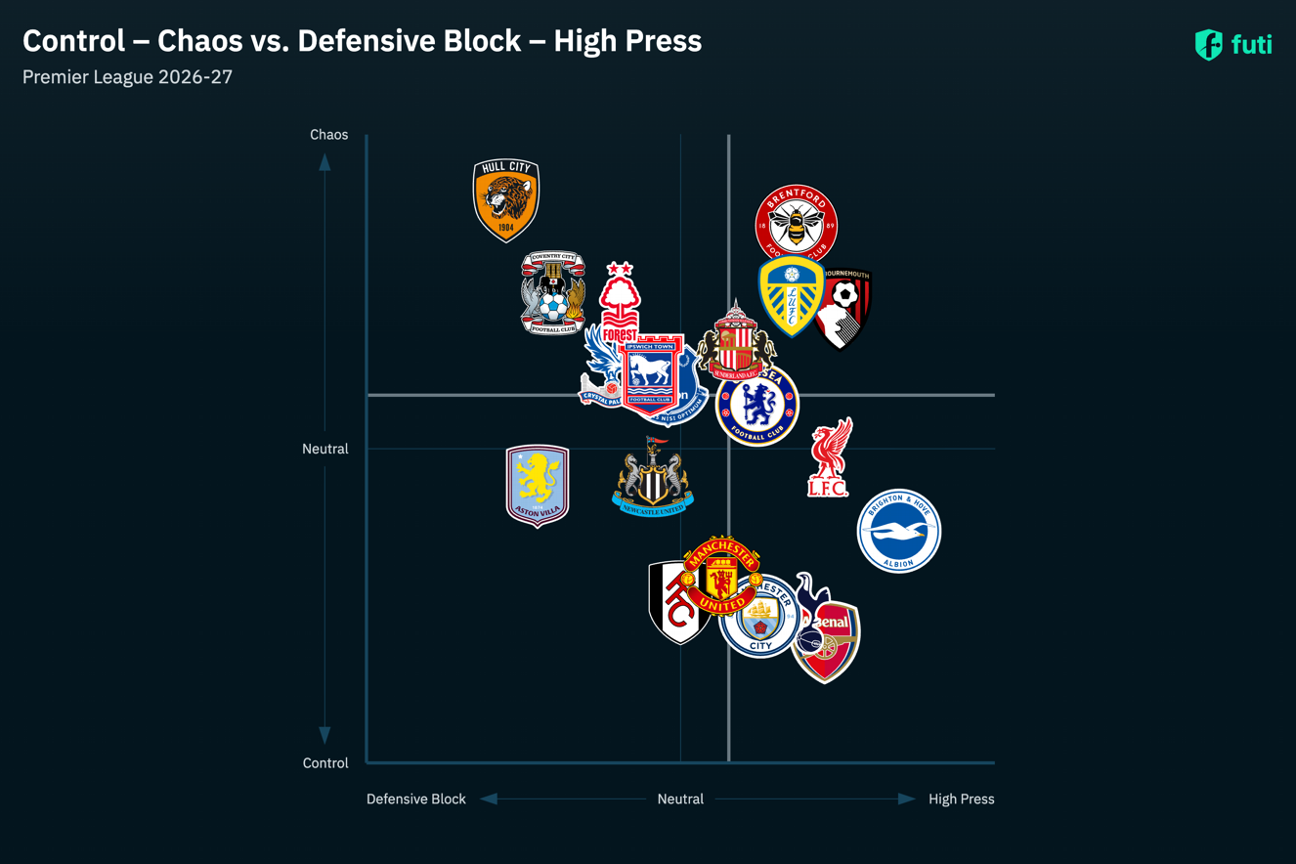
We don’t have the data for the entire Premier League era, but Hull had the worst xG differential in the Championship of any promoted team for the period in which we do have advanced data. They also have the consensus least-talented team in the league, per Transfermarkt estimations. Their average player has a market value of €8.95 million, while no other team is below €11 million.
And yet, they’ve kept their heads above water by playing like the overmatched teams of yesteryear: sitting as deep as possible, then playing forward as quickly as possible. They’ve been fortunate to turn a minus-2 xG differential into a plus-2 goal differential, but they’ve also been outshot by only eight shots despite letting their opponents live in their attacking third.
The most likely outcome is that they start to play more toward their talent level and they’re unable to maintain that healthy shot balance while ceding so much of the ball. But after five games, it seems pretty clear that their floor isn’t “worst Premier League team of all time” or anywhere close to it, either.
Throw in the eight points they’ve already banked — plus the prevailing uncertainty around the fate of Manchester City — and this team absolutely could live to fight another season. — O’Hanlon