
SAGA — A woman in southwestern Japan developed severe depression and saw her work, income and relationship upended after someone impersonated her on a dating app, exposing her personal information and prompting strangers to bombard her with sexually explicit messages.
One day, without warning, the woman began receiving a flood of messages from men she did not know. Her smartphone notifications would not stop, and the messages were filled with obscene language. The trigger was an account created by someone impersonating her on a dating app. Terrified by the harassment, the woman developed depression. Her life fell apart, and she became unable to continue doing the job she had found so rewarding.
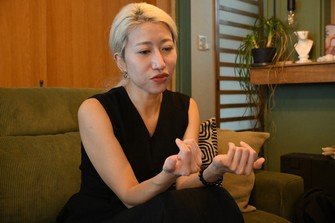
The woman is Yoko Hirao, 40, a company worker in the city of Saga.
“The act of causing harm in itself may take only a moment, but victims can never get back the time they have lost,” she said. “The harm caused by online impersonation does not remain confined to a screen.”
“I can’t live without sex lol. Won’t you do it with me?” “I’m looking for a friend with benefits. Interested?”
Sexually explicit messages and friend requests from complete strangers began pouring into Hirao’s social media account on the evening of Feb. 5, 2021.
Multiple men said they had seen her on a dating app, but Hirao had never registered for it. Suspicious, she asked a friend who used the app to investigate and discovered that someone had created an account impersonating her. It featured not only a photo of her face, but also her real name, former workplace and the school she had attended. Her actual social media account was listed alongside messages soliciting sex.
As she trembled in fear amid the nonstop notifications, Hirao saved screenshots of the posts as evidence and asked the app operator to delete the account. The company promptly complied, but a new impersonation account appeared the following day.
Believing the impersonation constituted defamation, she consulted the police, but the case was not resolved.

“I want the perpetrator to be identified and to realize the seriousness of what they did. I don’t want to simply suffer in silence,” Hirao thought. She decided to seek disclosure of information identifying the person behind the account.
In March 2021, through a lawyer, Hirao petitioned a court for a provisional injunction requiring the app operator’s Japanese subsidiary to disclose and preserve information identifying the person behind the account. At the time, however, only limited information could be disclosed under the law, forcing her to go through multiple rounds of legal procedures.
The mobile phone number registered with the app and information about the phone’s subscriber were eventually uncovered. But it was not until December 2022, about one year and nine months later, that the person responsible was finally identified.
The impersonator was a woman who was dating Hirao’s former boyfriend, with whom Hirao had been in a relationship more than 10 years earlier. Hirao had never met the woman.
The harassment continued for more than a year. With her personal information exposed, Hirao was gripped by fear that someone might physically harm her. She was diagnosed with an adjustment disorder in July 2021 and began experiencing panic attacks around May 2022. She later developed severe depression and other conditions, losing about 20 kilograms.
As she was increasingly compelled to take time off work, her income declined. Her fear of men also led her to break up with a partner she had been dating with marriage in mind.
Settlement negotiations with the woman responsible broke down, and in April 2025, Hirao filed a lawsuit with the Saga District Court seeking about 7.9 million yen (approx. $49,600) in damages.
The defendant claimed that she did not remember carrying out the impersonation. In July 2026, however, the Saga District Court recognized that the defendant’s posts had defamed Hirao and caused her emotional distress, and ordered the defendant to pay about 5.3 million yen (around $33,300) in damages, including compensation for emotional distress. Nearly five and a half years had passed since the harassment began.
The ruling was subsequently finalized, but the damages have still not been paid.
“I still cannot forgive her for taking precious years of my life away from me,” Hirao said. “I want a society that does not dismiss the harm simply because it occurs online and that ensures victims receive proper redress.”
(Japanese original by Yuki Kurisu, Kyushu News Department)