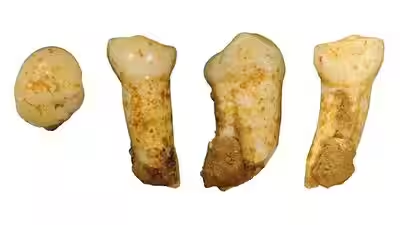
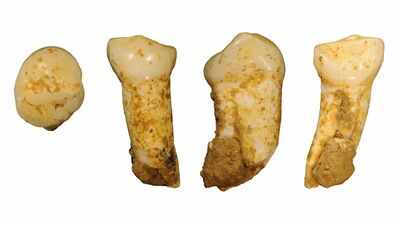
Four ancient human teeth found in two caves in southern China could provide new insight into the diversity of early human populations in Asia. The fossils, dating to about 100,000 years ago, suggest the possible presence of 2 distinct ancient human lineages in the region, including a group related to Denisovans and another whose place in human evolution is uncertain. The findings, published in the journal Nature, suggest that the human family tree in prehistoric China may have been more complex than previously understood.
Four ancient teeth from Chinese caves point to 2 human lineages
The discovery centres on 4 isolated teeth recovered from two archaeological sites, Longchuandong and Chuanshandong, in China’s Guangxi region. According to the study, the fossils belong to a period when several ancient human populations existed across Asia.The researchers used a combination of tooth-shape examinations, dating techniques and protein analysis to investigate the remains. Their findings suggest that the teeth from the two caves did not necessarily belong to the same ancient human population.The two teeth recovered from Longchuandong consisted of a molar and a bicuspid, a type of tooth located between the canine and molar teeth. Uranium-series dating placed them within an age range of approximately 104,500 to 42,600 years.The other two teeth, both bicuspids, came from Chuanshandong. These were considerably older, dating back at least 100,800 years. The fossils were small, but the physical characteristics and preserved biological material gave researchers a chance to investigate the identities of the individuals who once lived in the area.
What connects the Longchuandong teeth to Denisovans
The analysis of the Longchuandong teeth also revealed a connection to the Denisovans, an extinct group of ancient humans who roamed parts of Asia.Researchers studied inherited traits in teeth and matched them with previously identified Denisovan remains. The two Longchuandong teeth were found to have features very similar to those attributed to the Denisovans, the study said.This implies that Denisovan-related people were living in southern China in the Pleistocene, a geological time period from ~2.6 million years ago to 11,700 years ago.Denisovans are especially important to the study of human evolution because they were only recently discovered by scientists. The bones were discovered by researchers who analyzed DNA from a tiny finger bone found in a Siberian cave in 2010.Further discoveries in Asia show that the Denisovans were not an isolated population. Evidence also showed that they interbred with Neanderthals and modern humans, leaving traces of their genetic material in some present-day populations.
What makes the Chuanshandong teeth different
The Chuanshandong teeth presented a more complicated picture. Unlike the Longchuandong fossils, they did not closely match any previously established ancient human group from East Asia.Their physical structure was a combination of older and more recently developed characteristics. The teeth had a complex root system similar to that of Homo erectus, an ancient human species that roamed parts of Africa and Asia, according to the study. But their crowns, the visible parts of the teeth, showed features more associated with later human populations including Homo sapiens.The researchers also examined proteins preserved in the tooth enamel. This analysis revealed two important variations that helped distinguish the Chuanshandong remains from the Denisovan-related fossils.One variation, known as AMBN 253G, had previously been identified in some East Asian Homo erectus remains. Another, AMELY 179M, was an older genetic variation also found in Homo antecessor, an extinct human relative, and modern great apes.The combination of these characteristics suggests that the individual represented a different ancient human lineage. The Nature researchers established that the Chuanshandong individual formed a separate evolutionary branch related to the common ancestors of Neanderthals, Denisovans and modern humans.
Scientists are cautious about identifying a new human group
Despite the unique findings, researchers have stressed that more evidence is needed before the Chuanshandong population can be formally classified.The warm and humid conditions in the region make it difficult to recover well-preserved ancient DNA. Protein analysis, which can sometimes survive when DNA does not, therefore offers an important alternative for studying these fossils.Southern China may have supported several different ancient human populations during the Middle and Late Pleistocene. Besides the Denisovan-related group and the unresolved Chuanshandong lineage, researchers have also discussed evidence of a possible Neanderthal-related population from Maba in neighbouring Guangdong province.The study also suggests that Denisovans were capable of living in a wide range of environments, from cold, high-altitude regions to the warm and humid landscapes of southern China.