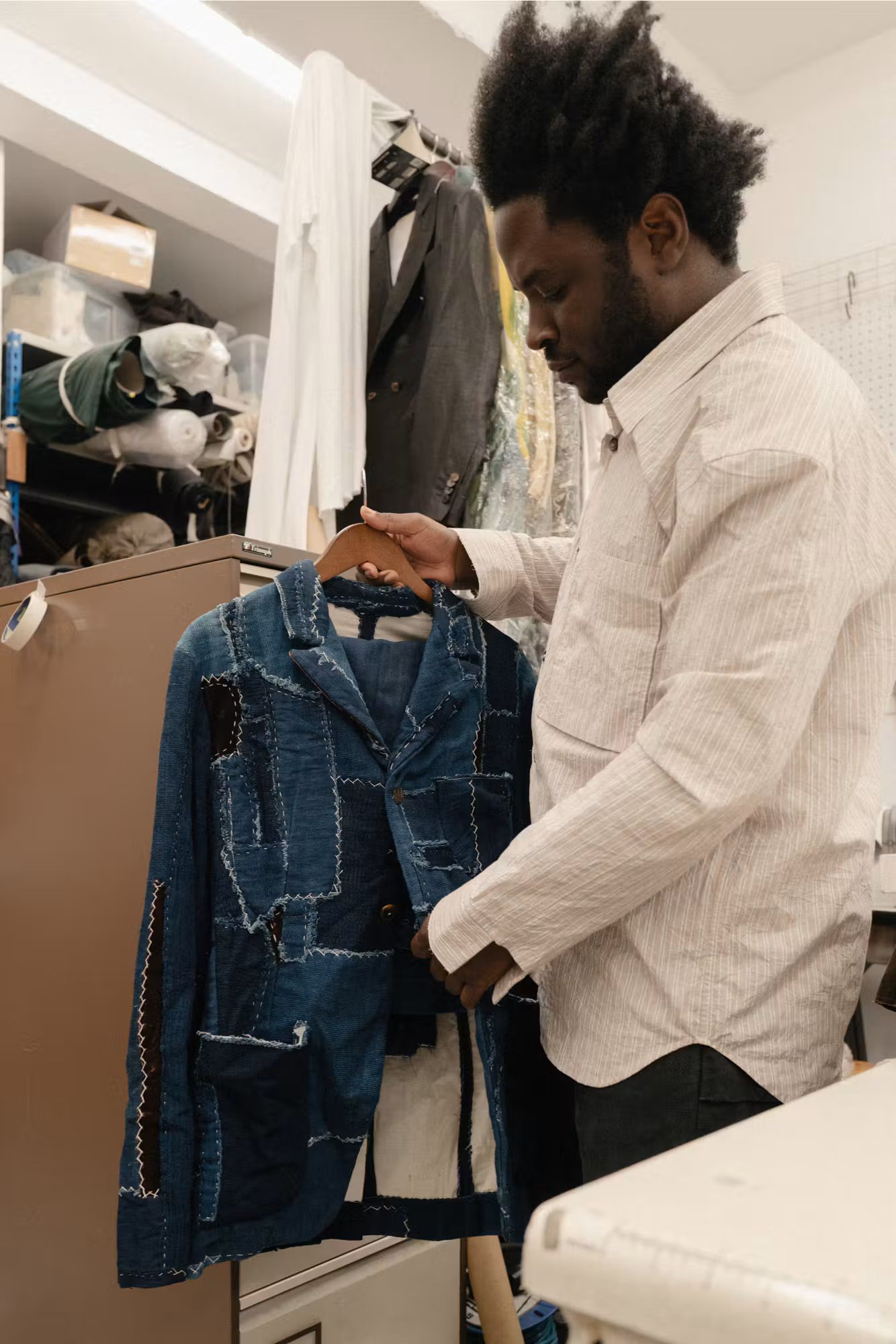
“I’m really stubborn,” Nigeria-born, London-based designer Daniel Olatunji says. It’s the first thing that comes to his mind when I ask him how he feels about the 10th anniversary of his slow-fashion label, Monad. “Since the start, I’ve been committed to my own ethos, whether it’s how I operate or which stores I want to work with. Whenever I feel I haven’t grown enough, I think that’s because I’ve maybe been a little too strict.”
A Central Saint Martins graduate, Olatunji knows what a fashion label is supposed to be. He has spent the past 10 years doing pretty much the opposite, however. At times, he admits, “to the detriment of Monad as a business.” True, back in 2016, he briefly sought outside investment. But he soon decided that it would ruin the budding label as he imagined it. Besides, he realizes now, “fashion isn’t really something people invest in — at this scale, anyway…”

Maybe Monad can’t exist as a big business. But exist it does, in its own unscalable way, stocked at a handful of adventurous boutiques like Atelier Solarshop in Antwerp and Maidens in Tokyo. In fact, halfway into our conversation, I find out that stubbornness is just another word for Olatunji making time to do what he enjoys most about fashion.
Much of that comes down to fabri, cs, the kind that today’s fabric nerds obsess over: Ugandan bark cloth, made using a UNESCO-recognized ancient craft, Chinese mud-dyed silk and handwoven Indian khadi, to name just a few. “It’s absolutely the center of what I do — and so is the feeling of discovering a fabric and getting my hands on it,” Olatunji says.
Take the Fulani blanket cloth he sources from Nigeria. Traditionally handwoven on narrow looms, it was initially too loose for the raw-edged casual tailoring Monad is known for. “Cut it, and it frays really badly.” Instead of choosing a different cotton, he spent several months in Nigeria collaborating with the weavers to make this one denser, gradually packing more yarn into the weave. “What made the process particularly interesting for me,” Olatunji says, “was that we were tweaking a traditional textile in an unconventional way.”
A large part of Olatunji’s ethos is accepting the constraints that come with such fabrics. Look at Eddie Doherty, one of the few remaining artisans hand-weaving Donegal tweed, with whom Olatunji has worked for years. Now in his eighties, Doherty maintains his own calendar. If Olatunji wants a particular warp that isn’t already scheduled, tough luck. “You either get what you get, or you adapt to his schedule,” Olatunji says.
Or look at the mud-dyed silk he sources from South China. Its already-small production window is shrinking as water pollution interferes with the dyeing process, leaving Olatunji with an extremely limited amount of cloth. Once that’s gone? He has to wait until the following year for a new batch. “And it’s never the same,” he says. “There’s always a slight difference in it.”
Not that it matters. In Monad’s artisanal corner of the good-clothes universe, irregularity is the point. “It makes each garment feel individual,” Olatunji says. He’s been particular about that since he was a teenager, when “you would never be caught dead wearing the same thing your friend had.” Scarcity is key to Monad, too, whether in meters of fabric, vintage buttons or available labor hours. It puts a natural check on how many pieces he and his team of two part-timers can make in his East London studio.

That less-is-more attitude also applies to the number of styles. All of them, about two dozen in total, are “carry-overs.” It’s the choice of fabric that makes them different from season to season. The buyers Olatunji works with have an unusually large say in that. The boxy-fitting “Bray Shirt,” Olatunji explains, “could be made in a paperweight antique linen for Spring/Summer, but when another stockist orders it in a handwoven tweed for Fall/Winter it becomes more of an overshirt or shacket.”
The result is that no two stores really sell the same Monad. Hiromi Yamanami, founder of Tokyo store 24th of August, calls what he does “interpreting” Olatunji’s clothes. Each season, he orders around 20 pieces, choosing from the fabrics, colors and finishes on offer. “Of course, we’re not changing Daniel’s design itself,” Yamanami says. “But within the framework he creates, there’s a lot of space for us to make our own choices. We really enjoy that freedom.”
Shinya Makino, head buyer at Maidens, one of Tokyo’s foremost taste-making boutiques, has a similarly personal relationship with Monad. He first discovered the label on Instagram, visited its Paris showroom a few months later, and decided on the spot that he wanted to carry it. Makino also bought a tweed suit for himself, which he still wears, among other pieces Olatunji has since made for him. For Fall/Winter 2026, he’s bringing the same style back to Maidens.
Makino’s relationship with Olatunji himself is equally warm. “I really love Daniel as a person,” he says. “He has such a warm, cheerful and generous personality — although he definitely has his own relaxed approach to delivery schedules, too!”

It’s part of Monad’s charm. Olatunji knows he could produce more, and faster, if every piece could simply be sent to a factory. But take away the handwork, he says, and “I’m just making clothes like everyone else.” And growing without giving it up? That’s tricky. “I would need to hire more human beings, which is one of the most difficult things to budget for if you’re self-financed.”
As Monad turns 10, Olatunji has been thinking about what he’d like the next decade to bring. He imagines a London space of his own: part store, part studio, where customers could have one-off pieces made from deadstock fabrics, or bring old Monad garments back to be mended and altered. He points to Savile Row, where a suit worn by someone’s great-grandfather can be taken back to the same house to be fitted to another generation. That kind of continuity sounds a lot like Olatunji’s idea of progress.