

Quick overview
- Merck (MRK) is currently trading at $148.22, up 3.20%, as the healthcare sector reaches an all-time high.
- The company is preparing to present key oncology data at the ESMO conference on October 24th and 26th, followed by its Q3 earnings release on October 29th.
- Merck’s stock has shown resilience, bouncing off its 50-day EMA at $142.65, with bullish sentiment as long as it remains above this level.
- Analysts expect Q3 earnings per share of $2.12, with varying price targets from different firms reflecting mixed outlooks.
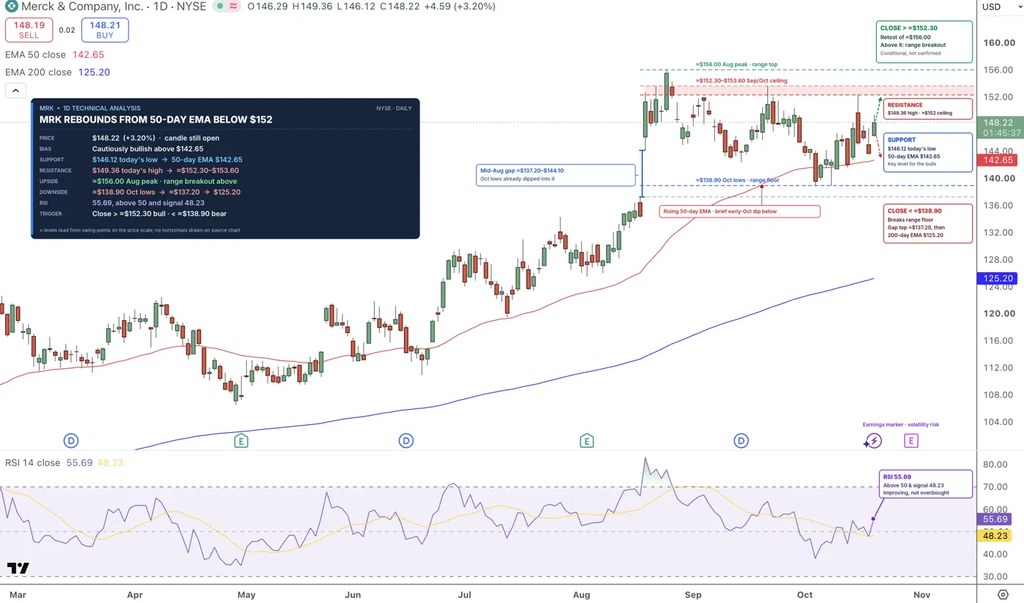
Quick Answer: Merck (MRK) is trading at $148.22 on Tuesday, October 20, up 3.20% as the healthcare sector hits an all-time high. The large-cap drugmakers lead the way with Merck at the center of a lot of attention this week, preparing to present key oncology data at the ESMO conference on October 24th and 26th, followed by the release of its Q3 results on October 29th. The daily chart shows Merck bouncing from its 50-day EMA at $142.65, and heading back to the $152 ceiling of its two-month trading range.
My view: Bullish while Merck holds above $142.65. A close above $152 would have me looking for a retest of the $156 peak.
Healthcare Rally Lifts Merck Into a Catalyst-Heavy Week
Reuters reports that the healthcare sector hit an all-time high on Tuesday as large-cap drugmakers led a rebound from last week’s tech-led selloff. Eli Lilly was up 4.7%, and Pfizer, Johnson & Johnson, and AbbVie all were up over 2%. Merck opened 3.79% higher. The bounce reversed a 1.59% drop on Monday to close at $143.63. The S&P 500 was up 0.41% on the same day.
What catches my attention is timing. Merck was already up 69.6% over the past year to October 8th. A lot of positive news has already been priced in. The fact that buyers are coming in at the $142.65 level right before two binary events tells me that people are more comfortable owning the stock going into ESMO and earnings rather than buying after.
ESMO Is the First Test of the Pipeline Story
Merck will present first-time data from pivotal trials in the ESMO Presidential Symposia. In August, INTerpath-001, the pivotal study of the mRNA cancer therapy, intismeran, met its endpoints of recurrence-free and distant metastasis-free survival. This was the first positive phase 3 study of an mRNA-based cancer therapy. The study of sac-TMT, an Antibody Drug Conjugate (ADC), as part of TroFuse-005, also met both overall survival and PFS endpoints in endometrial cancer. The KEYNOTE-C93 study is evaluating the role of Keytruda in a biomarker-defined endometrial cancer.
The topline data have been made public; the size of the survival benefit, along with the safety and how rapidly these therapies can get to patients will be the focus. Merck has an oncology investor meeting on October 26, before earnings; management may address investor questions at that time about the Keytruda pipeline.
Keytruda Growth Now Runs Through QLEX
In Q2, Keytruda sales increased 5% YoY to 8.4 billion USD, and Keytruda QLEX sales increased to 463 million USD. IV Keytruda sales decreased 1% to 7.90 billion USD from 7.96 billion USD. The biggest issue for me is conversion speed, because growth is now coming from the SQ formulation as Merck is moving patients toward the SQ formulation prior to patent loss. There is pending biosimilar competition with the FDA accepting Formycon’s Keytruda biosimilar in October.
Halozyme’s dispute is now more than a legal dispute. On October 7, a Dutch court ruled that Merck infringed Halozyme’s EP622 patent with Keytruda SC and barred Merck from selling or making it in 8 European countries. Merck is appealing a separate German court’s ruling for an injunction against Keytruda SC. In the US, the PTAB ruled four Halozyme PH20 patents unpatentable in September and October, a partial win for Merck.
New Launches Are Offsetting Older Products
Sales of Winrevair increased 75% to 588 million USD, Welireg increased 67% and Capvaxive increased 42%. Ohtuvayre added 204 million USD after the Verona acquisition. The FDA’s July approval of Lipfendra (an oral PCSK9 inhibitor) is a cardiometabolic launch for Merck. Januvia and Janumet fell 31% this quarter, and Gardasil was down 9% year to date despite a 4% increase this quarter.
What the Street Expects on October 29
According to analysts, expected earnings per share (EPS) for the third quarter of 2026 is $2.12, a 17.8% decrease from the third quarter of 2025, and flat revenue of $17.23 billion. The Zacks consensus estimate has fallen 3.8% in the last month. Merck & Co., Inc. (MRK) has beaten EPS estimates for the last four quarters. Therefore, I think the real bar for a beat is higher than the falling EPS estimate suggests.
Non-GAAP 2026 guidance of $2.66 to $2.76 includes one-time charges of $3.62 per share for Cidara and $2.31 for Terns. Adding those back, along with about $0.12 of Terns costs, means underlying EPS is around $8.75, or 17 times earnings at the current price.
Price targets have moved in both directions. Goldman Sachs lowered its price target to $155 and kept a Buy rating, RBC lowered its price target to $145 with a Sector Perform rating, and JPMorgan raised its price target to $165 with an Overweight rating.
MRK Technical Analysis: 50-Day EMA Holds the Uptrend
Currently trading at $148.22, an increase of 3.20% from the previous close, Merck & Co, Inc. (MRK) is rebounding off the 50 day Exponential Moving Average (EMA) at $142.65. MRK is well above the 200 day EMA at $125.20 and the broad trend is positive. Since the August 19 gap up, the stock has traded in a sideways range between roughly $140 and $156. What captures my interest is the fact that the 50 day EMA has absorbed the pull backs that have occurred during the month of October. This is indicative of buyers defending the upward trend.
Currently, the 14 day Relative Strength Index (RSI) is at 55.69. This is above its signal line at 48.23 and also above the 50 midline, after having dipped below the 40 level in early October. Thus, from a momentum perspective, the stock is poised to move higher and is not yet overbought. Currently, the stock is facing resistance at $149.36, and also at the $152 area, which was resistance in September and October.
Support is at $146.12, and then at the 50 day EMA at $142.65. The 200 day EMA is at $125.20. The most recent low at roughly $140 still provides support and would need to be broken for more significant weakness to set in. Below that, the August gap near $136 would be targeted.
I am still bullish as long as MRK holds above $142.65, and would expect any pullbacks to be bought in that area. ESMO and earnings could move the stock, but as long as the 50 day EMA doesn’t break, I would expect buyers to defend that area.
- Resistance: $149.36 | $152.00 | $156.00
- Support: $146.12 | $142.65 | $140.00 | $136.00 | $125.20
FAQs
Why is Merck stock up today?
Merck, along with other large-cap pharmaceutical companies, rose around 3% as healthcare hit new record highs. Traders are also preparing for upcoming ESMO data and the company’s Q3 report.
When does Merck report Q3 2026 earnings?
Merck will report third-quarter results before the market opens on October 29. Analysts expect EPS of $2.12 on revenue of $17.23bn.
What is the key resistance for MRK stock?
Key resistance is in the $152 region, which was a ceiling for rallies in September and October. A close above this region would set up a retest of the $156 region.

Arslan Ali Butt
Lead Markets Analyst – Multi-Asset (FX, Commodities, Crypto)
Arslan Ali Butt serves as the Lead Commodities and Indices Analyst, bringing a wealth of expertise to the field. With an MBA in Behavioral Finance and active progress towards a Ph.D., Arslan possesses a deep understanding of market dynamics.
His professional journey includes a significant role as a senior analyst at a leading brokerage firm, complementing his extensive experience as a market analyst and day trader. Adept in educating others, Arslan has a commendable track record as an instructor and public speaker.
His incisive analyses, particularly within the realms of cryptocurrency and forex markets, are showcased across esteemed financial publications such as ForexCrunch, InsideBitcoins, and EconomyWatch, solidifying his reputation in the financial community.