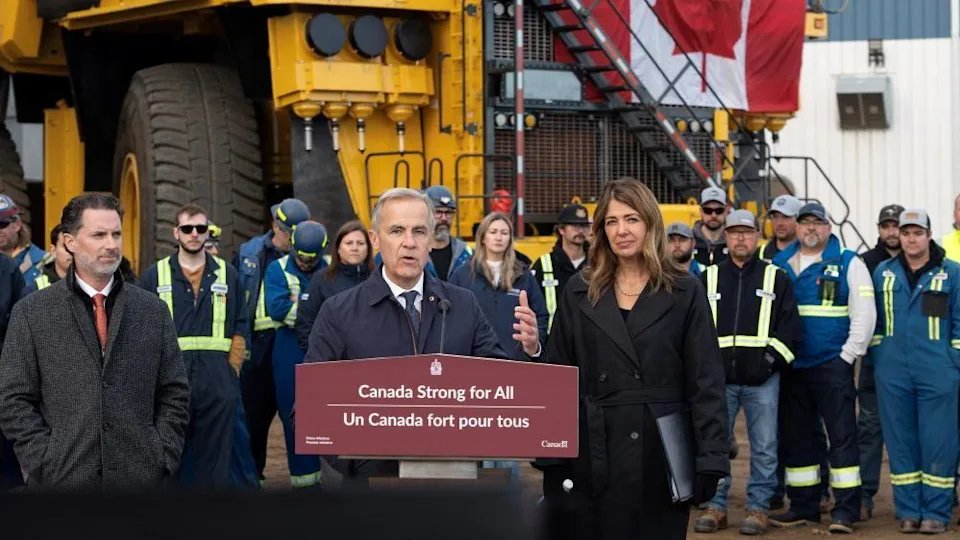
“Vote like Canada depends on it,” Prime Minister Mark Carney declared to cheering crowds in Calgary last week on a stage emblazoned with bright red and white “Forever Canadian” banners.
It’s a message that appears to have struck a chord with the electorate, as preliminary results show more than two-thirds of Alberta voters said they want to remain a part of Canada.
But the future of the federation does still rest on its richest province.
Alberta, with most of Canada’s proven oil reserves and abundant gas and mineral wealth, is playing a pivotal role in Ottawa’s drive to survive a punishing trade war with the US by diversifying trade, strengthening its economy, and forging new alliances on the other side of the world.
Carney, the former central banker who grew up in Alberta, is now Canada’s builder-in-chief – at home, and beyond its borders.
Note the emphasis in his first statement after Monday’s vote on separation in the province, as soon as the scale of the victory was clear: “They chose unity, to build together, and to take care of each other.”
Albertans’ overwhelming “yes” to stay in Canada gives him political bricks and mortar, too.
“Don’t mess with Canada,” warned Thomas Lukaszuk, a former lawmaker whose Forever Canadian campaign played a key role in this referendum’s outcome.
Addressing elated supporters in Edmonton, the provincial capital, as the “yes” count for Canada kept tumbling in, Lukaszuk underlined that this vote “will send a very strong message to the rest of the world”.
Everyone knows he’s talking about the troublesome neighbour to the south – in particular its president, who keeps threatening to turn Canada into the 51st US state.
“Let’s move on”: Albertans react to separatist movement referendum results
The same day Albertans were voting on their future in Canada, Trump sent his own signal north at a rally in Kansas ahead of next month’s US midterm polls.
“I will let you keep ice hockey, and I will let you keep your ‘O Canada’ national anthem,” he promised before adding: “We’re only kidding.”
For Canadians, it’s no laughing matter.
In the run up to this referendum, Carney reiterated a warning he’s often sounded that “there are some outside our borders who are working to break us, so they own us” – even if he didn’t spell out who “they” is.
He didn’t have to.
And, in this defining time for the separatist camp, some in their ranks didn’t hide their direction of travel. Some of their most prominent leaders admitted they travelled to Washington three times last year to meet US State Department officials and outline what an independent Alberta could offer – including a possible oil pipeline through the US to the Pacific.
But the rest of the world may take only passing notice of what was, for Canada, an historic vote sparking conversations and concerns across the country, from coast to coast to coast.

Mark Carney and Alberta’s leader Danielle Smith has worked closely on pushing for an oil pipeline to the west coast from the landlocked province. [Reuters]
“Short of a vote to separate, most foreign governments, with the exception of the United States, have little interest in domestic Canadian politics,” says Professor Janice Stein, founding director of the Munk School of Global Affairs and Public Policy at the University of Toronto.
“Foreign investors are focused on the time it will take to complete major infrastructure projects, a return on investment, and predictable regulations,” she explains in a nod to Carney’s long list of megaprojects he hopes will eventually turbocharge economic growth. They’re all costly; many will take years to build.
An ambitious blueprint already includes a proposed pipeline to the Pacific coast which opens opportunities for Alberta’s oil to reach Asian markets – a move which also addresses Alberta’s long-standing grievance that its economy has been stifled by federal policies, including environmental regulations.
At a rally in Alberta last week, it was Carney’s comment that the pipeline “will reduce our dependence on the United States” that triggered the loudest and longest applause of the night.
After Monday’s vote, Carney – the former UN Special Envoy for Climate Action and Finance – pointed to “unleashing our full potential as a global energy superpower with Alberta as its core”. Political and economic pressures now seem to eclipse his green credentials.
“Build Canada Strong” has been Carney’s mantra ever since he first entered politics, a complete neophyte, at the start of last year.
At home there are possible wide-reaching repercussions from the final tallies in the referendum’s nine other questions which dealt with issues ranging from greater provincial powers, the costs of immigration, and potential constitutional changes.
Those results are certain to provoke debate, and deal making or breaking, involving Canada’s nine other provinces and three territories. They all have their own grievances, too.
The prime minister has had to defend himself when journalists ask if he is spending too much time on foreign trips with his charm offensive to build new political alliances and trade partnerships, including an unprecedented and still uncertain offer of associate membership of the European Union.
“I can do both and I need to do both,” he recently replied with his signature bluntness before listing the more than 16 bills which went through Parliament in the last session dealing with everything from major tax changes, public safety, and the price of fuel.
For now, Carney is riding high in the polls at home – including in Alberta, which doesn’t traditionally support his Liberal party – in a long “political honeymoon” other beleaguered politicians would envy.
And the plain-speaking politician’s strong and steady response to Trump threats, including retaliatory tariffs, has seen his star rising on the world stage. It’s an unexpected turn for a country which has often been missing from top tables and has sometimes even been dismissed as “boring”.
The Economist magazine decided to put Carney on their cover, on this week of weeks for Canada, with a perfect red maple leaf between his teeth.
“Mark Carney shows middle powers how to handle a dangerous world,” reads one of its headlines, with an article which also focuses on Canada’s “vulnerabilities” including Alberta’s ballot.
“The broader takeaway from this vote might be that Canadian unity is in fine shape,” remarks David Moscrop, political scientist and author of the forthcoming book On Nationalism.
“But what happens after Donald Trump is gone and Canada no longer has a single, bombastic target which drives Canadians to rally around the flag?” he asks.
Carney’s decision to recently walk away from trade talks with the US gave rise to another swell of Canadian pride and patriotism. But if this trade war drags on with a country which traditionally takes 70% of Canada’s exports, Canadians will feel even greater pain in their daily lives.
But today is a day to vigorously wave the maple leaf flag.
“It’s a win for Team Canada and its resilience,” commented CBC journalist Janyce McGregor during the public broadcaster’s rolling coverage of a vast country of never-ending building issues.