A-book reconciliation is often complicated and time-consuming.
That’s why Match-Trader has introduced Hedge Analytics, a new application that lets White Label brokers check it themselves – quickly, clearly, and down to the individual position. It connects to the broker’s CRM and trading platform and reconciles both into a single, verified view of what their A-book really earns.
How Hedge Analytics Works
When a White Label broker routes part of its client flow to the A-book, every client order gets a covering order on a hedge account. The broker earns the gap between the two: wider prices, commission, and swap charged to the client, minus whatever the A-book side charges back. That margin rarely shows up in a single report. Each half of the trade sits in a different system, with client positions in the broker CRM and covering trades on the trading platform.
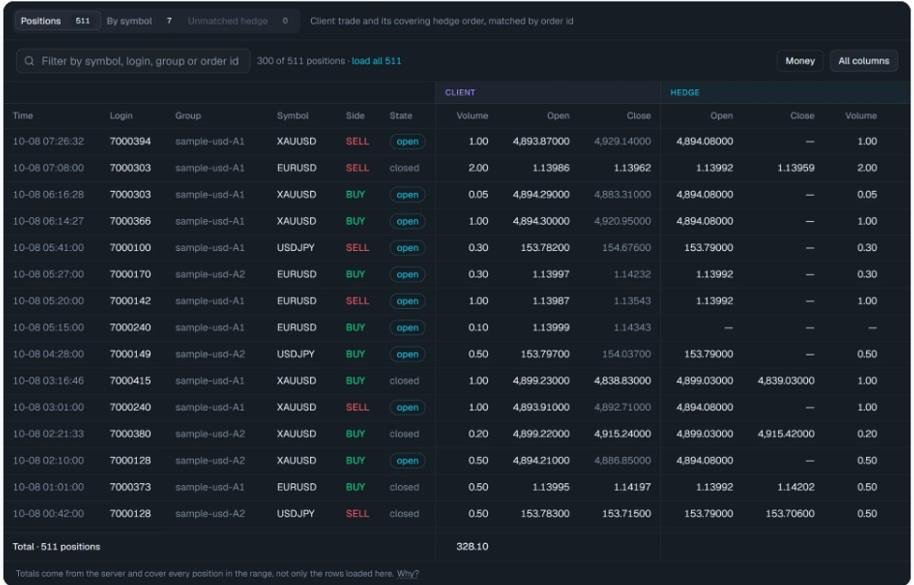
Hedge Analytics reads client positions from the CRM and hedge orders from the trading platform, and pairs each one with its hedge leg. Because routed hedge orders carry the client order ID inside their own identifier, no manual mapping is needed. For every matched pair, the application measures the price difference between the client fill and the hedge fill on entry and exit, then converts it to USD using the instrument’s contract size. It adds the commission and swap charged to the client and deducts the hedge-side fees. The output is a single net revenue figure per position, per symbol, and per day. The link between both sides is detected from real trades and re-checked on every view.
What the Dashboard Shows
The Hedge Analytics dashboard covers any time range from an hour to 12 months. In Live mode, it refreshes as new trades arrive. Its core metrics are:
- Net revenue – what the broker kept, in USD, after A-book costs.
- Revenue sources – entry markup, exit markup, commission, and swap, each net of A-book charges.
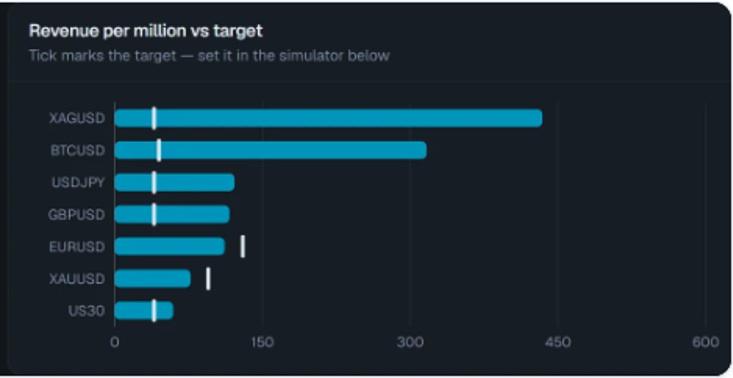
- Revenue per million (RPM) – net revenue per USD 1M of notional, compared with the broker’s target for each symbol.
- Matched flow – the share of client positions that found their hedge leg. B-book trades and accounts outside the routing rules are labeled as not hedged and stay out of the totals, so the figures reflect A-book revenue only.
The positions table lists every client position next to its hedge leg, with a Money view for revenue figures and an All columns view for auditing a single trade – open and close prices on both sides, order IDs, logins, and groups.
Understanding Profitability Before Making Pricing Decisions
The Markup Calculator gives brokers a practical way to estimate profitability under different trading conditions. By factoring in trading volume, price movements, markups, and associated costs, the tool calculates the potential profit or loss per lot and across a specified trading volume. Brokers can adjust individual parameters, compare scenarios, and better understand how pricing and trading conditions affect their bottom line.
“Every broker wants to know how much they can actually earn from their trading volume. But profitability depends on more than just the spread. Market movements, trading costs, and execution conditions all play a role. With the Markup Calculator, we want to make these calculations straightforward, allowing our partners to test different scenarios and understand their potential earnings before making business decisions,” says Piotr Różycki, Account Manager at Match-Trade Technologies.
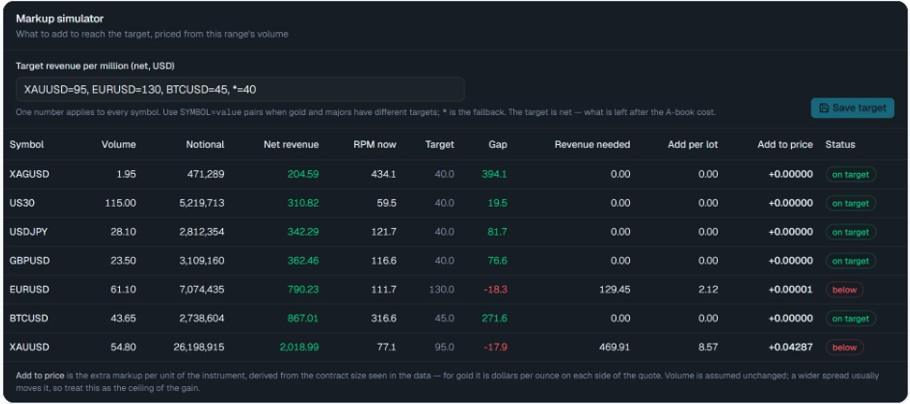
The Reports page adds a second layer: revenue components over time, cumulative revenue with each source’s share, and RPM per symbol plotted against its target, making it clear which instruments are running above or below plan.
Built-In Data Quality Checks
Every view runs built-in checks, displayed in a data quality strip alongside the figures. Markup computed from fill prices must agree with the markup implied by each trade’s own net profit (reconciliation), and revenue from prices and fees is compared with an independent calculation from both account balances (cross-check). Manual orders placed on the hedge account are excluded automatically. The match rate points to routing or scope issues, and any failed check is clearly flagged, with a red warning banner if reconciliation doesn’t agree.
Read-Only by Design
Hedge Analytics has read-only access to broker systems. It can’t place, modify, or close orders, or change anything in the CRM or on the platform. Stored credentials are encrypted before being saved, each workspace’s data is kept separate at the database level, and every settings change is recorded in an audit trail. Access is role-based and set per workspace. The service runs on Match-Trader’s own infrastructure, and client data is never sent to third-party analytics services.
Setup in Five Steps
Each broker operates in a dedicated workspace, configured from a single Settings page with a progress checklist:
- Connect the CRM with a read-only API token.
- Choose the client groups in scope, keeping B-book groups out.
- Connect the hedge account on the trading platform.
- Detect the link between hedge and client orders from real trades.
- Set the RPM target.
Once every step is complete, the dashboard is ready.
What This Means for Your Brokerage
The real value of Hedge Analytics lies in the decisions brokers can make once their A-book margin is known. Costs that used to be hard to pin down become measurable, which gives a stronger position in commercial discussions. Pricing now follows results rather than assumptions, and its impact is easy to track over time. “When the numbers are clear, the questions change. Partners stop asking whether their A-book is profitable and start asking which symbols to grow and where to adjust. That’s exactly the shift we built Hedge Analytics for,” says Kamil Rozmus, Dealer at Match-Trade Technologies. With those answers in hand, the whole brokerage works from evidence every team can rely on.
About Match-Trade Technologies
Founded in 2013, Match-Trade Technologies is a global provider of trading technology for forex brokers, prop trading firms, and financial institutions. Its flagship Match-Trader platform supports flexible deployment models, including a standalone platform, back-end technology for proprietary front ends, and add-on environments for companies offering FX brokerage and prop trading services. Match-Trade delivers end-to-end brokerage infrastructure, including white-label trading technology, server licence, prediction markets, CRM and client office tools, liquidity and market data connectivity, and a broad ecosystem of external integrations for firms ranging from startups to established brokers.