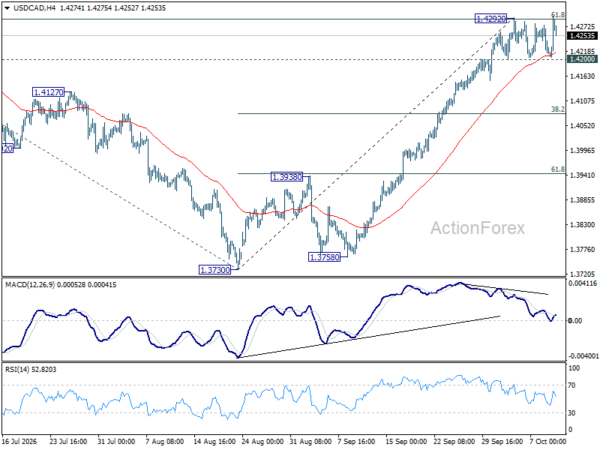
TL;DR: The Dollar rally has lost momentum rather than direction. DXY stalled at 102.232 as Fed urgency faded, long-end Treasury yields met buyer demand at two-decade highs, and France was left shouldering more of the Dollar’s remaining support. Absent a sizeable US CPI surprise, the Dollar looks poised for consolidation, with scope to drift lower into the midterm elections.
Why This Matters
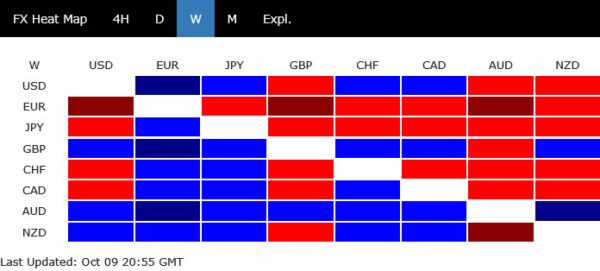
The Dollar ended the week higher but with noticeably less momentum than earlier in the rally. DXY closed at 102.232 after reaching 102.536, yet failed to extend higher even with the Euro remaining the weakest major currency on the weekly heat map. That does not establish a Dollar top. But it does suggest that the forces which previously reinforced one another are beginning to separate.
The rally rested on three supports: Fed urgency has clearly faded, long-term Treasury yields have retreated from their highs after buyers stepped in at historically elevated levels, and France remains a source of Euro weakness—though that third pillar now depends on whether sovereign stress deteriorates again. Unless next week’s US CPI delivers a sufficiently large surprise to reactivate the rates trade, the Dollar may find itself consolidating further ahead of the November 3 midterms rather than immediately extending its advance.
Fed Urgency Has Already Faded
The first Dollar pillar has weakened the most.
New York Fed President John Williams started the shift on September 29 when he said there was “no need for urgency” after September’s hike and suggested one further increase later this year could be enough if the economy evolved as expected. September payrolls then reinforced the case for waiting: job growth came in at just 29K, unemployment rose to 4.2%, wage growth slowed to 0.1% m/m, and previous payroll estimates were revised lower.
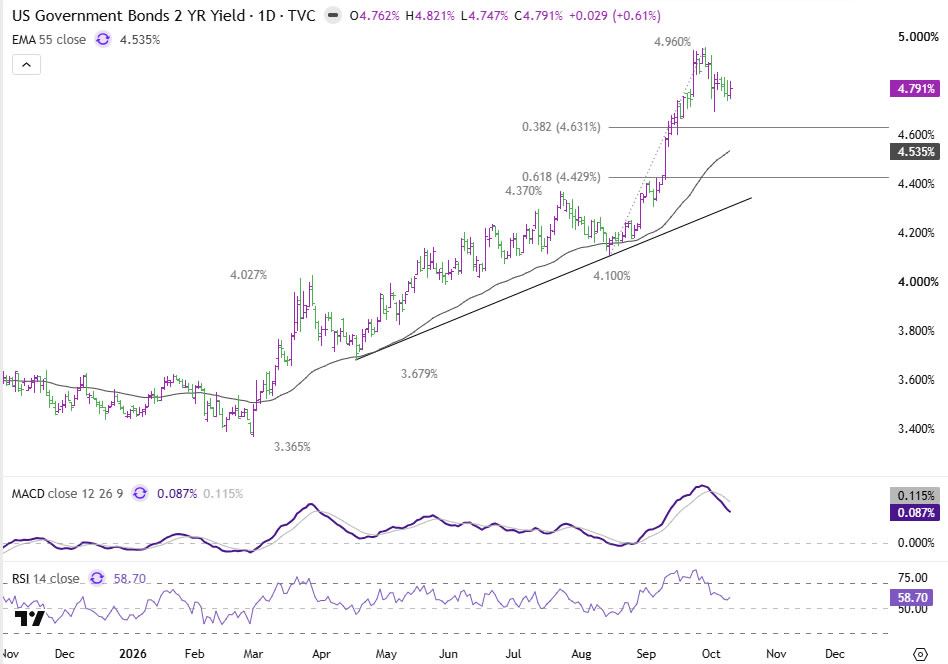
The bond market has reflected that change. The US 2-year yield peaked at 4.960% around the turn of the month before ending Friday at 4.791%, unwinding roughly 17bp. Fed Governor Christopher Waller’s later message that further hikes may still be needed but “do not need to come at consecutive meetings” fits that repricing well.
The Fed has therefore not turned dovish. The important change is that the urgency premium has largely disappeared. A back-to-back October hike is no longer the central market assumption, even though another move later remains firmly possible. That distinction matters for the Dollar: the front end can stop providing incremental support without requiring markets to price an easing cycle. The question is not whether the Fed has finished tightening, but whether there is enough urgency left to push short-term yields back toward their highs.
Long-Term Yields Have Started Meeting Buyers
The second pillar has not broken, but it has stopped strengthening.
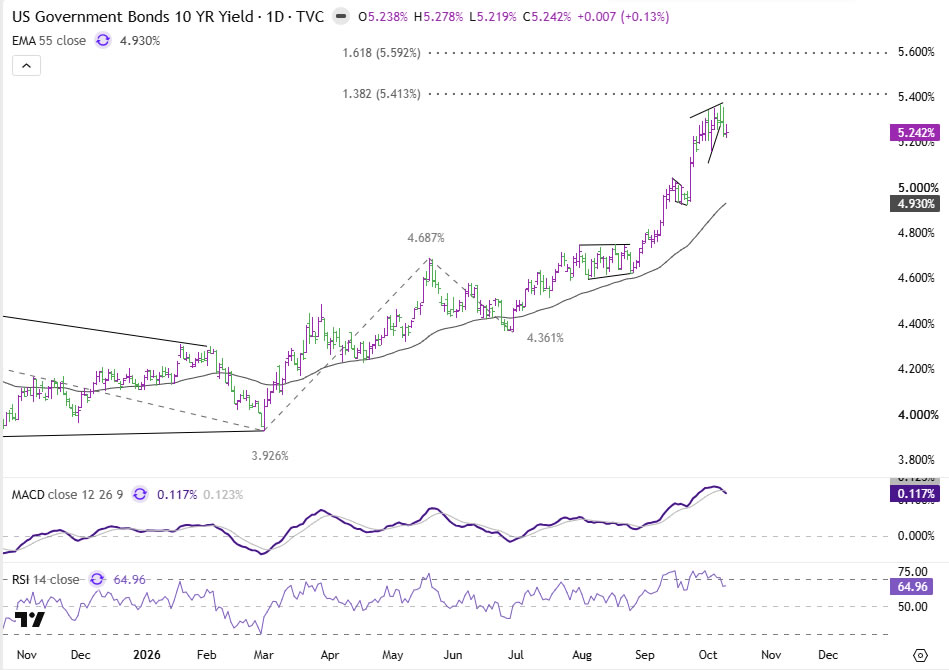
The US 10-year yield reached 5.365% during the week before retreating to 5.242% by Friday. The 30-year yield similarly eased from around 5.73% to 5.600%. These are better described as retreats from extreme highs than outright declines: the 10-year remains roughly 45bp higher over the past month.
What changed was the response to Treasury supply. The 10-year auction cleared at 5.300%, the highest auction yield since 2000, but produced unusually strong demand. Bid-to-cover reached 2.77 against an average around 2.51, the auction stopped through by 1.7bp, and indirect bidders took 80.3%. The 30-year auction also showed solid indirect demand at 72.3%, even though overall bid-to-cover slipped to 2.54.
Together, the auctions raised a different question from the one dominating markets only days earlier: have Treasury yields finally become high enough to create their own resistance?
There is also a secondary possibility worth noting: pre-midterm positioning may be playing a role at the margin. There is no direct positioning data to establish that, so it should not be treated as the main explanation for the yield retreat. But the election carries fiscal implications for Treasuries, particularly after President Donald Trump’s September 10 proposal for a $5,000 “dividend” payment and warnings from DBS that a Republican sweep of both chambers could increase fiscal risk. With November 3 approaching, some investors may simply prefer to lock in historically elevated yields before the fiscal outlook becomes less certain.
For now, though, the clearest evidence remains the auctions themselves: buyers stepped in when yields reached their highest levels in roughly two decades.
That does not mean the long-end uptrend is finished. Relative-yield spreads still favor the Dollar: US–Japan and US–Canada 10-year differentials widened during the week, while the US–Germany spread was broadly unchanged. The Dollar has therefore not lost its yield advantage. But the mechanism has changed. Previously, rising long yields continuously reinforced Dollar strength. Now, buyers are demonstrating that sufficiently high yields can attract their own demand. The long-yield pillar has stopped strengthening, but it has not yet turned against the Dollar.
Oil Keeps the Rates Story From Turning Dovish
Oil remains an indirect support rather than the reason Treasury yields retreated.
Brent ended around $104.53, still below September’s $109.97 high but higher on the week. That divergence matters: crude remained elevated while Treasury yields came off their peaks, indicating that the bond-market pullback was driven more by demand for Treasuries than by any meaningful easing of energy-related inflation concerns.
President Donald Trump said on Thursday that the United States would not attack Iran before the November 3 midterm elections, while describing US-Iran discussions as productive. That has put a temporary ceiling on the most immediate US escalation risk without resolving the conflict itself.
For markets, the result is unusual. The geopolitical premium has been capped rather than removed, and the pause comes with a date attached to it. Oil can therefore continue keeping inflation risk elevated without necessarily producing another immediate surge in Treasury yields. And unless the Iran outlook changes substantially beforehand, November 3 becomes another natural point around which markets may reconsider both energy and broader risk pricing.
France Is Carrying More of the Dollar’s Remaining Support
The third pillar lies outside the United States.
French sovereign stress has been one of the main reasons the Euro has remained under pressure. The OAT–Bund spread reached around 159bp the prior Friday before easing toward roughly 135bp by October 9, while France’s 10-year yield retreated from above 5% toward 4.85%.
The immediate pressure has eased, but the fiscal problem remains unresolved. Prime Minister Sébastien Lecornu’s government is seeking to bring the deficit down from 5.4% toward 5% while operating in a divided parliament, and French borrowing costs remain highly sensitive to the credibility of the budget path. Bank of France Governor Emmanuel Moulin said this week that France does not currently need ECB intervention and that the necessary solution lies primarily in France itself.
Political uncertainty also remains tied to the 2027 presidential race, where Marine Le Pen has been positioning her fiscal program toward increasingly nervous bond investors.
That keeps France potentially Dollar-supportive through the Euro channel. EUR/USD ended the week around 1.12015, not far above 1.1159.
But France introduces an important complication. A renewed widening in OAT–Bund spreads would likely pressure the Euro and support DXY. Yet if French stress became sufficiently severe to generate demand for Treasuries, falling US yields could simultaneously strengthen Yen and Swiss Franc. France can therefore lift the Dollar Index without necessarily producing a broad Dollar rally.
That is one reason the latest DXY consolidation deserves attention. The Euro was already the weakest major currency last week, but DXY still failed to break decisively higher.
Dollar Index Is Tiring, Not Yet Topped
The technical picture matches the macro story.
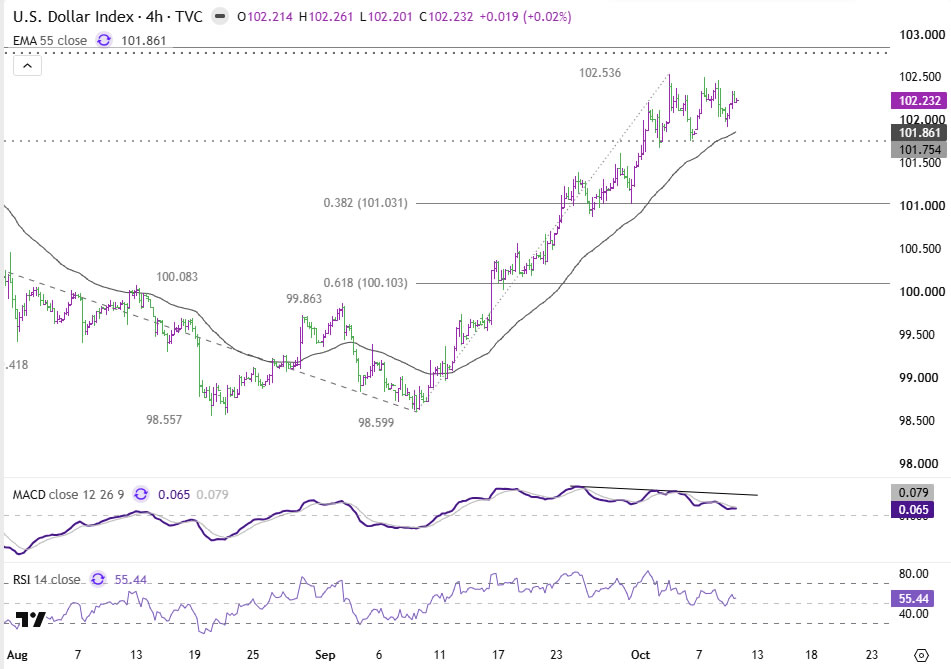
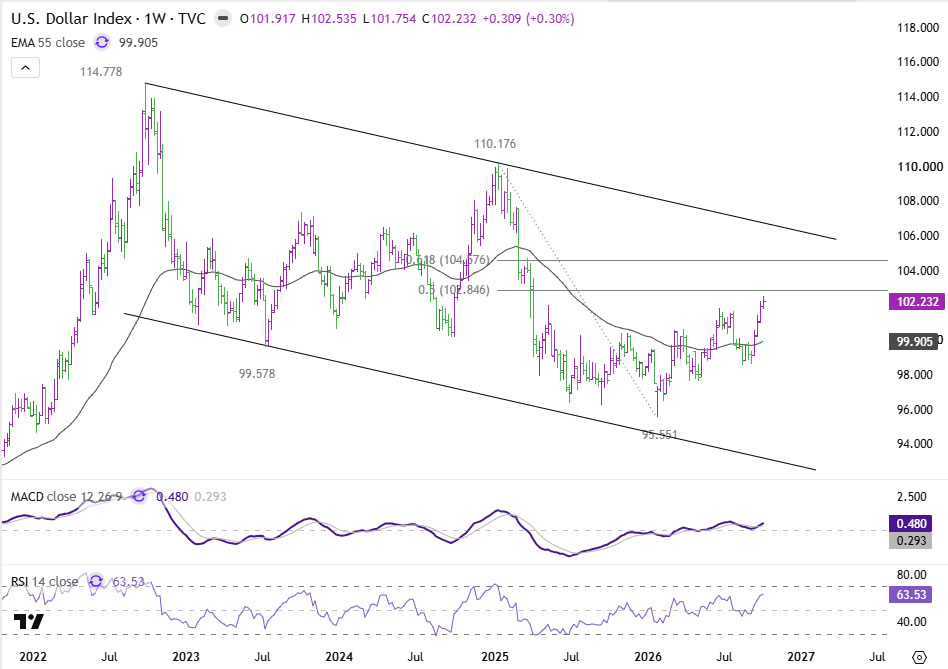
DXY has moved sideways after reaching 102.536. The broader near-term trend remains constructive while the 4-hour 55 EMA around 101.86 holds, but momentum has weakened.
Resistance is concentrated just above the market. The 100% projection of 97.62 to 101.80 from 98.60 at 102.77, the 50% retracement of 110.17 to 95.55 at 102.84, and the upper boundary of the daily rising channel all converge around 102.77–103.00.
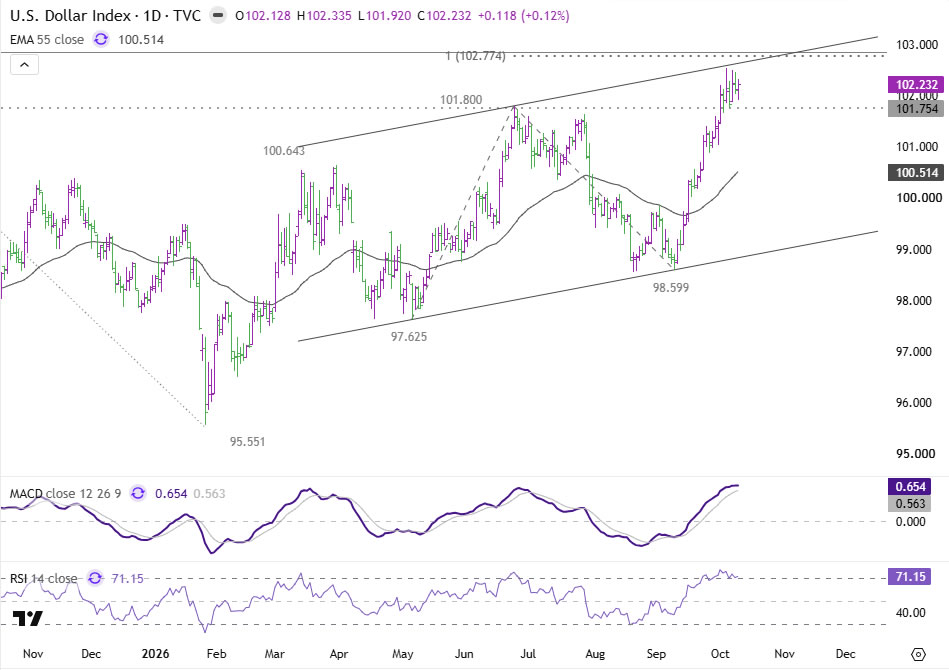
Daily RSI is at 71.15, marginally overbought, while 4-hour MACD shows bearish divergence. That combination warns that the rally is becoming increasingly difficult to extend, but neither indicator alone confirms a reversal.
The first meaningful downside trigger is 101.75 support. A sustained break would argue that consolidation has turned into a larger correction and bring a deeper fall to the 38.2% retracement of 98.599 to 102.536 at 101.03. Importantly, 101.03 would still represent a normal correction rather than confirmation of a Dollar top.
On the upside, a decisive break through 102.77–102.85 would largely invalidate the immediate exhaustion argument and open the 61.8% retracement at 104.58.
Two-Year Yield Confirms the Loss of Momentum
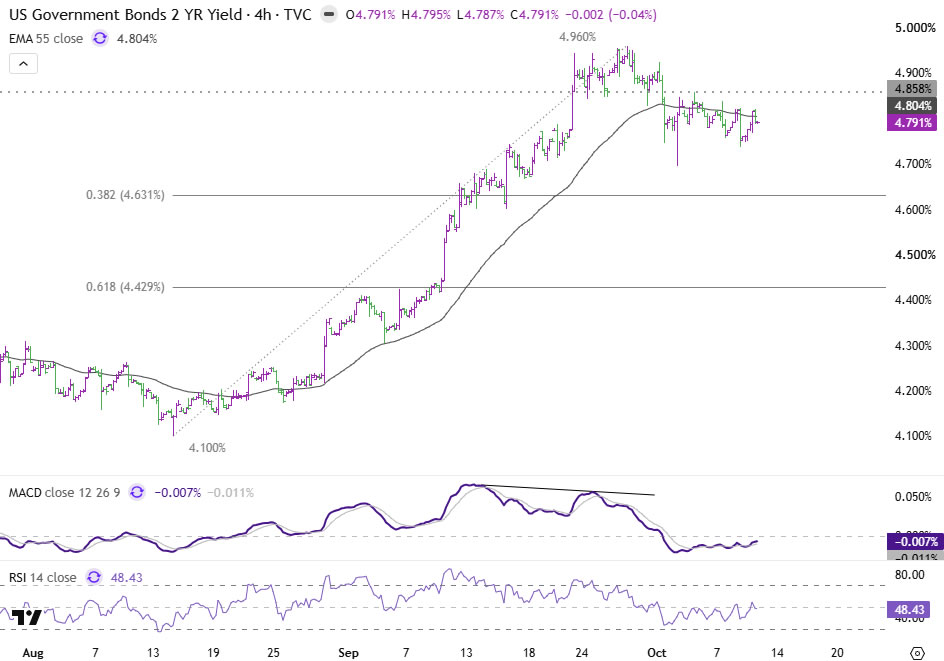
The 2-year yield has formed a short-term peak at 4.960%, accompanied by bearish divergence in 4-hour MACD.
It has also repeatedly struggled around the 4-hour 55 EMA, currently near 4.804%. The immediate resistance to watch is 4.858%. Remaining below that level keeps the correction intact towards the 38.2% retracement of 4.100% to 4.960% at 4.631%.
A firm recovery through 4.858% would instead suggest that the front-end correction has run its course and bring 4.960% back into focus.
Ten-Year Yield May Have Completed Its First Major Upswing
The 10-year chart presents a similar but potentially more mature setup.
The rally from 4.619% to 5.365% can be treated as a five-wave impulse, with the final advance from 4.920% forming an ending diagonal. The move stalled just below the 161.8% projection of 4.732% to 5.041% from 4.920% at 5.420% before breaking below 5.252%.
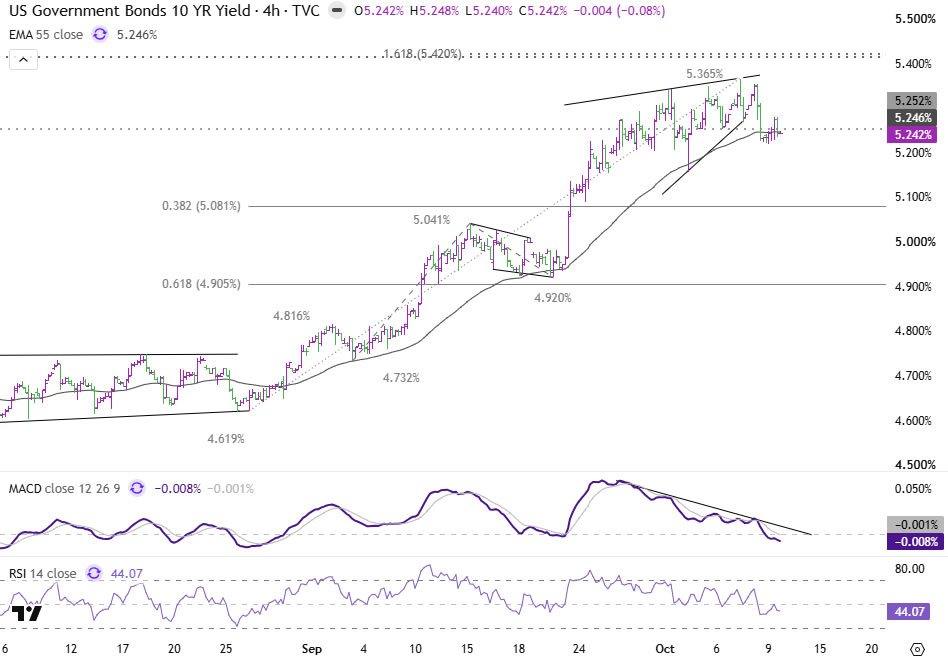
Momentum has also weakened materially. Sustained trading below the 4-hour 55 EMA (now at 5.246%) will solidify this case and bring a deeper fall back to the 38.2% retracement of 4.619% to 5.365% at 5.081%.
Conversely, a firm break through 5.365% would indicate that the top is not yet established and put the 5.420% area back into play.
CPI Comes First, Then the Midterms
The most immediate challenge to the wait-and-see thesis comes with US CPI on October 14.
A sufficiently soft inflation report could remove more residual near-term tightening premium, putting 4.631% in the 2-year yield and 101.03 in DXY firmly into play. A hot CPI report is the clearest route back toward 2-year yields at 4.960% and a fresh attempt by DXY to break 102.77–102.85. In that case, the Dollar would not need to wait for November.
France remains the parallel trigger. A renewed EUR/USD break below 1.1159, particularly alongside OAT–Bund spreads moving back toward 150–159bp, would provide an independent source of DXY strength even if US yields remain subdued.
The October 27–28 FOMC comes next. With no new projections and markets already leaning heavily toward a hold, the meeting may prove less decisive than CPI, although any guidance on December and subsequent tightening could still move the rates curve.
Then comes November 3. Trump’s decision to postpone any US attack on Iran until after the midterms has given that date additional market significance beyond domestic politics.
Rally Stalled Does Not Yet Mean Rally Over
The Dollar’s problem is not that its supports have disappeared. They are simply not strengthening together.
Fed urgency has faded. The 2-year yield has corrected. Long Treasury yields are starting to find buyers at historically high levels. France remains a source of Euro weakness, but French stress is carrying more of the burden of supporting DXY.
That leaves the Dollar vulnerable to consolidation in the weeks ahead. Unless CPI delivers a substantial surprise, markets may increasingly prefer to wait for the larger catalysts clustered around the end of October and the November 3 midterms. In that environment, a drift toward 101.03 would be entirely consistent with digestion of the previous rally.
The Dollar may have stalled. But calling a top requires more evidence.
Key Takeaways
- DXY closed the week at 102.232 after reaching 102.536, failing to extend even as the Euro stayed the weakest major currency—a sign the rally’s three pillars have stopped reinforcing each other.
- Fed urgency has faded the most: the 2-year yield has unwound 17bp from its peak after soft September payrolls and Williams’ “no need for urgency” comment.
- Strong demand at the 10-year (5.300%) and 30-year Treasury auctions shows buyers stepping in at two-decade-high yields, suggesting long rates may be creating their own resistance.
- France remains Euro-negative but is now carrying more of DXY’s support alone; a flare-up in OAT–Bund spreads could lift the Dollar Index without a broad Dollar rally.
- US CPI on October 14 is the nearest catalyst—a soft print opens the door to DXY 101.03, while a hot print could send DXY back toward 102.77–102.85 ahead of the October 27–28 FOMC and November 3 midterms.