Created with generative AI
View original image
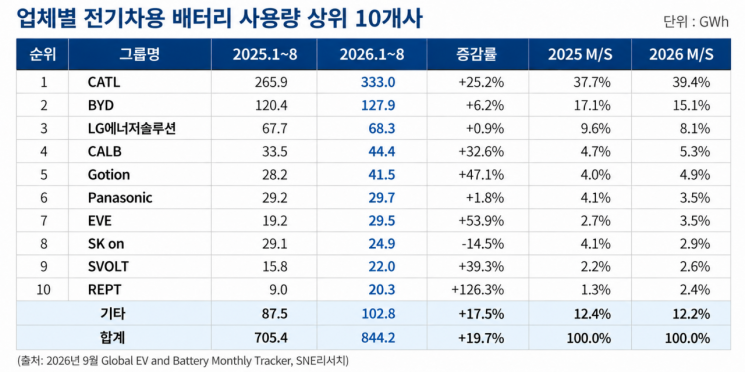
From January to August of this year, the global usage of batteries for electric vehicles grew by 19.7% compared to the same period last year. However, the combined market share of the three major Korean battery manufacturers fell by 3.9 percentage points (p).
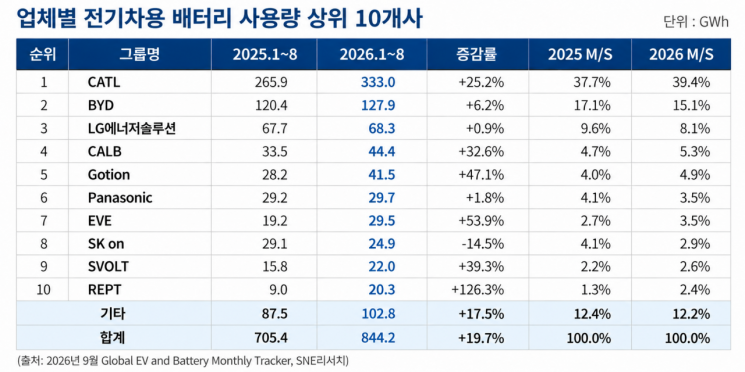
According to SNE Research, a secondary battery market research firm, the total battery usage installed in pure electric vehicles (EV), plug-in hybrid vehicles (PHEV), and hybrid electric vehicles (HEV) registered in countries around the world between January and August reached approximately 844.2 gigawatt-hours (GWh), an increase of 19.7% year-on-year.
By battery supplier, China’s CATL retained the top spot with 333.0 GWh, a 25.2% increase from the previous year. Its market share rose from 37.7% to 39.4%, up by 1.7 percentage points.
Ranked second, BYD achieved 127.9 GWh, up by 6.2%; however, its market share decreased from 17.1% to 15.1%, dropping by 2.0 percentage points. The combined market share of these two companies stood at 54.6%, maintaining a similar level to the same period last year (54.8%).
Among Korean companies, LG Energy Solution remained in third place with 68.3 GWh, up by 0.9% year-on-year. Although supply to major automakers like Tesla, GM, Hyundai Motor Group, and Volkswagen continued, its market share declined from 9.6% to 8.1%, a decrease of 1.5 percentage points, as growth fell significantly short of the overall market pace. Usage increased in Europe and Asia, but most of this growth was offset by a 42.3% drop in North American usage, which fell from 25.2 GWh to 14.6 GWh.
SK On remained in eighth place with 24.9 GWh, a 14.5% decline, and saw its market share fall from 4.1% to 2.9%, down by 1.2 percentage points. Although the company supplies batteries to Hyundai Motor Group, Ford, Volkswagen, and Mercedes-Benz, a 41.8% drop in North American usage—from 11.7 GWh to 6.8 GWh—had a significant impact.
SNE Research stated, “The combined market share of the seven leading Chinese companies increased by 3.6 percentage points compared to the same period last year, reaching 73.3%. In contrast, the three major Korean companies’ share fell by 3.9 percentage points to 12.7%.”
Japan’s Panasonic rose to sixth place with 29.7 GWh, up by 1.8%. While supplies to Tesla in North America supported usage, its growth rate lagged far behind the market average, resulting in its market share falling from 4.1% to 3.5%, a decrease of 0.6 percentage points.
The regional gap was significant. In China, the installed capacity of batteries for electric vehicles grew by 16.9%. Europe (29.2%), Asia (excluding China, 76.0%), and South America (179.9%) also posted strong growth, whereas North America saw a decrease of 23.7%. In the United States, a continuing demand gap following the end of the federal electric vehicle tax credit has led battery suppliers to shift EV battery production lines to those for energy storage systems (ESS).
By technology, the share of lithium iron phosphate (LFP) batteries increased from 52.2% to 57.3%, a rise of 5.1 percentage points, and the average installed capacity per vehicle rose from 35.1 kilowatt-hours (kWh) to 39.2 kWh, an increase of 11.9%.
Hot Picks Today

“Only 3 Passengers on a 180-Seat Flight”… The Shocking State of the ‘Honeymoon Hotspot’
SNE Research forecasted, “Since September, China has begun imposing a 2% consumption tax on domestically sold lithium-ion batteries and plans to abolish the export value-added tax refund for batteries from January next year. The speed at which Chinese suppliers expand overseas production and adjust their pricing policies will be key factors in determining the competitive landscape through the end of the year.”
This content was produced with the assistance of AI translation services.
© The Asia Business Daily. All rights reserved. Unauthorized AI training and use prohibited.