What should you automate next? Get ideas at AMA: Software 2026.
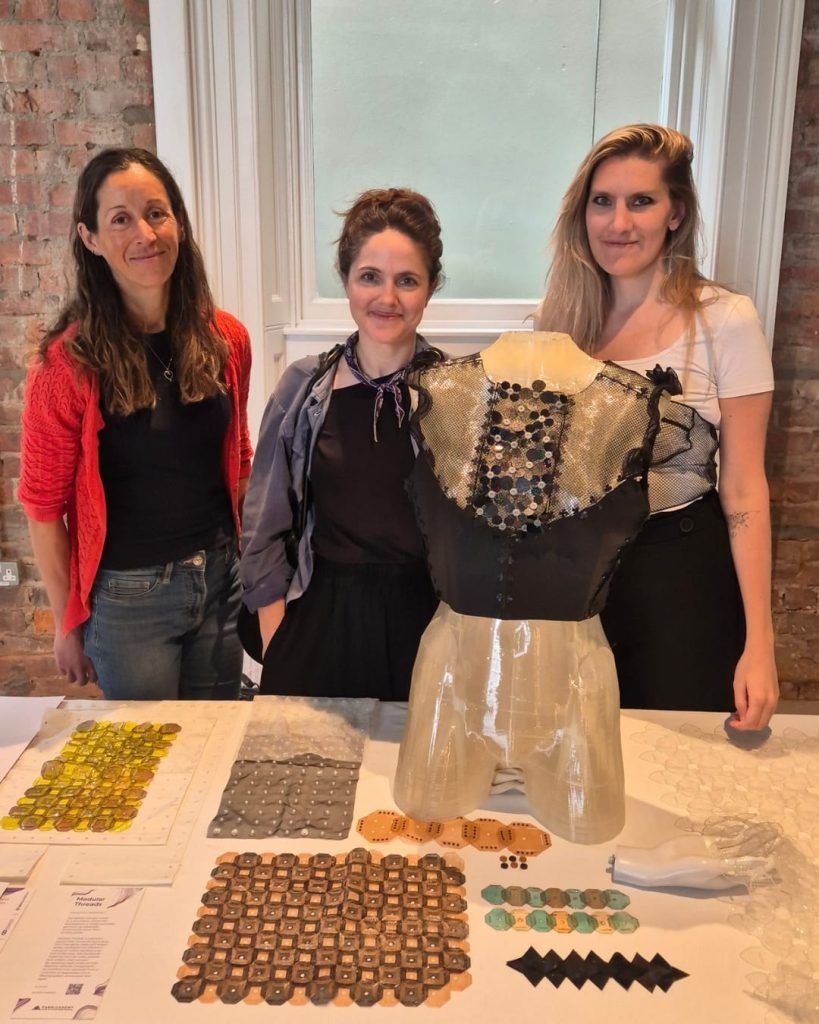
Fashion and 3D Printing, an exhibition of work by three designers who combine fashion and technology, opened on October 8 at the 3D Print Gallery in Haarlem, the Netherlands. The gallery occupies one of the cells of the Koepel, a former prison, and describes itself as the world’s first 3D print museum.
The exhibition brings together garments that respond to their wearer and surroundings, along with two applications of additive manufacturing (AM): garments whose final shape comes from tension built into the print, and textiles produced directly on the printer without sewing. The pieces on display include a dress that changes shape as stored tension in the printed material is released, clothing that reacts to people nearby, and lace dresses made without a single stitch.
Robotic Couture and Tension-Formed Dresses
Anouk Wipprecht has worked in FashionTech for 20 years, with clients including Intel, Audi, and Disney. Her robotic couture, including her spider dress, responds to the wearer’s movement and to the proximity of people around them.
Jessica Joosse and Fabienne van der Weiden, the designers behind LABELEDBY., met while studying at Eindhoven University of Technology (TU/e). Their work began with a question about how fashion could become more sustainable, smarter, and fairer.
Their Rolling Ruffles Dress is stretched while it is being printed. When that tension is released, the dress deforms, and the making process remains visible in the finished garment.
Printing Clothing Without Sewing Patterns
Jojanneke Tamis is self-taught and has no formal fashion training. She worked out on her own how to produce a dress on a 3D printer, without relying on sewing patterns.
According to the gallery, she now prints clothing and textiles that cannot be made through any other method, including printed lace and fabrics that move.

Printing as Part of How the Garment Is Made
LABELEDBY. and Tamis use 3D printing to determine how a garment takes shape, beyond adding decoration to it. The Rolling Ruffles Dress gets its final form from tension introduced while it is printed, and Tamis produces dresses and textiles directly on the printer without sewing patterns.
At the Royal College of Art (RCA) in London, researcher Mingjing Lin and Tsai-Chun Huang made costumes for a Beijing Opera performance from textiles printed in TPU on a LISA SLS printer from Sinterit. Lin said the project tested whether printed textiles could handle far more body movement than catwalk wear. This ties to Tamis’s moving fabrics, since both treat printed textiles as a material that has to move with the wearer. The finished garments combined the printed textiles with pleating and weaving.
In both cases, how the printed material behaves once it leaves the printer is part of the design.
Register now for AMA: Software 2026. Join 3D Printing Industry on 22 October for expert presentations, panel discussions and live audience Q&A exploring the software shaping additive manufacturing. Register here.
To stay up to date with the latest 3D printing news, don’t forget to subscribe to the 3D Printing Industry newsletter or follow us on LinkedIn.
Explore the full Future of 3D Printing and Executive Survey series from 3D Printing Industry, featuring perspectives from CEOs, engineers, and industry leaders on the industrialization of additive manufacturing, 3D printing industry trends 2026, qualification, supply chains, and additive manufacturing industry analysis.
Featured image shows 3D Print Gallery opens new exhibition on fashion and 3D printing. Image via 3D Print Gallery.