We wrote at length about how SpaceX’s plans for 10GW in 2027 was feasible, paving the way for 300b+ ARR. We received a lot of pushback from folks calling it impossible. Now, just two months later, we’re already seeing 3.6GW under construction across multiple sites, both existing and new. SpaceX has even revised its estimate up to ~13GW in 2027. This would be the largest amount of datacenter capacity ever built by any one company in that timeframe, roughly equivalent to all of Google’s datacenter capacity from 1999-2026 in just 1.5 years. We think it’s possible and have already identified >9GW of capacity.
We’ve since written multiple update notes to our Datacenter Industry Model subscribers showing off all the sites that can make this possible. We now believe that SpaceX may be the fastest datacenter builder in the world, even more so than Chinese peers. Watch how Colossus 2 adds nearly two Stargate Abilenes (2GW) in just under one year!
These sites now build so fast that the power supply is often identified mid-flight. Looking at our Energy Model, we see that power under Elon’s management (>8GW) is less than our total datacenter power coming online (>9GW).
Datacenter Industry Model subscribers knew all of this before anyone else. On June 23, we sent our customers information on the infamous Elon “10GW in 2027” statement on SpaceX’s first earnings call by six weeks, pointing out a 5-10GW incremental order for 2027 was floating around the supply chain and that a new building was already under construction at Colossus 2, now publicly known as “MiniHard.” On September 14, before a single datahall went vertical, we identified >2GW of fresh sites, both at Colossus 2 and SpaceX’s Starbase campus.
The Elon locations have a pioneering track record with us. We called Colossus 2 the first gigawatt datacenter in the world back in September 2025, when onsite gas was called a science experiment. We showed exactly how xAI bypassed the grid (and permitting!) with truck-mounted turbines, why the behind-the-meter playbook was going to spread to 40GW+ of behind-the-meter datacenters by 2028, and how the Anthropic and Google deals turned SpaceX into the most profitable neocloud on earth. Now, Colossus 2 could soon house the largest BESS deployment in the world, with 5.9GWh already being installed, and more to come.
This report unveils our analysis of SpaceX’s “proprietary plan.” From repurposing Starship’s rocket building and launching campuses into datacenter sites, to the gargantuan BESS deployment, buying out homeowners to house construction workers, and relocating mobile turbines, this report covers it all.
For example, did you know TeraFab, Elon’s 100M sqft, 10GW+ chip fab project in Texas, will likely also have a datacenter? See the clip below of SpaceX representatives talking to Grimes County officials.
Source: Local Filings
Keep reading to find out why we think the TeraFab datacenter will be for third party renting!
And beyond the paywall, we dive deeper into the likely SpaceX power solutions, another site that may house a datacenter, and potential pricing for future SpaceX contracts, build off our proprietary SpaceX Funding Model as part of our Capital, Compute and Markets model.
What does building two Stargate Abilenes in one year look like? Let’s talk about the Colossus expansions, where Elon is already trying to buy hundreds of nearby homes to both soothe noise complaints and provide construction worker housing. We’ve already spoken about MiniHard in Memphis finishing construction in just ~5 months, but the newly purchased “Gun Range” plot just south of the state line in Mississippi will take ~4 months!
To our knowledge, this would be the fastest greenfield datacenter ever built at scale. While most are fighting for 8-12-month build times, SpaceX has cut them in half.
Looking closer at Colossus 2, we see SpaceX trying to break its own record again. SpaceX’s first retrofit at Colossus 1 took 122 days for 150MW, and Colossus 2 took just 91 days for 210MW. Now, SpaceX has taken the building (codenamed Project SPAM) directly in the middle of Colossus 2, and targets December to bring its first tranches online. With a construction start date of October 5, 2026, this could be shorter than the 91-day record, which itself broke the 122-day record; both are held by SpaceX.
Colossus expansions were to be expected, but repurposing sites from Elon’s other ventures was not. For example, many are familiar with Elon’s Starbase in Texas, traditionally used for rocket building and launching. However, as flagged two months ago to Datacenter Industry Model subscribers, this site will now house two datacenters too!
The site went from simply clearing ground at the end of August to full vertical construction by the end of September, and we now believe it will actively fit out datahalls in the coming weeks.
At this size, and with the knowledge of a 2027 timeline (meaning Vera Rubins), this site could be well over 1GW! Looking at the datacenter on the right, you can see that the steel mainframe is being built, while the roofing is actively following behind it. And on the left, you can see the transition from dirt to full preconstruction. These are multiple construction processes performed simultaneously, a visual representation of speed.
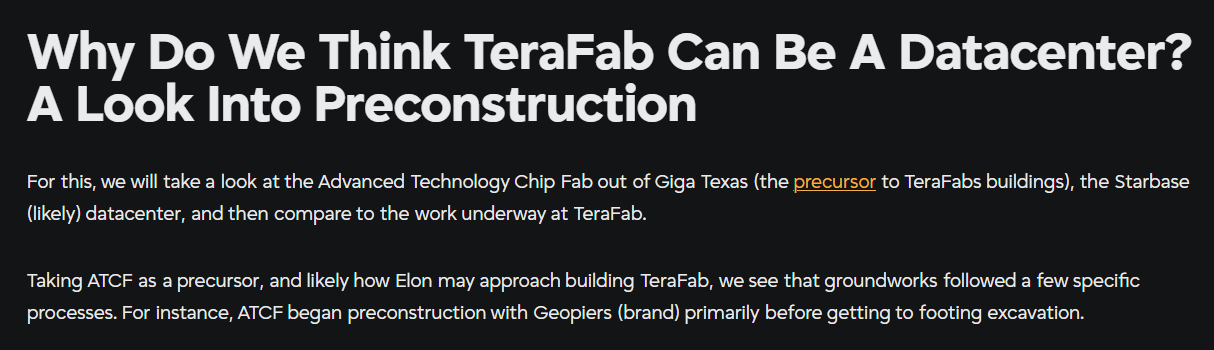
Lastly, we have medium-high confidence that TeraFab will have a datacenter too. That’s right, the 10GW, 100M sq.ft chip fab venture from SpaceX will likely have a datacenter. We flagged this possibility ~3 months ago, and again 1.5 months, to Datacenter Industry Model subscribers, solely by examining preconstruction work and filings.
The project actually initially started as a datacenter and then quietly pivoted to TeraFab.

We showed the clip at the beginning (August 2026) of the site housing compute; furthermore, the representatives do not confirm that the datacenter will be for SpaceX’s use only, leaving room for third parties to rent the capacity too.
Source: Local Filings
The main remaining question is whether the current work on the ground is for one or more datacenters or for supporting facilities for TeraFab (like onsite gas, Central Utility Plant, etc.). We lean toward a datacenter for now, but suspect the vertical construction is moving slowly to ensure their JETI agreements/permits are fully compliant; otherwise, they may be subject to the TCEQ pauses or other regulatory scrutiny. Preconstruction work is so early that these pads can be pivoted a number of ways if datacenter work is not granted.
One thing often overlooked is that the Elon companies are some of the best hardware companies in the world. We mentioned in our previous newsletter that their labor can run at 3k workers per GW thanks to their top-tier engineers. However, we also believe that Tesla is manufacturing modular MEP equipment, allowing SpaceX to deploy so rapidly.
If SpaceX and Tesla can manage their global supply chains appropriately, their partnership can easily construct GWs with far fewer constraints than others. This is like Crusoe manufacturing their own Switchgear to skip lead times, but on a massive scale. Tesla will likely become more than a BESS merchant to SpaceX soon.
Now that we’ve walked through GWs worth of sites, how will they power them? So far, we track 8GW+ of likely behind-the-meter capacity for SpaceX. This includes deals such as FTAI, Solaris, and others that only our Energy Model subscribers get access to. We have discussed how SpaceX decides the power on the fly, and one amazing example is the new Starbase, Texas site, where APRs are being deployed just one month after vertical construction started!
The site may use >1GW of APRs, but judging by building size, this will not be enough. And looking at the (two!) pipelines underway, the site will likely have multiple GWs of power, and more turbines on the way. According to a TikTok with the Brownsville mayor, the site is building a fiber optic channel through the Port of Brownsville, as well as looking at leasing waterfront space (potentially for its own port). At such a massive scale, we suspect most of the temporary turbines from Colossus 2 will be relocated here.
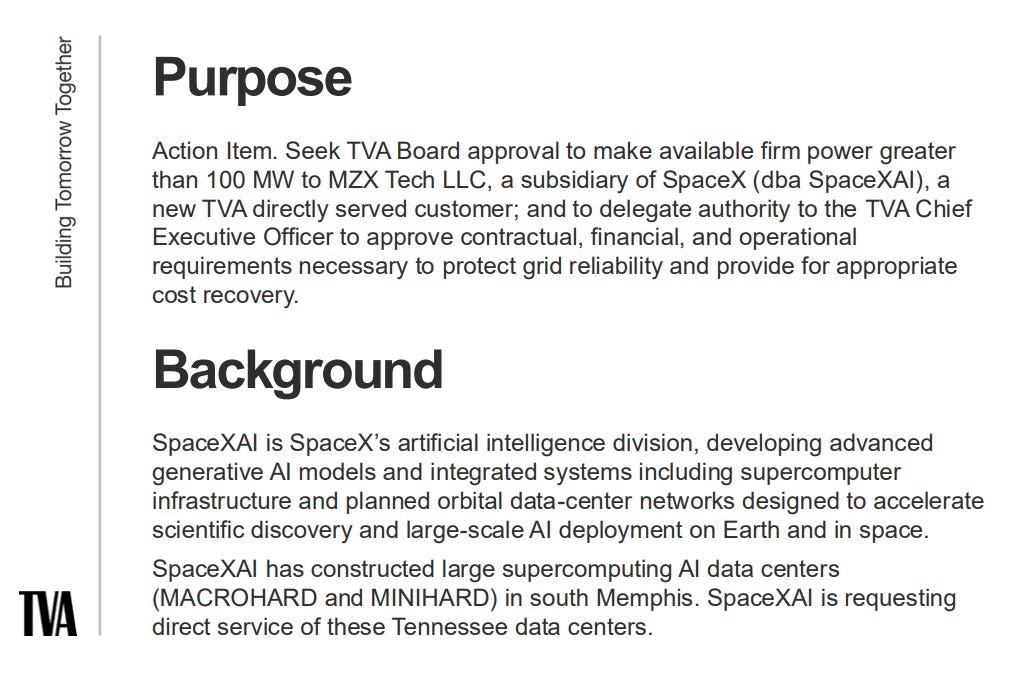
Next, let’s move on to Colossus 2, where the opposite is happening: a grid connection. According to TVA (the region’s utility), Macrohard (700MW) and MiniHard (450MW) have both requested service for their facilities. For now, we assume this grid connection services Macrohard and MiniHard in full.
We’ve already seen SpaceX building out the 500kV gas-insulated substation (GIS) to the left of MiniHard, which is scheduled to finish construction by December 31, 2026, and connect to the Freeport substation.
This comes at the perfect time, as the turbines at the Southaven power plant must be shut down. The site can legally operate 2.7GW nameplate right now, but only 1.24GW nameplate by July 2027, due to the binding requirement signed July 30, 2026.
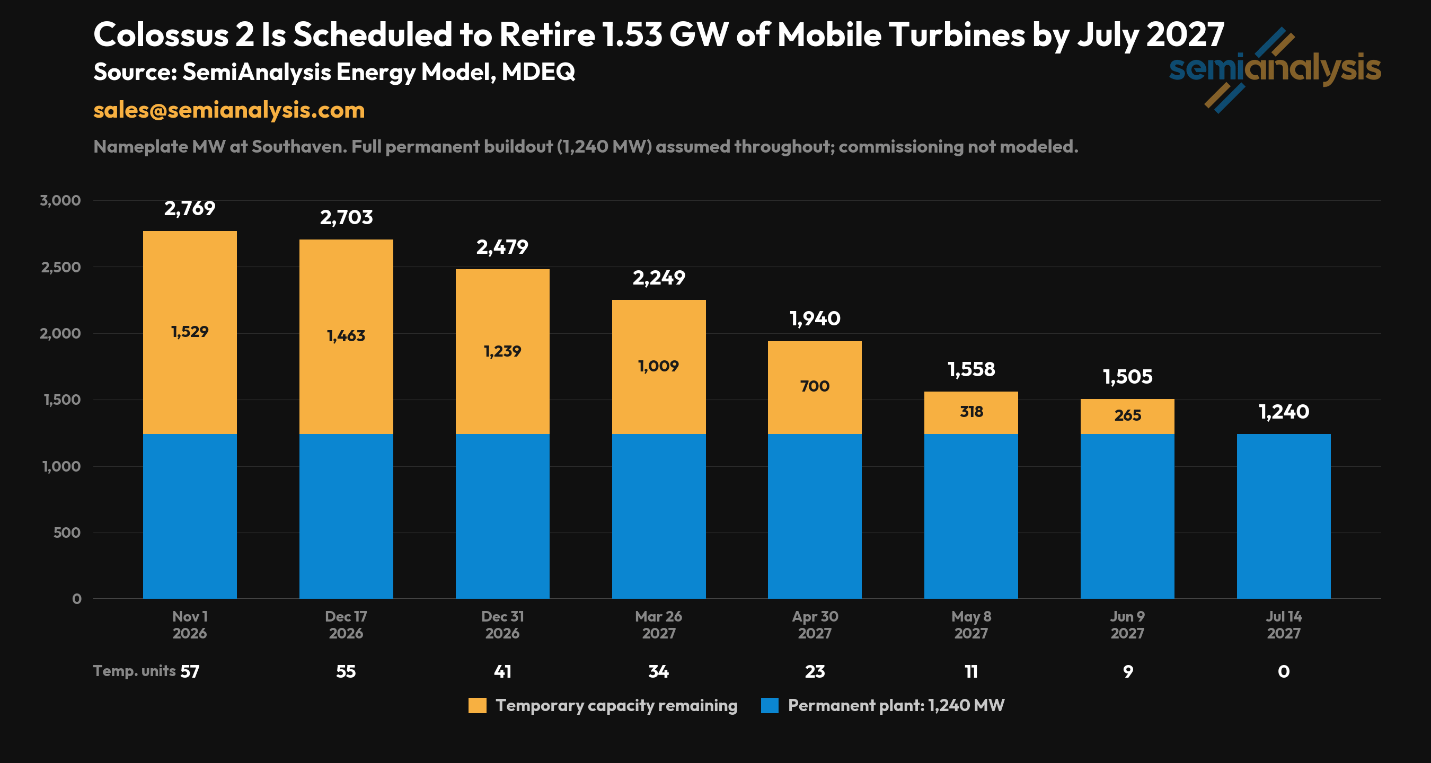
But the eagle-eyed reader may notice: after subtracting the ~1.2GW grid connection, we’re left with 1.3GW of compute… and 1.24GW of nameplate power generation… Recall, nameplate generation still takes a haircut on efficiency and derate, and IT MW doesn’t represent the full facility load. There could be a gap upwards of 300MW. How does this get solved?
We think there are a few ways, and the Energy Model team will explore this power system in depth soon. But first: we think SpaceX has built the largest BESS field in the USA for a reason. With the BESS nearing 6GWh, we think the site will orchestrate gas and BESS to increase baseload, while the turbines cycle through charging them. If the datacenters are designed right (and our IT MW assumptions are correct), this could work. Given some clusters are customer-facing while others are for internal training, there could be an SLA uptime tiering to increase total capacity.
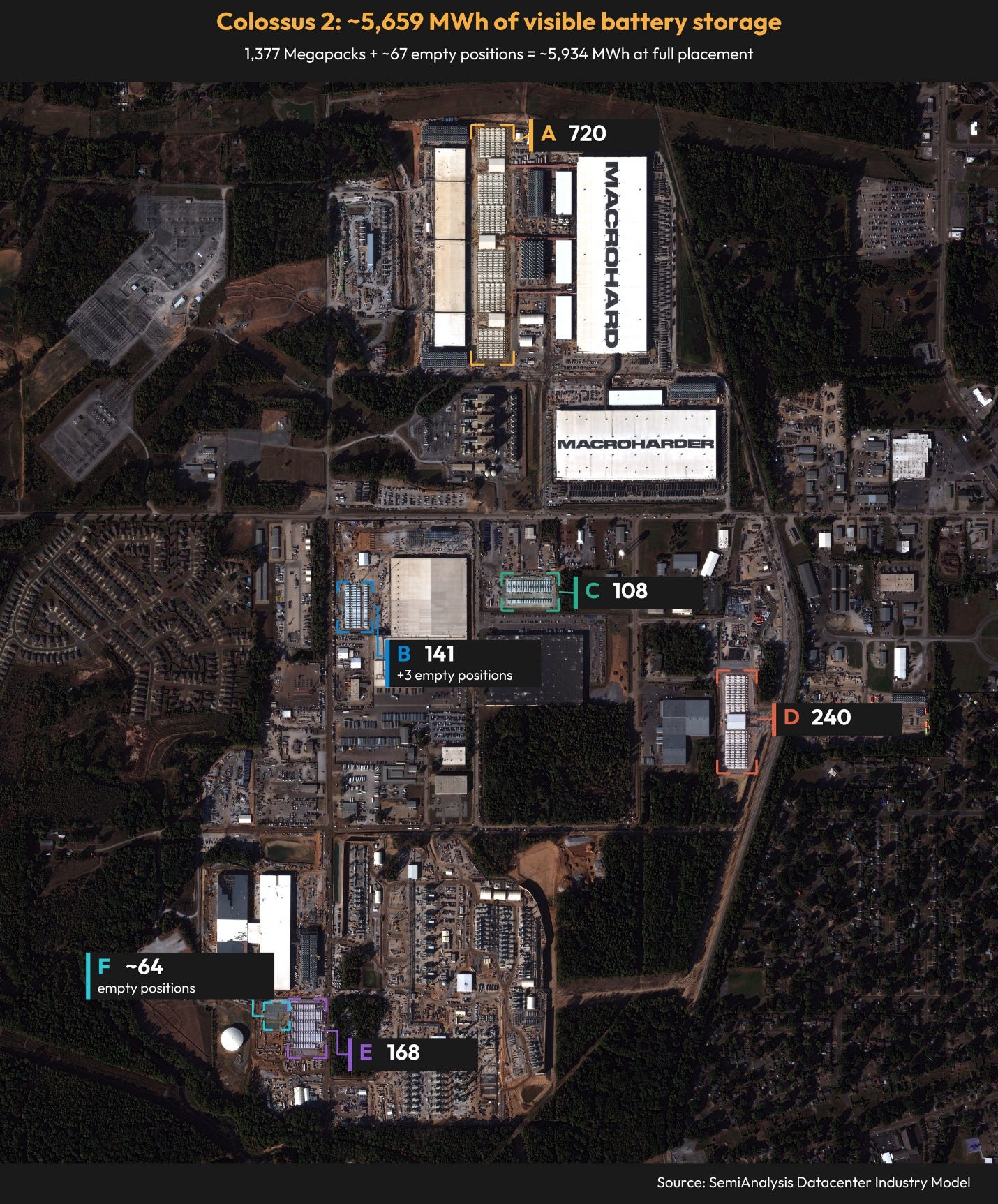
We suspect that with an ultralow PUE of ~1.10-1.15, variance in datacenter types (inference vs training, customer-facing vs internal usage), rack designs using less power (Project SPAM using half the fiber of others), and the oversized BESS, the project may still be able to cover a ~300MW shortfall.
Beyond the paywall, we will further discuss the power situation, and how we think SpaceX economics could play out.