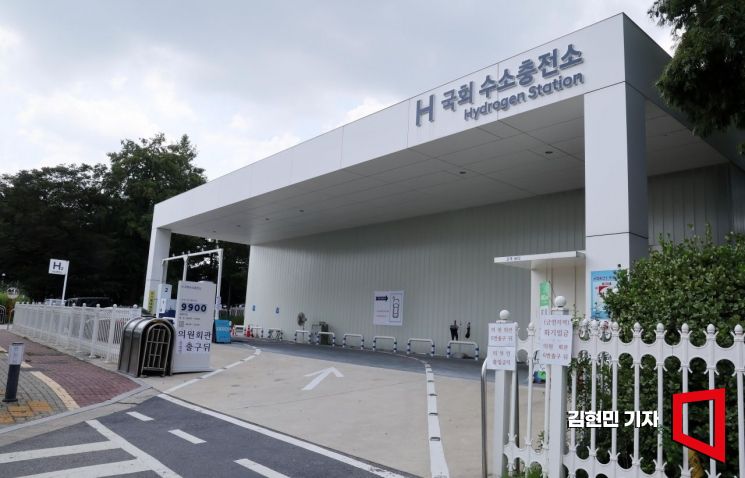
National Assembly hydrogen refueling station. Photo by Kim Hyunmin.
View original image
China selected five urban clusters this year to launch its second hydrogen pilot program. The selected clusters span the country: Jing-Jin-Ji (Beijing, Tianjin and Hebei), the Greater Bay Area (Guangdong, Hong Kong and Macao), the Northeast and the Yangtze River Delta, the Xinjiang-Chengdu-Chongqing economic zone, and the Yellow River Jiziwan and Central Plains.
The central government will invest up to 8 billion yuan (about 1.6 trillion won) over the next four years to develop industries that use hydrogen, including not only hydrogen vehicles but also green ammonia and methanol, as well as hydrogen-based steelmaking. It has set a target of increasing the number of hydrogen fuel-cell vehicles to 100,000 by 2030 and lowering the average hydrogen price for end users to less than 25 yuan (about 5,000 won) per kilogram.
While the first pilot program, launched in 2021, focused on localizing key materials and components such as fuel-cell stacks and catalysts, the second program prioritizes lowering costs through mass production and practical applications. If China achieves economies of scale by leveraging its vast domestic market, competition with Korean companies will inevitably intensify. China’s gains are already visible in the market. BYD, which ranked ninth in electric vehicle markets outside China through 2024, rose to third place last year, overtaking Hyundai Motor Group, which ranked fourth. The gap has widened further this year. The hydrogen fuel-cell vehicle market is no exception. Last year, China sold 7,797 vehicles in the global market, surpassing South Korea’s 6,802.
While China continues to expand its hydrogen industry, South Korea is falling further behind. The government’s budget for its hydrogen fuel-cell vehicle deployment program for 2027 is 445.7 billion won, down 22.6% from this year. Even when national government subsidies are allocated, some purchases do not go ahead because local governments lack the funds to provide their share. The current system, which relies on local governments matching the budget, must be improved, and the level of national government support must be substantially increased.
Hot Picks Today

“Two Spend 500,000 Won in a Flash, Yet Wait Two Hours?” … ‘Dreamland’ Shunned by Kids and Foreign Tourists
China has overtaken us in the electric vehicle market, and our domestic market is now under threat as well. We cannot afford to cede the hydrogen vehicle market to China, even though we have long prided ourselves on being ahead in this field. We must focus on competitive areas such as hydrogen commercial vehicles and fuel cells, and establish a mid- to long-term deployment roadmap to reduce uncertainty around corporate investment.
This content was produced with the assistance of AI translation services.
© The Asia Business Daily. All rights reserved. Unauthorized AI training and use prohibited.