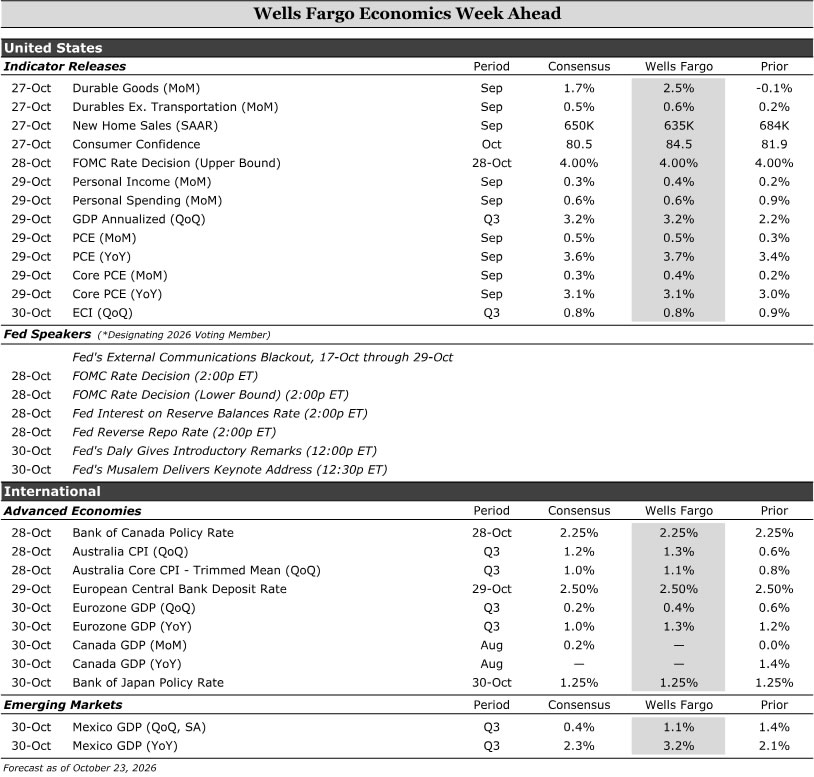
Next week, we expect the FOMC to hold rates steady. A pause runs counter to Chair Warsh’s inflation fighting bravado, but we remain of the view that hiking rates can do little to slow today’s supply-side inflation problem. There will be no updated SEP or dot plot, and we suspect the Chair will be reluctant to offer much forward guidance, though a December hike is still the base case. Consumer spending should remain resilient and support Q3 GDP growth, with firmer income fundamentals likely sustaining household demand. Housing remains a weak spot, however.
In Canada, we expect the BoC to hold rates steady, though risks are tilted toward a hike. Like the Fed, we expect the ECB and BoJ to remain on hold next week before hiking in December. Stronger-than-expected momentum in Mexico points to firmer Q3 GDP growth, reinforcing our base case for Banxico to remain on hold through 2027.
United States:
- New Home Sales (Tue.), FOMC Meeting (Wed.), Personal Income & Spending (Thu.)
Advanced Economies:
- Bank of Canada (Wed.), European Central Bank (Thu.), Bank of Japan (Fri.)
Emerging Markets:
U.S. Week Ahead
New Home Sales • Tuesday
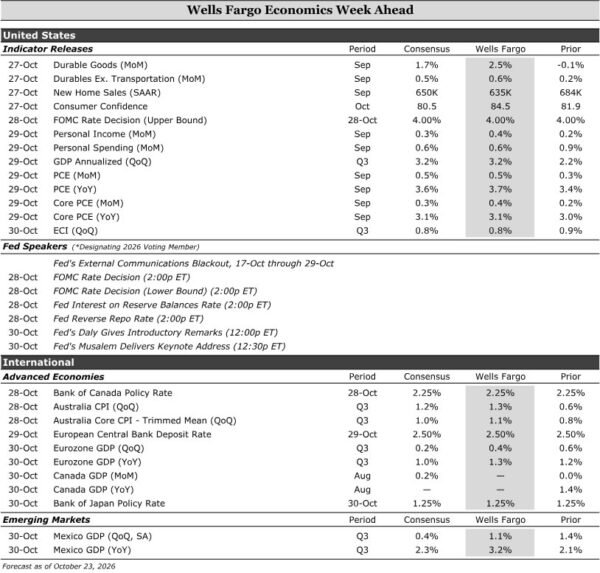
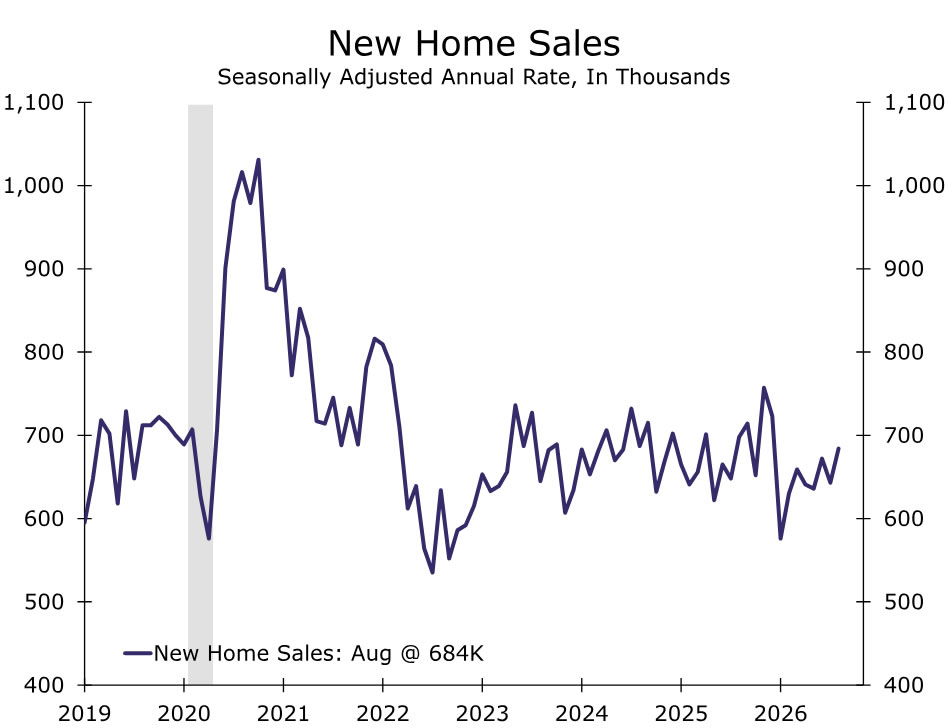
We would be surprised if new home sales rose in September. The average 30-year fixed mortgage rate broke 6.7% at the start of the month and surpassed 7.0% by month-end, reflecting a lift from longer-term treasury yields. This has intensified the housing affordability issue for buyers who already feel crunched by rising fuel and food prices. Although builders have found success in the past using price cuts and rate buy-downs to improve affordability, those incentives no longer appear to be moving the needle. Builder sentiment sank three points in September and another three points in October, dipping to its lowest level since June 2012. We estimate that new home sales fell 7.2% in September to a 635K annual rate.
FOMC Meeting • Wednesday
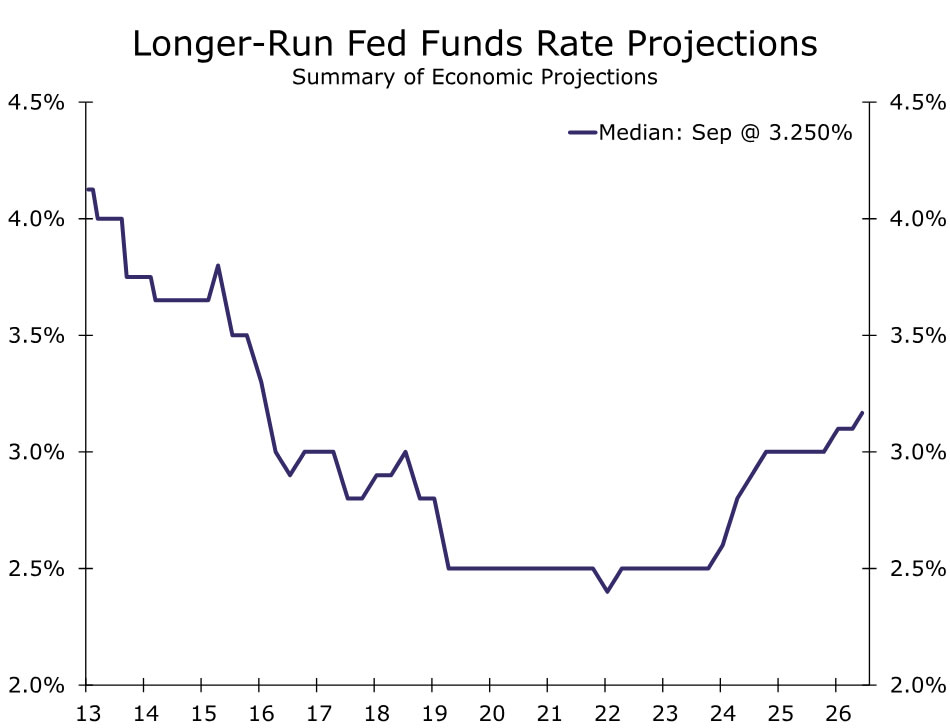
The FOMC looks poised to leave the fed funds rate unchanged next week, although the decision feels inconsistent with Chair Warsh’s inflation fighting rhetoric. At Jackson Hole, Chair Warsh laid out a hawkish message, and the FOMC delivered on that bravado with a 25 bps rate hike a few weeks later. Since then, we got a hotter-than-expected inflation reading paired with a run of Fed speak that signaled the October meeting likely would be a hold. If the Fed hiked in September and inflation has picked up since then, why not hike this time? Our own view is that gradual rate hikes make more sense when done as a catch-up to a higher neutral rate rather than as a tool to combat today’s supply-side inflation.
We think the meeting itself probably will be on the quieter side, assuming the FOMC does in fact keep rates unchanged. There will be no updated SEP or dot plot, and the short post-meeting statement doesn’t seem likely to change much. We suspect the Chair will channel his inner Greenspan and strive to mumble with great incoherence in the press conference. We see no reason to think Warsh will offer much in the way of forward guidance about what is coming next. If he has a lean, we suspect it will be hawkish given the aforementioned hot inflation data and the high likelihood that the Fed hikes rates in December.
One agenda item we will be listening closely for in the press conference is an update on the task forces. Our sense is there are no imminent changes coming on this front, but Chair Warsh originally laid out a timeline for the task forces to start reporting their findings around the turn of the year, so we won’t be surprised if attention starts turning to them in the coming months.
Personal Income & Spending • Thursday
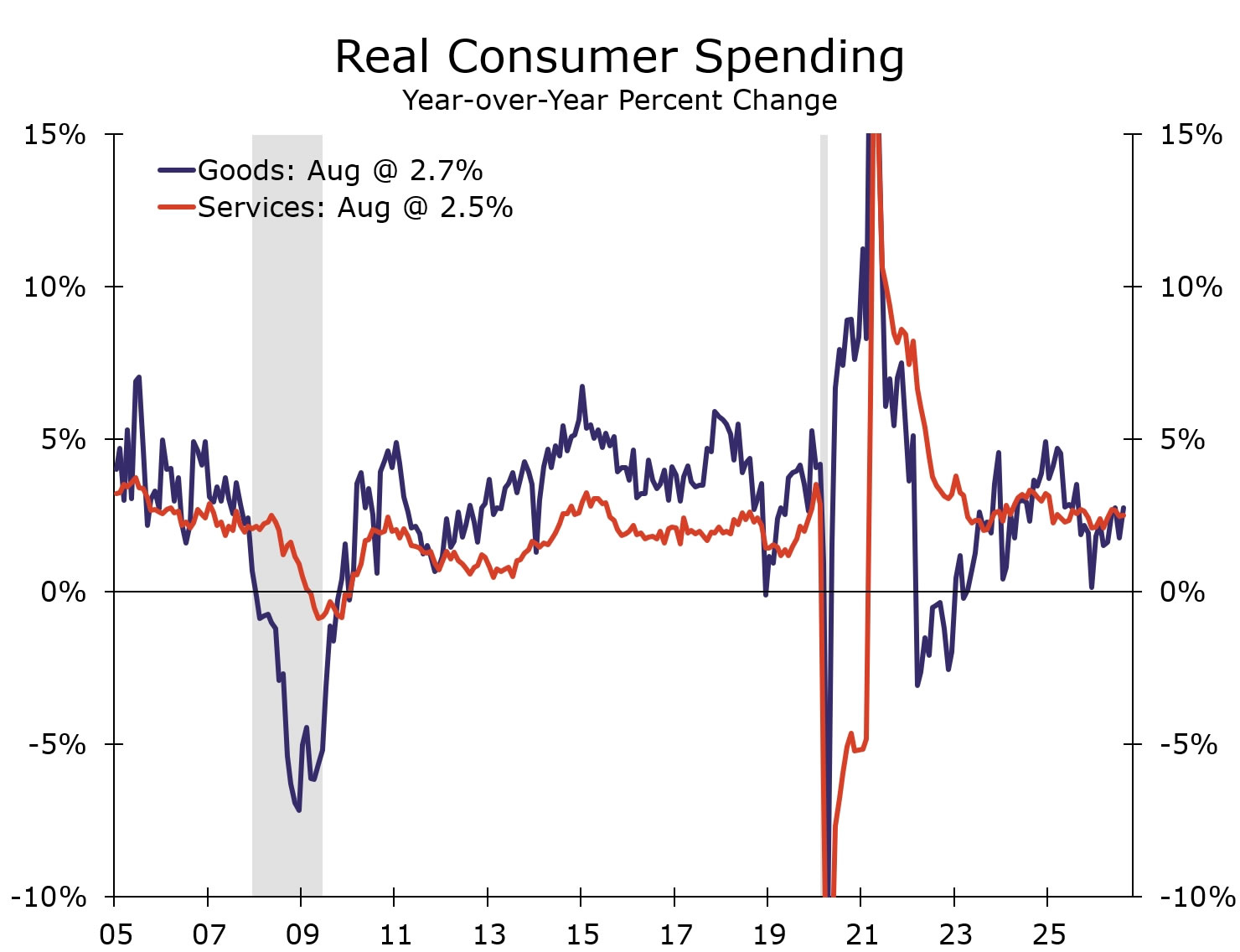
Next week’s personal income & spending report should show a consumer that remains willing and able to spend. We forecast personal spending rose 0.6% in September, or about 0.1% after accounting for higher prices. Spending was likely relatively broad-based during the month, with some weakness concentrated in auto sales. Control-group retail sales point to continued growth in goods consumption, while restaurant sales suggest services spending remained on solid footing.
More broadly, the report comes on the heels of annual revisions that showed household incomes grew faster than previously believed. Along with continued support from rising household wealth, the revised income backdrop helps explain why consumer spending has remained resilient despite elevated borrowing costs and persistent inflation pressures. We look for personal income to rise 0.4% during the month, though firmer inflation likely weighed on real purchasing power.
Even as this data follows the Fed’s policy decision the day prior, the market will remain focused on the inflation data. We forecast the headline PCE deflator increased 0.5% in September, with the core measure up 0.4%, lifting the annual rates to 3.7% and 3.1% respectively. This report will also arrive alongside the first estimate of third-quarter GDP on Thursday morning. We expect real GDP expanded at a 3.2% annualized clip, driven primarily by consumer spending and a continued expansion in business investment, namely high-tech related capex. Indeed, we estimate real consumer spending increased at a 3.4% annualized pace in Q3, reinforcing the view that households remain a key source of support for economic growth. While spending should moderate from the robust pace seen in the third quarter, firmer income fundamentals suggest the consumer should remain a source of economic support through year-end.
Advanced Economies Week Ahead
Bank of Canada Monetary Policy Meeting • Wednesday
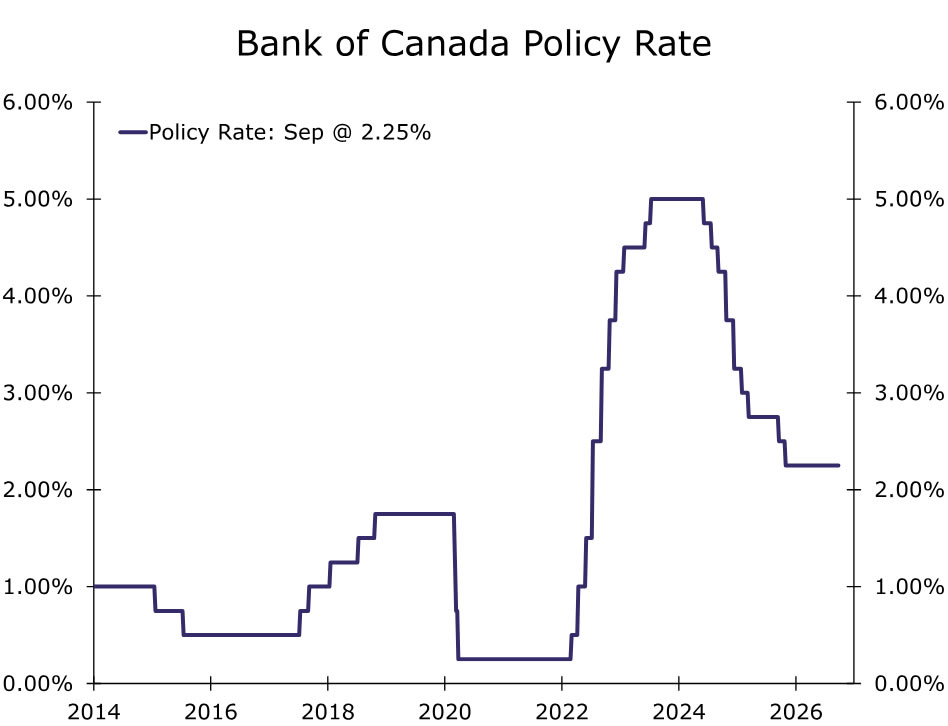
The odds of a Bank of Canada (BoC) hike next week have increased sharply, but we continue to think the risk of a hold may be underappreciated. Market pricing has moved from ~30% a week ago to more than 80% following Governor Tiff Macklem’s comments last weekend, which highlighted higher oil prices could boost domestic growth but also potentially increase the need for the bank to hike if higher costs spread beyond energy.
Markets took those comments as distinctly hawkish, but Monday’s September CPI report did little to reinforce a sense of urgency. Headline inflation rose less than expected to 3.1% amid higher gasoline prices, while the BoC’s preferred core measures were little changed and, in some cases, eased further toward target. Meanwhile, labor market conditions have softened since the BoC’s last meeting, and there remains downside-risk to growth heading into year-end from the recent escalation in tariffs. Our base case has been that policymakers leave rates unchanged next week, though the risks have shifted toward a hike with the BoC somewhat boxing itself into that outcome.
Beyond next week, market pricing looks even harder to justify. Investors currently expect roughly 100 bps of cumulative tightening by year-end 2027, placing the BoC among the most hawkish major central banks. While that outcome cannot be ruled out entirely given there is little sign of an end to the Iran-conflict in sight, the current data simply do not point to an inflation problem requiring that degree of restraint. In discussions with our FX strategists, that leaves the CAD vulnerable to near-term disappointment if either the data or the Bank fails to validate those expectations.
European Central Bank Monetary Policy Meeting • Thursday
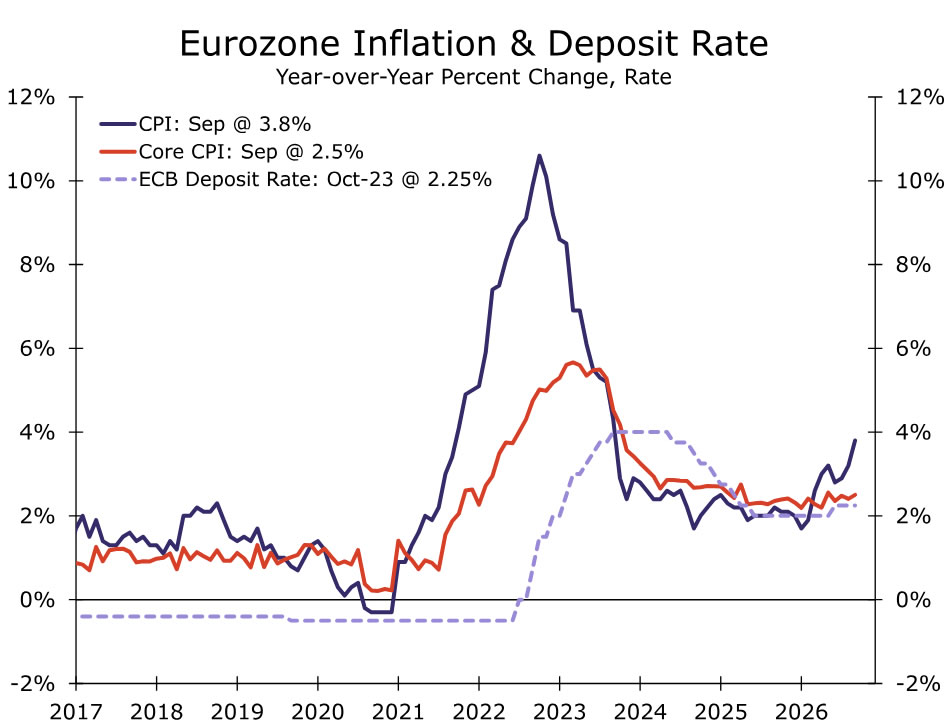
Bond markets are complicating the European Central Bank’s (ECB) next move. We expect the Deposit Rate to remain unchanged at 2.50% next week as France’s fiscal and political turmoil pushes borrowing costs higher. Communication will matter most: tighter financing conditions could temper the need for further hikes, even as energy prices keep inflation risks elevated.
In our view, the economic backdrop still supports further tightening. September headline inflation rose to 3.8% year-over-year and core inflation to 2.5%. We expect next week’s Q3 GDP release to show growth of 0.4% quarter-over-quarter, with the drag from France likely limited by its late-quarter onset. Slightly softer October PMIs still point to expansion (outside France).
For now, December remains our base case for the next hike. A resolution to France’s fiscal troubles could bring relief to bond markets, while a disorderly sell-off that spreads to other highly indebted Eurozone sovereigns could derail that call. The key will be whether the ECB signals that tighter financing conditions warrant more patience without closing the door on further hikes.
Bank of Japan Monetary Policy Meeting • Friday
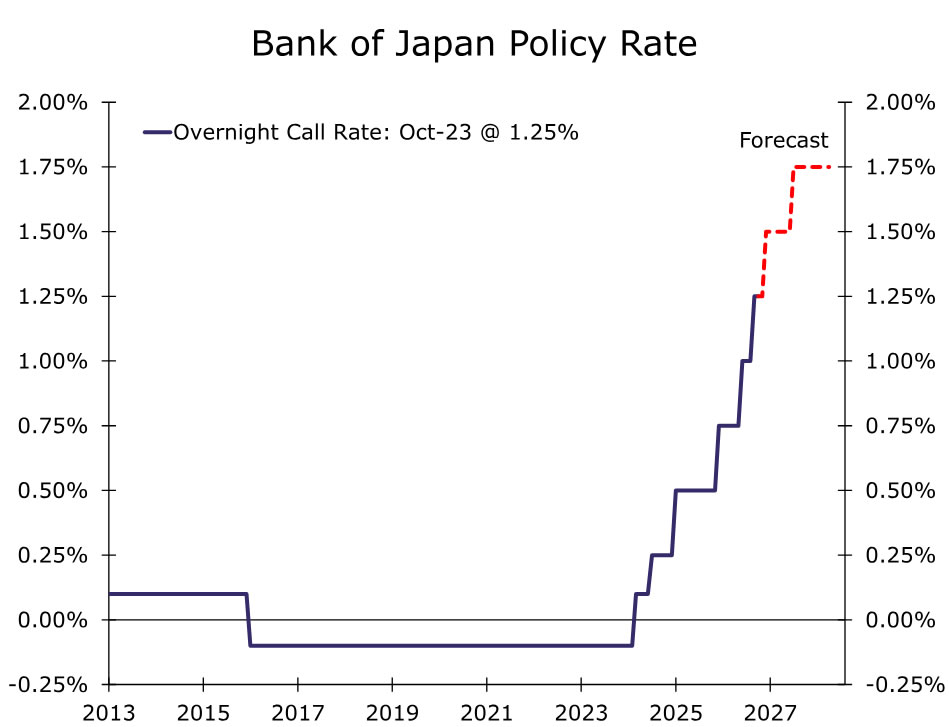
We expect the Bank of Japan (BoJ) to hold its policy rate at 1.25% next week after hiking at its last meeting. The focus will be on updated forecasts and whether policymakers signal greater confidence in the durability of domestic inflation pressures. September headline inflation rose to 2.1% year-over-year, above the BoJ’s 2% target, while its preferred “core-core” measure, which excludes fresh food and energy, rose to 2.4%. In our view, the backdrop continues to support further normalization. Policymakers describe financial conditions as accommodative despite the latest hike, with low real borrowing costs and strong bank lending growth. Meanwhile, geopolitical uncertainty has supported safe-haven demand for Japanese government bonds, with rising bond prices pushing yields lower.
We continue to expect another hike in December and a further increase in 2027 to bring the policy rate to 1.75%. Risks remain tilted toward more tightening as financial conditions remain supportive and domestic inflation pressures persist.
EM Week Ahead
Mexico GDP • Friday
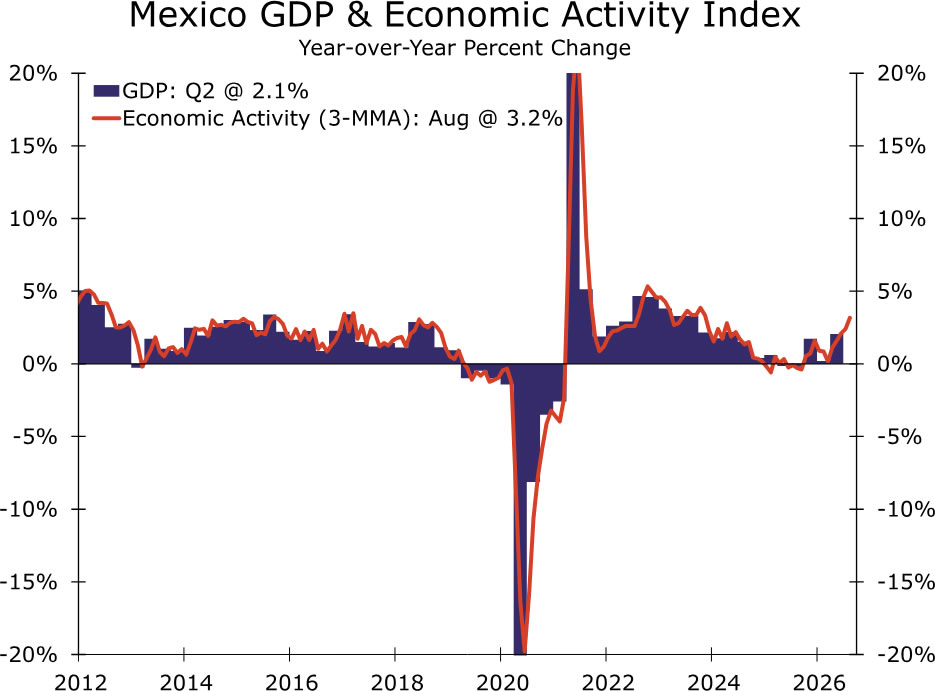
Mexico’s economy looks set for another solid quarter, with stronger year-over-year growth despite a modest slowdown from Q2’s quarterly pace. We expect next week’s GDP release to show growth of 1.1% quarter-over-quarter on a seasonally adjusted basis and 3.2% year-over-year on a non-seasonally adjusted basis. Mexico’s August Economic Activity Index rose 0.56% month-over-month and 3.33% year-over-year, supported by industry and services. The solid print points to continued strength in Q3 and should support full-year 2026 growth.
Stronger activity also gives Banxico less reason to ease, even as policymakers sound dovish. Headline inflation accelerated to 3.62% year-over-year in the first half of October, with upward pressure from both core and non-core components. El Niño adds to upside inflation risks and reinforces the case for patience.
We continue to expect Banxico to remain on hold at 6.50% through 2026 and 2027. A firmer growth backdrop and persistent inflation risks should keep policymakers cautious despite their dovish tone.