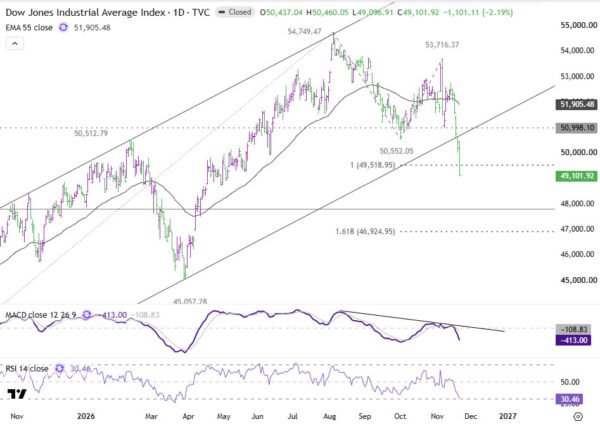
TL;DR: The AI selloff has spread across Wall Street, with Dow and Nasdaq both breaking important support and the rout hitting Asia, precious metals and crypto. Dow’s 47,820 and Nasdaq’s 22,780 retracement levels are the next tests of whether this stays a correction within the medium term uptrend or turns into something much deeper.
Why Is the AI Selloff Raising Fears of a Larger Correction?
Wall Street’s selloff intensified on Thursday as weakness spread beyond AI-related technology stocks into the broader market, raising concerns that the retreat from recent record highs could develop into a larger correction. Dow plunged 2.19%, S&P 500 lost 2.02%, and Nasdaq Composite declined 2.25%, reversing an earlier recovery attempt. More than 90% of S&P 500 constituents finished lower, while VIX surged to 28.43, reflecting a sharp deterioration in investor sentiment.
The damage extends beyond a single session. Through Thursday’s close, Dow had fallen 6.21% for the week, outpacing Nasdaq’s 5.00% decline. The selloff also spread into Asia on Friday, with Nikkei and KOSPI both tumbling nearly 5% in early trading. Meanwhile, heavy losses in precious metals, cryptocurrencies and other risk-sensitive assets suggested that investors were reducing exposure more broadly. With both Dow and Nasdaq breaking important technical support, attention is shifting from the immediate AI selloff to whether the larger equity uptrend is entering a more significant corrective phase.
Follow the equity selloff and the key Dow and Nasdaq levels on the ActionForex Telegram channel.
AI Concerns Trigger Wider Selling as Wall Street Rebound Fails
Thursday’s trading began with hopes that the recent decline in technology stocks might be stabilizing. Nasdaq-100 futures advanced more than 2% ahead of the US opening, while broader equity futures also posted solid gains. The recovery initially extended into the cash session, supported by anticipation surrounding Anthropic’s highly publicized Nasdaq debut.
The IPO itself demonstrated substantial investor appetite. Anthropic priced its shares at USD 83, above the expected range, and opened at USD 111.50 before closing at USD 97.17, a gain of 17.1% over its offering price. Nevertheless, the broader equity market reversed sharply as the trading session progressed, with selling accelerating around the debut.
- Offer price: USD 83 (above the expected range)
- Opening price: USD 111.50
- Close: USD 97.17 (+17.1% over the offering price)
The contrast was revealing. Strong demand for a prominent AI company proved insufficient to sustain a recovery in the wider technology sector, suggesting that investors remained reluctant to rebuild exposure despite an apparently favorable event.
The underlying concerns had already been accumulating. Questions about the profitability of massive AI infrastructure investment have been compounded by uncertainty surrounding semiconductor export restrictions and regulatory scrutiny of major chipmakers. Reported investigations involving Nvidia and allegations concerning AMD-related technology have added to worries about the risks facing the industry’s supply chain.
These developments do not establish that demand for AI technology is collapsing. Rather, they are challenging investor confidence in the valuations, future earnings and regulatory assumptions underpinning the sector’s earlier advance.
Nvidia’s performance illustrated the fragility of sentiment, with the stock surrendering an early gain of 4.7% to finish 3.3% lower. The reversal reinforced the impression that positive developments were increasingly being used as opportunities to reduce exposure rather than rebuild positions.
Importantly, the deterioration was not confined to Thursday. Dow had already fallen sharply on Wednesday even as Nasdaq managed a modest gain, indicating that broader market weakness was developing before Anthropic’s listing.
Selling Broadens Beyond Technology as Dow Leads Weekly Decline
The most significant development is the breadth of the selloff.
More than 90% of S&P 500 stocks declined on Thursday, indicating that selling pressure had extended well beyond a small group of heavily weighted technology companies. The sharp fall in Dow, alongside weakness across the wider S&P 500, suggests that investors were reassessing equity exposure more generally.
Dow’s relative underperformance is particularly noteworthy. Its 6.21% weekly decline through Thursday exceeded Nasdaq’s 5.00% loss, despite the latter’s greater exposure to the AI investment theme. That divergence strengthens the case that the correction has broadened beyond its initial concentration in technology shares.
Both indexes have also retreated substantially from their recent peaks. Dow closed approximately 10.3% below its 54,749.47 high, while Nasdaq Composite was around 13.9% below its record of 27,722.75.
- Dow: −2.19% on Thursday, −6.21% on the week, about 10.3% below its 54,749.47 high
- Nasdaq Composite: −2.25% on Thursday, −5.00% on the week, about 13.9% below its 27,722.75 record
- S&P 500: −2.02% on Thursday, with more than 90% of constituents lower; VIX at 28.43
The rise in VIX to 28.43 further illustrates the deterioration in risk appetite. European equities also weakened on Thursday, although their losses were less severe than those on Wall Street.
The increasingly widespread selling is more consistent with a broad equity correction than an isolated adjustment in AI valuations. Nevertheless, the price action alone does not establish that the economy is entering a downturn. The immediate evidence points instead to a reassessment of market risk and the willingness of investors to maintain elevated equity exposure.
Asian Markets Extend the Rout as Semiconductor Shares Come Under Pressure
The selling carried into Asian markets on Friday, with technology-heavy indexes bearing the brunt of the decline.
At 04:47 GMT, Nikkei was down 4.69%, while South Korea’s KOSPI had plunged 4.98%. Hang Seng also fell 1.71%, with losses extending across other regional markets.
The severity of the declines in Japan and South Korea reflects their substantial exposure to semiconductor manufacturing, advanced electronics and companies connected to the global AI supply chain. The sharp reversal on Wall Street added pressure to these sectors as investors reassessed their exposure to technology-related growth.
The deterioration is especially striking because both Nikkei and KOSPI had participated in Thursday’s earlier recovery. Their subsequent losses illustrate how quickly tentative optimism has given way to renewed selling.
However, weakness in some Asian markets had already emerged before the US reversal, suggesting that the latest decline intensified an existing deterioration in regional sentiment rather than creating it entirely.
The broader geographical spread nevertheless adds to the concern that the correction is becoming increasingly difficult to contain within the US technology sector.
Cross-Asset Selling Points to Broad Risk Reduction
The shift in sentiment has also been reflected in other financial markets.
Precious metals suffered particularly heavy losses following Thursday’s US opening, with silver falling approximately 8%, platinum nearly 6% and gold around 5% by Friday’s early Asian session. Cryptocurrencies and copper also declined, suggesting that selling pressure was affecting a wide range of assets rather than equities alone.
US Treasuries moved in the opposite direction. Yields fell across maturities, with the 10-year yield declining approximately 8bps from Thursday’s pre-opening levels to around 5.02%. Dollar Index, meanwhile, remained relatively stable near 103.79.
- Silver: about −8%; platinum: nearly −6%; gold: about −5%
- US 10-year yield: about −8bps to around 5.02%
- Dollar Index: relatively stable near 103.79
This combination points toward broader risk reduction, with investors selling assets across several markets while demand for government bonds increased. The decline in precious metals alongside equities is consistent with portfolio rebalancing or position-cutting, although the available evidence does not establish that forced liquidation or margin calls were responsible.
Lower Treasury yields also suggest that the episode has not developed into a generalized rush to raise cash by selling government bonds. At the same time, the absence of a sharp Dollar surge offers little evidence of an acute scramble for Dollar liquidity.
The cross-asset behavior reinforces the picture of investors reducing risk exposure, but it is premature to interpret the selloff as either a funding crisis or confirmation of an impending economic contraction.
The more immediate question is whether the selling pressure begins to stabilize or continues to spread across markets.
ActionForex’s Technical View: Dow, Downside Acceleration Puts 47,820 Support in Focus
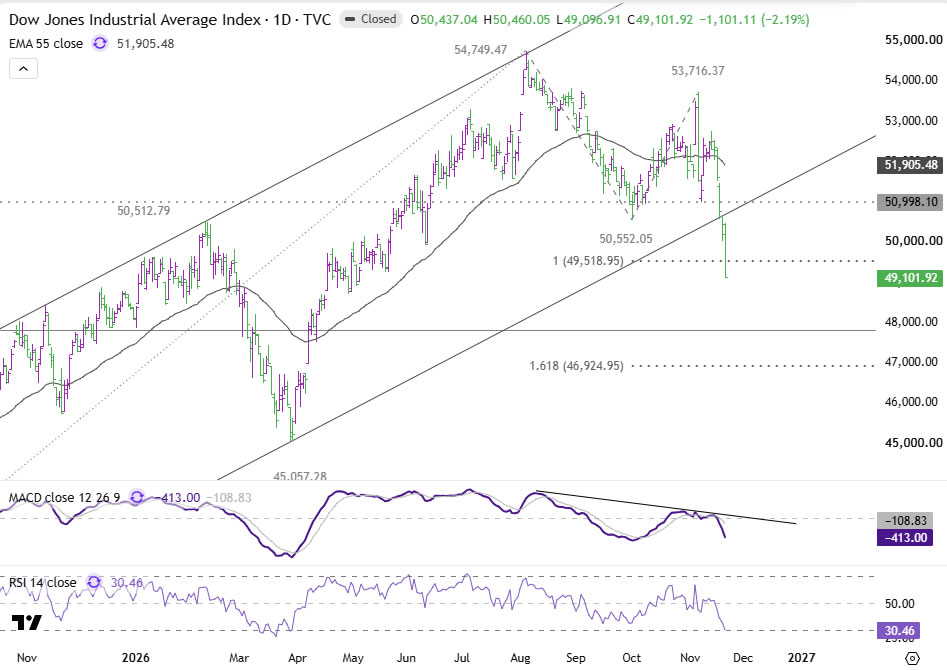
Dow’s technical picture has deteriorated materially following Thursday’s selloff.
The index broke below 50,512.79, the February 2026 high that had subsequently become support, while also breaching the floor of its medium-term rising channel. The breakdown indicates that the decline from 54,749.47 is extending beyond an ordinary short-term pullback.
More importantly, the break below the 100% projection of 54,749.47 to 50,552.05 from 53,716.37 at 49,518.95 signals downside acceleration. The index also fell below its 55-week EMA on Thursday’s close, adding to the medium-term bearish developments.
With these support levels giving way, near-term risk will remain heavily on the downside as long as 50,998.10 support-turned-resistance holds.
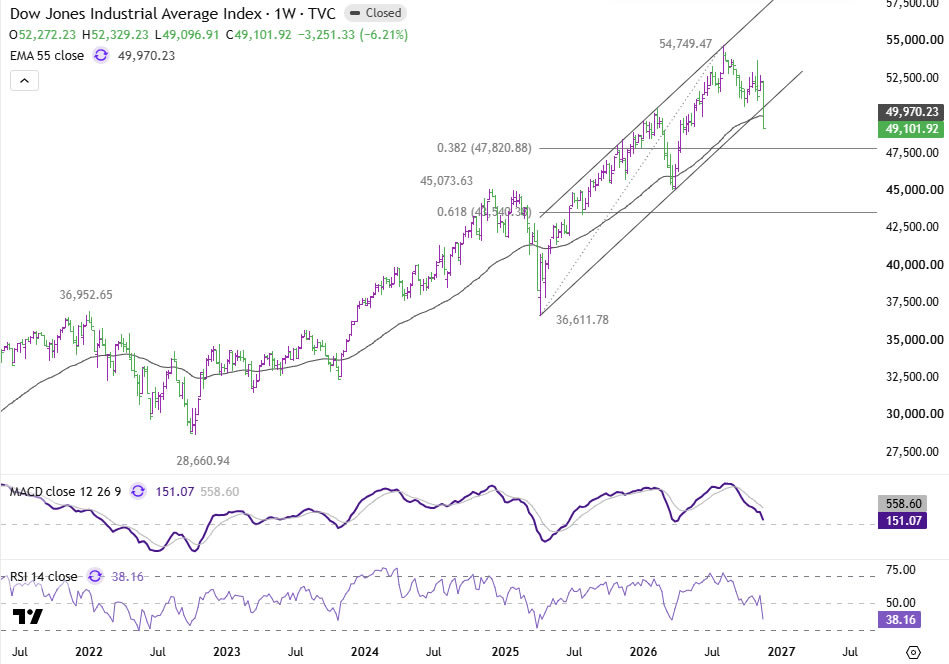
From a broader perspective, the decline from 54,749.47 is still viewed as correcting the advance from 36,611.78.
For this interpretation to remain intact, notable support should emerge around the 38.2% retracement of 36,611.78 to 54,749.47 at 47,820.87, bringing a rebound at least on the first attempt.
That level represents an important test of the medium-term uptrend. A convincing recovery from 47,820.87 would support the view that the current decline remains a correction of the advance from the 2025 low.
However, sustained selling through 47,820.87 would materially increase the risk of a larger-scale correction to the uptrend from the 2022 low at 28,660.94.
The distinction is important: Dow’s immediate technical outlook has turned decidedly bearish, but the larger bullish structure has not yet been conclusively invalidated.
ActionForex’s Technical View: Nasdaq, Break Below 24,020 Opens Risk Toward 22,780
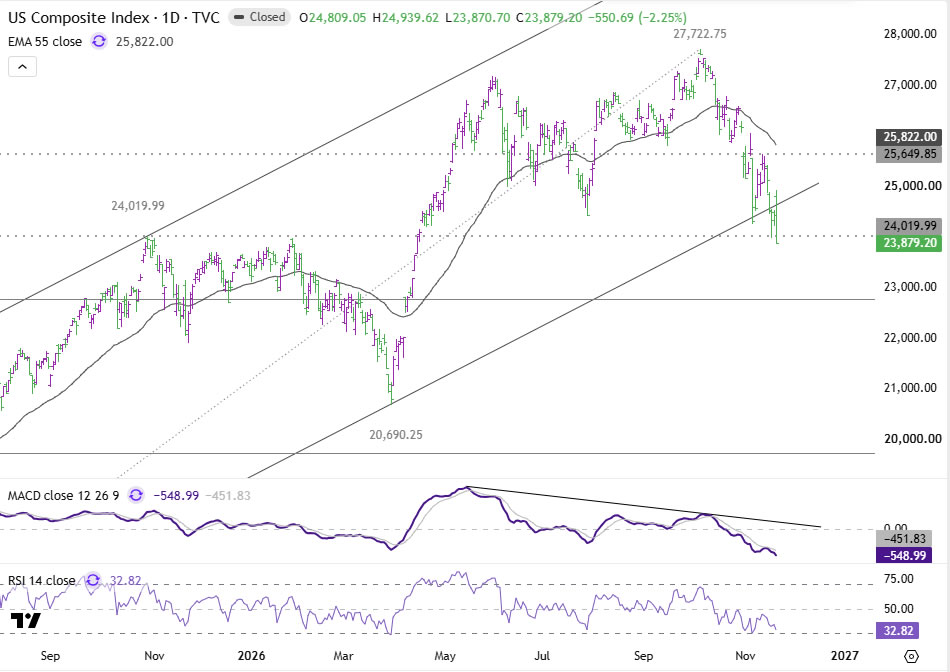
Nasdaq’s technical picture is somewhat less negative than Dow’s, largely because of its midweek rebound. Nevertheless, Thursday’s losses were marginally larger, and the index has also suffered significant medium-term technical damage.
The decline has broken below the medium-term rising channel floor and the October 2025 high at 24,019.99, which had served as an important support level. Nasdaq also fell below its 55-week EMA on Thursday’s close.
These developments reinforce the bearish outlook following the decline from 27,722.75.
Further downside is expected as long as 25,649.85 resistance holds. A recovery above that level would be needed to suggest that the immediate selling pressure is beginning to ease.
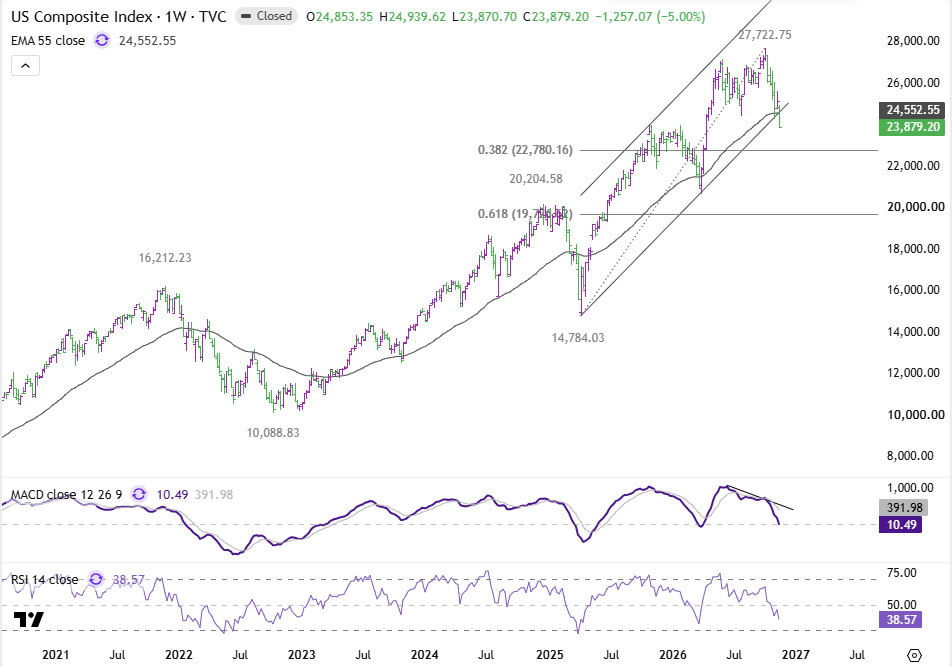
The current decline from 27,722.75 is still interpreted as correcting the uptrend from 14,784.03.
The next important support lies at the 38.2% retracement of 14,784.03 to 27,722.75 at 22,780.15. Notable buying interest should emerge around this level to produce a rebound, at least initially, and preserve the view that the decline remains a correction of the preceding advance.
However, sustained selling through 22,780.15 would increase the likelihood that the market is entering a larger-scale correction of the uptrend from the 2022 low at 10,088.83.
Both Dow and Nasdaq are therefore approaching an important technical test. Their immediate outlooks remain bearish after the breakdowns, while the next major retracement levels will help determine whether the declines remain contained within their respective medium-term advances.
The broader market picture adds weight to the downside risks. Selling has spread beyond AI shares, market breadth has deteriorated, and weakness has extended across regions and asset classes. Friday’s US session will provide the next test of whether investors are prepared to rebuild exposure or whether the correction continues to deepen.
Key Takeaways
- Dow fell 2.19%, S&P 500 2.02% and Nasdaq 2.25% on Thursday, with more than 90% of S&P 500 stocks lower and VIX at 28.43, after a failed morning rebound around Anthropic’s IPO.
- Dow’s 6.21% weekly decline outpaced Nasdaq’s 5.00%, which suggests the correction has broadened beyond AI-related technology shares.
- The selling spread to Asia (Nikkei −4.69%, KOSPI −4.98%), metals and crypto, while Treasury yields fell and the Dollar stayed stable, pointing to risk reduction rather than a funding crisis.
- Dow broke 50,512.79 and the 49,518.95 projection, with 47,820.87 the key 38.2% retracement and 50,998.10 the resistance for the bearish view.
- Nasdaq broke 24,019.99, with 22,780.15 the key 38.2% retracement and 25,649.85 the resistance, and sustained selling through either level would raise the risk of a larger correction.
Stay ahead of the Dow and Nasdaq support tests and the selling that could decide them—join the ActionForex Telegram channel for regular market updates and analysis.