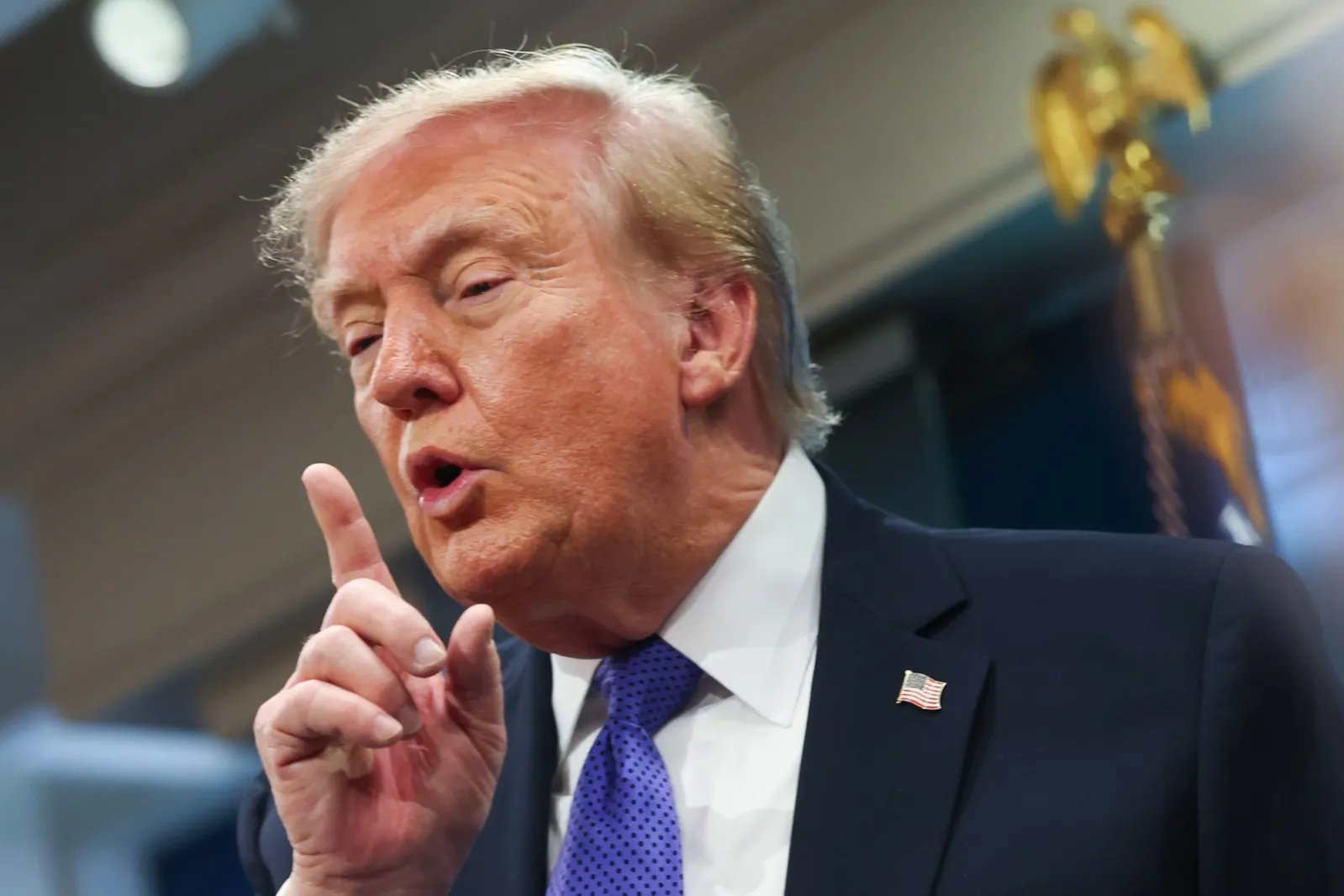
President Donald Trump’s net approval among Americans without college degrees fell 16 points from late October to late November across five Economist/YouGov polls.
The largest movement came between the November 4-6 and November 9-11 polls, immediately following the midterm elections, raising questions about whether the result exposed broader dissatisfaction with his presidency.
And the approval rating trend among this demographic is not limited to a single polling series.
Read More on Politics
A separate Prolific panel study followed the same Americans before and after the midterms. An additional analysis of the study’s data supplied to Newsweek found a post-election fall in Trump’s approval among respondents without college degrees.
Analysts told Newsweek the decline could pose a turnout problem for Republicans, rather than automatically delivering those voters to Democrats.
“Promises have a shelf life,” Joseph Lopez, a Republican strategist working with local GOP candidates in Texas, told Newsweek. “These voters gave Trump credit on prices and paychecks. When the receipts don’t show up, his approval goes down with them.”
Costas Panagopoulos, a distinguished professor of political science at Northeastern University, said the findings pointed to a potentially serious fracture in Trump’s coalition.
Voters without college degrees have become increasingly important to Republicans as America’s “diploma divide” has widened, he told Newsweek, making any sustained loss of their support “extremely damaging for Trump and the GOP brand.”
Panagopoulos said these voters were disproportionately affected by inflation and higher gas and grocery prices, with many now believing they had been “overlooked or completely ignored” by the administration.
Among Americans without college degrees, Trump’s net approval was virtually unchanged before the midterms in Prolific’s study, moving from minus 34 in late October to minus 35 immediately before Election Day. It then fell seven points to minus 42 after the vote. Prolific said the movement was statistically clear after accounting for the margin of error.
“The midterms clearly did something to how these Americans see Trump,” Oriol Bosch Jover, head of polling at Prolific, told Newsweek.
Bosch Jover said Republicans accounted for about 70 percent of the overall post-midterm decline among respondents without degrees.
He added: “These are not Trump’s most loyal voters, but they are people the Republican coalition needs: Republicans who turn out only some of the time, and independents who lean their way.”
Bosch Jover went on to say that the movement was concentrated among Republican-leaning adults who were already less reliable voters.
“The drop is happening among Republicans who don’t vote, or didn’t vote this time,” he said.
The White House defended Trump’s record, citing tax cuts, border security, lower prescription drug costs, private-sector job growth and trade agreements.
Spokesperson Davis Ingle told Newsweek the administration had delivered “the largest working-class tax cuts in history,” added more than 1 million private-sector jobs and secured nearly 20 trade deals.
“President Trump will never stop delivering results for the American people,” he said.

Why It Matters
Americans without four-year college degrees are central to Trump’s electoral coalition.
A Pew Research Center analysis of validated 2024 voters found that 67 percent of Trump voters did not have a degree, compared with 51 percent of Kamala Harris voters. Across the electorate, the figure was 59 percent.
An October Economist/YouGov survey also found that 34 percent of respondents without degrees said they had backed Trump in all three of his presidential campaigns, compared with 24 percent of college graduates.

A Decline Across Five Polls
The reported margins of error apply to each poll’s full sample; uncertainty is greater for the smaller group of respondents without college degrees.
In the October 23-26 Economist/YouGov survey, 43 percent of Americans without degrees approved of Trump’s job performance and 54 percent disapproved, producing a net rating (those who approve minus those who disapprove) of minus 11. The poll questioned 1,440 registered voters and had a margin of error of plus or minus 3 percentage points.
The November 4-6 survey recorded 41 percent approval and 56 percent disapproval within the group, leaving Trump at minus 15. It included 3,166 registered voters and had a 2.2-point margin of error.
The sharpest change appeared in the November 9-11 poll, conducted immediately after the midterms. Approval fell to 35 percent and disapproval rose to 59 percent, putting Trump at minus 24. Pollsters questioned 1,685 adult U.S. citizens, with an approximate margin of error of 3 points.
The November 13-16 survey found 36 percent approval and 60 percent disapproval, keeping the rating at minus 24. It included 1,628 adult citizens and had a 2.9-point margin of error.
By November 20-23, approval had slipped to 34 percent while disapproval reached 61 percent, producing the minus 27 result. That poll questioned 1,623 adult citizens and had a 2.9-point margin of error.

What The Midterms May Have Changed
The Economist/YouGov series compares different groups of respondents, so it cannot identify who changed their minds. Prolific offered a different view by following the same people through three waves.
Prolific surveyed 1,518 U.S. adult citizens online on October 21-22 and returned to the same panel before Election Day and from November 4-12, when 1,297 responded.
Its education comparison included 577 respondents without degrees and 469 graduates.
Researchers used propensity-score sampling and weighted the results for demographics, education, income, employment, past voting, registration and party identification, adjusting the final-wave weights to match the original October sample.
Margins of error were calculated as 95 percent intervals by repeatedly resampling respondents.
Prolific acknowledged that reported turnout in its sample was higher than the official rate and tested several adjustments before publishing its findings.
The change in Trump’s approval rating was not limited to the non-college education group, with college graduates recording a similar decline.
Within the non-college group, however, Bosch Jover said Trump’s net approval fell 12 points among Republicans and 10 points among independents who leaned Republican.
Non-college Trump voters remained broadly stable.
The largest movement came among Republicans who had not voted in 2024, many of whom had also skipped the 2022 midterms.
That distinction adds weight to the turnout warning raised by the other analysts.
“The biggest threat to Republicans isn’t necessarily that these voters become Democrats,” Mike Fahey, a Republican political strategist and founder of Fahey Communications, told Newsweek. “It’s that they become politically disengaged.”
Mary Elizabeth Elkordy, a Democratic political strategist and founder of Elkordy Global Strategies, said her party should not assume it would inherit that support.
“Voter loyalty isn’t unconditional, and dissatisfaction with one political party doesn’t necessarily translate into enthusiasm for the other,” she said.

Affordability And Turnout Remain Central
Economic pressure appears to be one dividing line.
Political scientist Daniel Schatz said Trump’s support among non-college voters was built on a promise to confront cultural elites while delivering prosperity and order.
“When voters feel that everyday costs remain high,” he told Newsweek. “That bargain begins to fray.”
Inflation was named as the most important national problem by 23 percent of Americans without degrees in the November 9-11 and November 20-23 Economist/YouGov surveys.
Bosch Jover said Prolific found Trump’s net approval fell six points among respondents without degrees earning below $50,000, while remaining unchanged among those earning at least $100,000.
The company’s broader midterm study found cost of living was voters’ leading issue.
It also concluded that turnout accounted for most of the movement away from Republicans in its panel: Trump voters who only somewhat approved of him were more likely to stay home, while some who disapproved and still voted crossed to a Democrat.
Those findings do not establish that the midterm result caused the entire 16-point decline in the Economist/YouGov series. They do show that the election was followed by weaker approval among less committed Republican-leaning voters, while the later YouGov polling suggests that deterioration continued.

What Happens Next
The test now is whether those voters return. If they do not, Republicans may face a turnout problem inside a coalition that has powered Trump through three presidential campaigns.
Newsweek’s reporters and editors used Martyn, our AI assistant, to produce this story. Learn more about Martyn here.
Contact Newsweek editors on this story: John Fitzpatrick and Emma Lee-Sang