Alex Gibney’s nearly four-hour, fire-and-brimstone documentary Musk — about tech oligarch and the world’s richest man Elon Musk — is not uplifting. Instead, it is one of the most depressing and terrifying pieces of public media since An Inconvenient Truth alerted a largely unaware public to its imminent annihilation by climate change.
Unlike An Inconvenient Truth, Gibney’s Musk does not appear to offer a hopeful final message about how we might get out of this mess. Instead, we get an outline of how, in Gibney’s view, Musk rose from upstart entrepreneur to political arriviste who orchestrated the dismantling of USAID, then attempted to create a baby farm and commune to survive a supposed civil war. That is all before, we are to believe, he supposedly upended all of Western democracy.
Sitting for an interview this September ahead of the film’s showing at the Toronto International Film Festival, Gibney was not too surprised by the dour perception: he had spent the previous few days fielding defamation lawsuit threats from a similarly unhappy Musk, after all. That is along with Musk’s descriptions of Gibney as “a shill for the far left,” “horrible human” and, simply, a “douche.”
Gibney also acknowledged the foreboding length: it was only after they finished their original two-hour feature that Musk allied himself with U.S. President Donald Trump. At that point, he said, HBO executives told Gibney they needed to expand the work, using it as a “building block for a much more epic drama … For this figure, who has so much influence on the future of the planet, it’s deserving of that three hours and 45 minutes.”
WATCH | Musk documentary trailer:
That relationship proved fraught on its own. The film hits North American theatres Oct. 16, but — at the time of the interview — Gibney was nervous. The international rights-holder, Universal, hadn’t confirmed whether it would even distribute the film outside North America, given the potential of political pressure.
At the same time, he said Paramount’s acquisition of HBO parent company Warner — with Paramount controlled by the Trump-friendly David Ellison — had him “concerned in the back of [his] mind” that the documentary’s streaming release could be scuppered entirely.
Since that interview, Gibney has said international theatrical release plans are now being discussed; the documentary is slated for an early 2027 streaming release, though no specific date has been given. When, or if, audiences do see it, he hopes the reception isn’t quite so bleak.
“It’s not a funeral; it’s a warning. But things are pretty dark. We’re going to be lowered into the earth if we’re not careful,” the director said, even while recognizing the sheer inescapability of dread his film tends to elicit. “You know, and the film ends with the planet Earth exploding and Musk escaping on his spaceship. So that’s about as pessimistic as it gets.”
A question of objectivity
Though he started the project as an avowed Musk fan — a Tesla solar panel system-owner and all — by the time he began working on it in earnest, he says, any benefit of the doubt he had extended to his subject had evaporated. When he reached out to interview Musk himself, he said he was stonewalled.

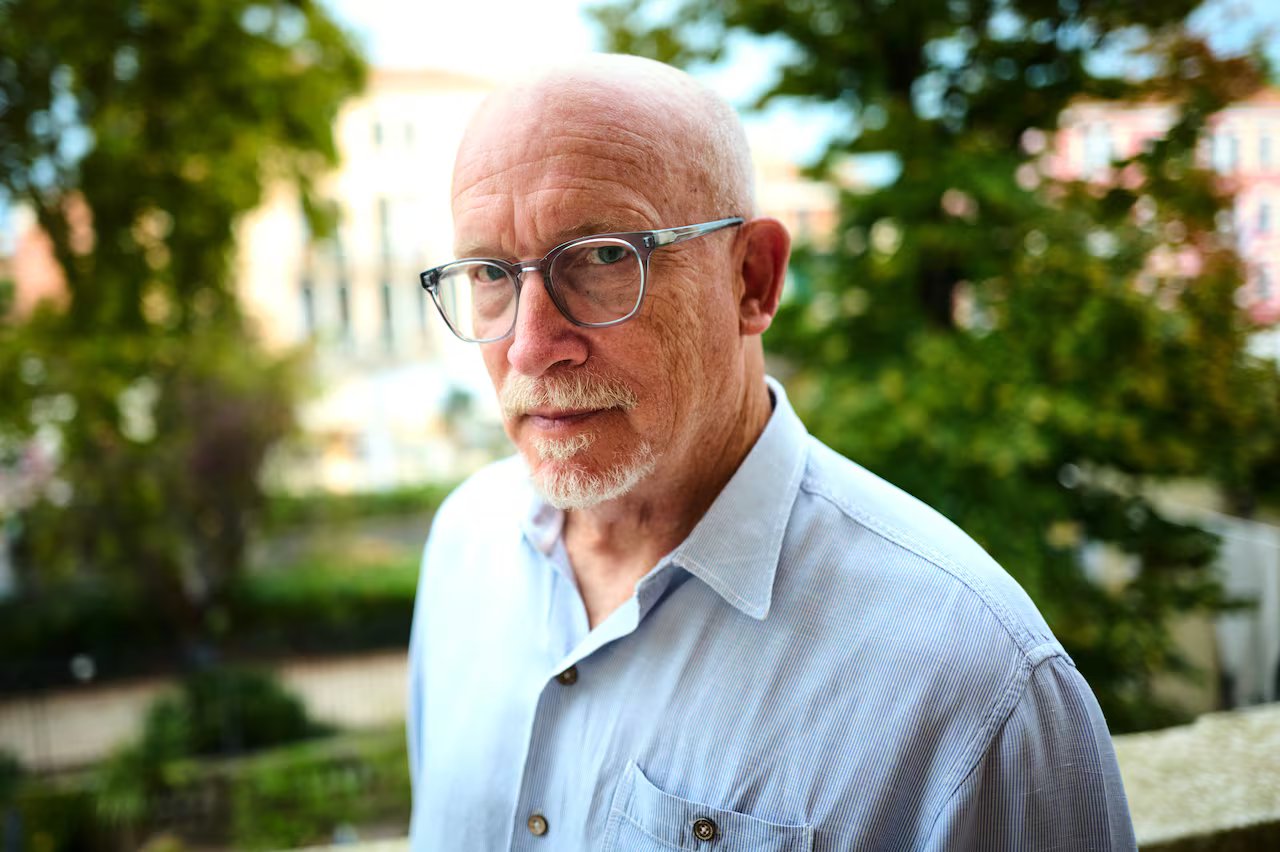
Director Alex Gibney poses for portrait photographs for the film Musk during the 83rd edition of the Venice Film Festival in Venice, Italy, in September 2026. (Scott A Garfitt/Invision/The Associated Press)
Outreach to those around Musk was similarly stymied: close business associates uniformly refused to speak without his permission. The workaround was to instead give Musk a voice of his own.
An AI-avatar, using Musk’s own statements, narrates much of the documentary. Much of what it says, like the real Musk’s statements about the “hit piece” Gibney came out with, is overtly critical of the documentary’s framing.
The result is a somewhat bifurcated, but overwhelmingly negative picture of a man Gibney asserts is at the centre of modern politics’ downfall.
There is the charting of Musk’s early history as a self-described “founder” at Paypal and Tesla — including interviews ranging from journalists covering him at the time to his former wife, Justine Musk — that characterize his public persona as an engineer and genius as little more than a PR-crafted lie.
“There is a kind of generalised notion in modern societies that if you’re rich, you must be very smart — you must be a genius,” Gibney says, sharing the central thesis of the documentary. “But maybe you’re just ruthless. And maybe you can be very rich and very powerful — and also, to some extent, unhinged.”
And then there is Musk’s time at the Department of Government Efficiency (DOGE) and, in Gibney’s telling, his role as an architect of the dismantling of the U.S. federal government.
The film includes accusations from former MAGA influencer Ashley St. Clair, the mother to one of Musk’s children, who speaks about cryptic text messages Musk sent her ahead of the 2024 U.S. presidential election that saw Trump re-elected — messages that include references to an “anomaly in the Matrix” created by “ten thousand lasers in space.”
Gibney then asks her whether she thinks that was a reference to SpaceX satellites. She responds: “I don’t know where else he has lasers.”
“I should point out that the remarks about the ‘anomaly in the Matrix’ and lasers from space didn’t come from a critic of Musk. It didn’t come from me; they came from Elon Musk himself,” Gibney said.
That is despite a letter sent to Gibney’s Jigsaw Productions, claiming the exchange reinforces a disproven conspiracy theory that Musk used his internet provider, Starlink, to interfere with voting machines in swing states.
“That seems a legitimate thing to put in a film,” Gibney said. “I don’t say in the film that’s what he did. I say that’s been said.”

Elon Musk is leaving his special government role as a top adviser to U.S. President Donald Trump. His departure, announced Wednesday, marks the end of a turbulent chapter that included thousands of layoffs and the removal of government agencies. Musk says he still plans to act as a consultant despite his decision to step down.
Similarly when pressed, Gibney defended the decision of including an AI-generated avatar in a documentary critical of an AI proponent: “We used some AI tools, but they’re being used by — they’re guided by human hands,” he said. He explained that the idea was for it to serve as a sort of “agent provocateur” that foments a negative reaction to AI proliferation by forcing audiences to witness it.
When asked whether he hopes or theorizes that the film could affect people’s votes ahead of the upcoming U.S. midterms, he has a simple response: “I do.”
Because to Gibney, Musk’s accumulation of power isn’t just a failure on Musk’s part. When “a reckless tech billionaire takes effective control of the federal government, and attempts to destroy it for personal aggrandisement,” he says, Americans themselves bear responsibility.
“We did. We let him take it, because we didn’t demand that our representatives hold him to account,” he said.
“You know, ‘Oh, I like my Tesla, so he must be a good guy.’ Well, you may like your Tesla, but what if he’s not a good guy, right?”